How does a hydrogen car work?
 Antonio Roncero @roncero_antonio
27 January 2020
5 min.
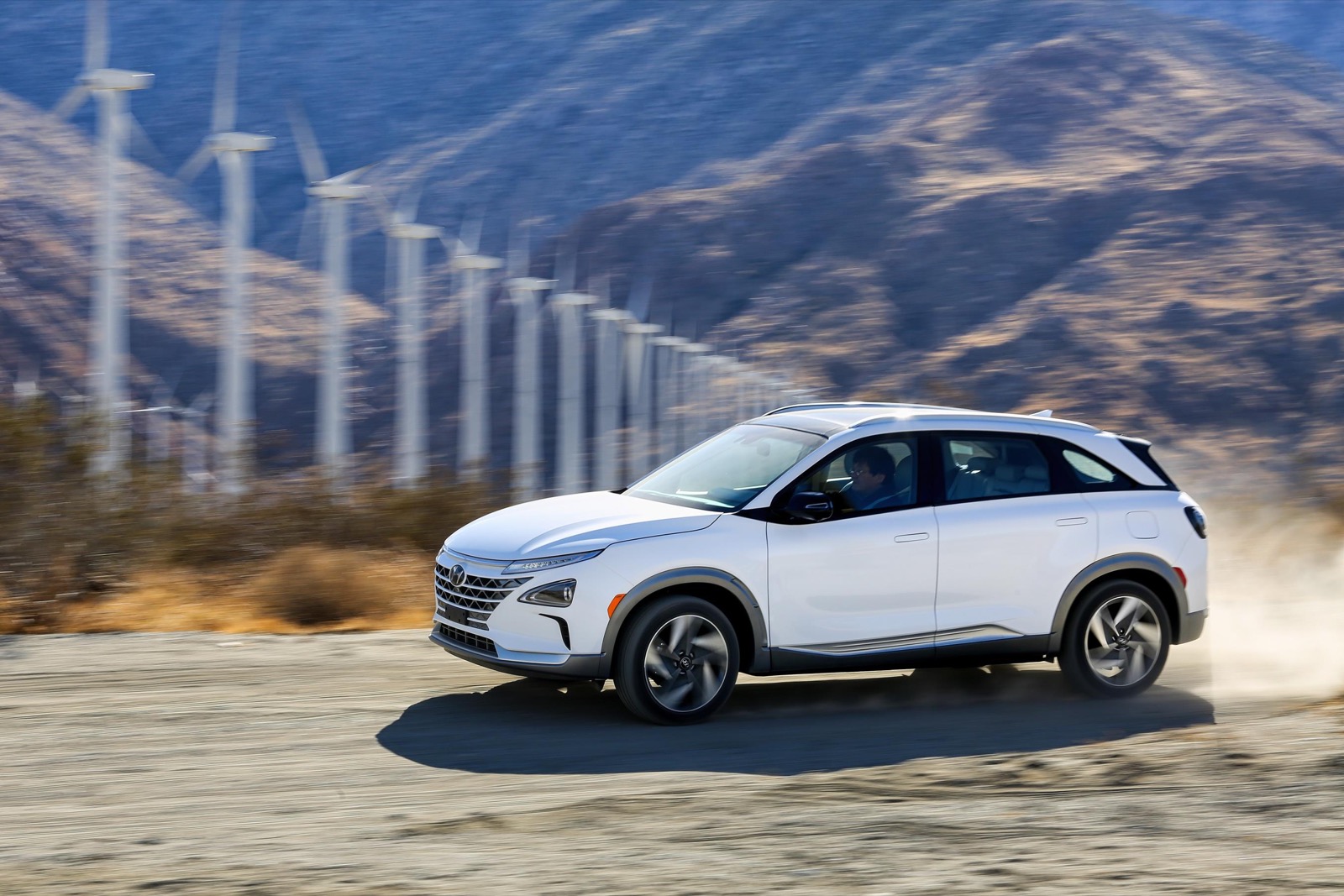
For the time being there are few alternatives, but the hydrogen car could be one of the solutions for the mobility of the future once oil reserves run out. Here are some key points to understand how the car of the future works.
Lately, hydrogen seems to have lost some of its prominence following the push that electric cars have been experiencing. But both the Hyundai Nexo and the Toyota Mirai have made it clear – and others did so before them – that the hydrogen car is viable.
The technology exists, and it works. Right now it would be possible to put on the market hydrogen-powered cars that would solve, at a stroke, the problems of limited range and the long recharging times an electric car requires. The problem? The main one, today, is the lack of infrastructure.
There are studies showing that it is possible to convert today’s petrol stations into future “hydrogen stations”, service stations where hydrogen can be refuelled. Now all that is missing is a commitment to it. It will all come…
But what is a hydrogen car and how does it work? Let’s look at some of the key points of this technology.
The fuel cell: generating electricity on board
Hydrogen cars carry on board a “fuel cell”, which combines the hydrogen stored in the tanks on board the vehicle with the oxygen found in the air. A chemical reaction takes place inside the cell, which is rather like electrolysis in reverse: the products of this process are electricity, which is used to drive the electric motor that propels the vehicle, and water vapour.
In fact, water vapour is the only thing a hydrogen car emits from its exhaust pipe. Here is a revealing demonstration: Mireia Belmonte taking on the challenge of breathing, inside a bubble, the gas emitted by the exhaust of a Hyundai Nexo.
The hydrogen car versus the electric car
The main advantages of a hydrogen car over an electric one are its range and its refuelling time. Although in this case we should perhaps say “refuelling” rather than “recharging”. Here you can see how a hydrogen car is refuelled. The operation is similar to refuelling a petrol or diesel car: at a special pump it takes roughly 3 to 5 minutes.
Depending on the capacity of the hydrogen tank, the range of a car of this type can easily exceed 500 km, to which must be added the kilometres the car can cover on the charge stored in its batteries after the vehicle has been plugged in. Indeed, a hydrogen car can also have this feature, like plug-in hybrids, and recharge its batteries by plugging into the electricity grid.
How much does a hydrogen car cost to run?
At present, the cost per kilometre is high because hydrogen is expensive. The key in the future will be the ability to bring down the cost of producing and supplying hydrogen. By way of example, with today’s technology a hydrogen car can consume, in real-world use, around 1 kg of hydrogen per 100 km travelled. And hydrogen costs around 10–11 euros per kilogram. The medium- or long-term goal is to reduce this price to less than half.
Is a hydrogen car safe?
Given that hydrogen as a fuel is an unstable and explosive gas, the doubt is reasonable. To store it in tanks and make it usable it can be kept at high pressures, of around 700 bar, or at very low temperatures, of 273 degrees below zero. For this reason special tanks are needed. But there is already a safe technology for storing and transporting hydrogen in a car with a fuel cell, and doing so safely.
The Hyundai Nexo, for instance, is the first hydrogen car to have undergone the Euro NCAP crash tests, passing with the maximum rating.
When will I be able to buy a hydrogen car?
Among the most active brands that have developed this technology are Mercedes and General Motors. Audi has also presented prototypes capable of moving into series production with minimal adaptations when required. And Honda led the way for years with its Honda FCX, which was sold in a small series between 2009 and 2011. At that time, Mercedes and Opel had plans to put their hydrogen cars on the market by 2015, but they ultimately postponed those plans.
Today, hydrogen cars such as the Hyundai Nexo or the Toyota Mirai can already be bought. Both manufacturers have already registered some units in our market, although their presence is merely token. Renault has also bet on hydrogen in its range of commercial vehicles. Hydrogen technology, including a varied offer of vehicles running on this fuel and an adequate supply network, could begin to be important by 2030.
Where is hydrogen extracted from?
This is another advantage of the hydrogen car: the fuel used, hydrogen, is found freely in nature and can be extracted from water, so it is an abundant resource. It is obtained through electrolysis, which is indeed an expensive process… and requires electrical energy. But if the electricity to produce it, and the hydrogen itself, is generated sustainably using solar energy, photovoltaic plants or wind power, the equation starts to make sense.


 Peugeot E-208 GTi: a battery-powered toy that revives the spirit of the 1980s sports cars
 New Lexus ES: luxury grows and goes electric
 First contact with the Dacia Sandero Hybrid 155: power and efficiency from €19,890
Comentarios cerrados