Mitsubishi Space Star Análisis Tests Urban
Mitsubishi Space Star 120 MPI Motion, road test (exterior design, interior and boot)
 Daniel Valdivielso @valdi92
24 March 2015
5 min.
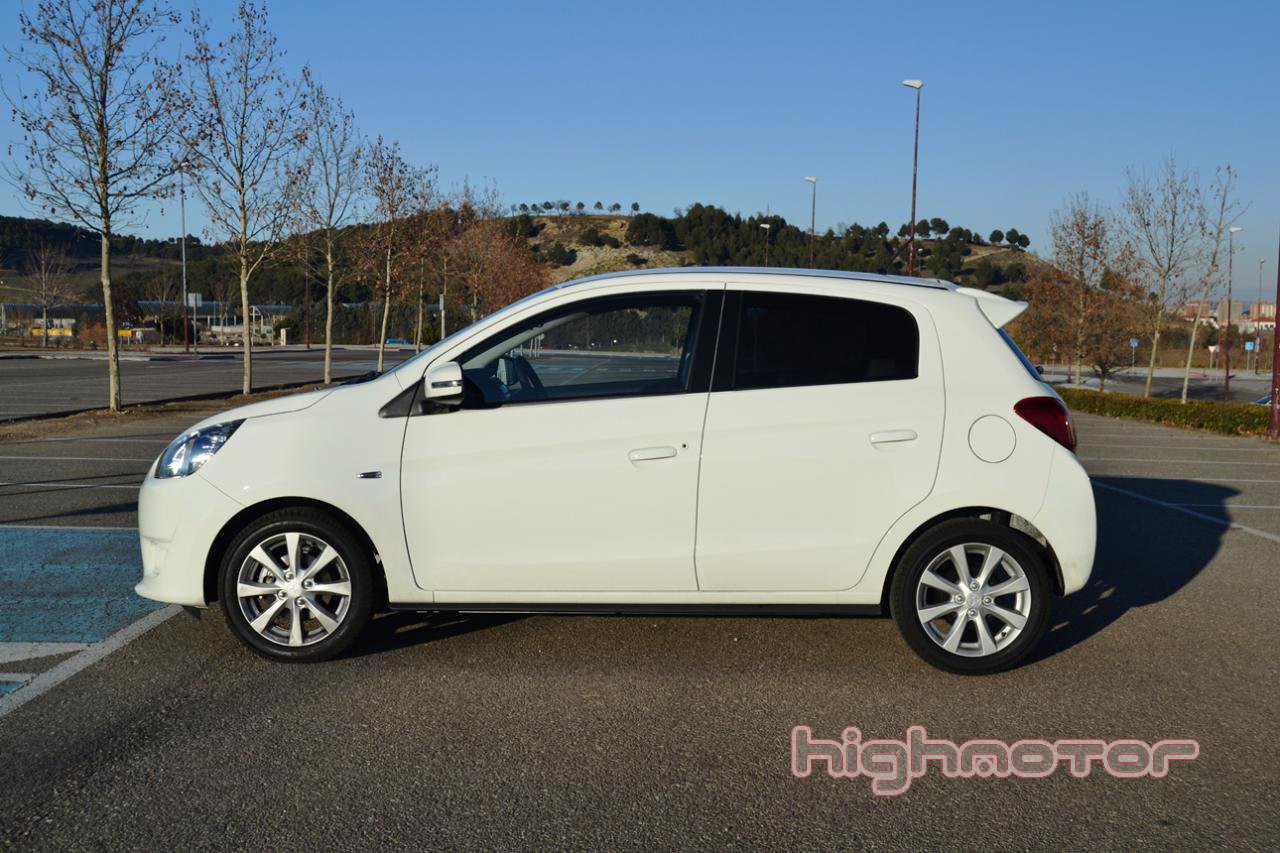
After examining in detail the dynamic behaviour of the small Mitsubishi, it’s time to look at its practical abilities.
We also analyse the interior and exterior design of the Japanese city car, which has been completely redesigned for this new generation.
Exterior design
The exterior design of the Mitsubishi shows no great displays of flair, nor any extremely eye-catching lines. The brand’s engineers didn’t intend it to either. The Space Star is a global car, which has begun to be sold in many markets, always with a humble approach and no grand pretensions.
The small Space Star is a vehicle measuring 3.71 metres in length, which makes it one of the most compact cars on the Spanish market. It is also relatively narrow (1.66 metres), though sufficiently tall (1.49 metres). These dimensions, together with a wheelbase of 2.45 metres, result in a “mini-MPV” look, similar to other models on the market such as the Hyundai i10, the Nissan Micra or the Suzuki Celerio.
The front of the Mitsubishi is very simple, with the headlights being the most striking element of the ensemble, due to their large size. They are, incidentally, halogen units, and offer sufficient illumination, though not particularly generous. There is no grille as such, just a small air intake in the upper part of the dashboard, combined with a larger one in the lower part of the nose. The fog lights, standard across the range, sit at the extremes, forming a simple but pleasant image without any flashiness.
The side view leaves no room for doubt: this is a very simple car, as there isn’t even any kind of moulding, whether between the front and rear door windows or as a strip along the lower part of the doors. The only aesthetic flourish is found in the wing mirrors with built-in LED indicators, along with a small air-outlet-style moulding that they have seen fit to place on the front wing. A clearly rising waistline gives the final impression of an even “raised” rear axle, which is not the case.
Finally, the rear, also easy in design, leaves no room for flourishes from the designers. A single-piece bumper without mouldings wraps around the entire rear section, also integrating a recess for the number plate. The boot lid, of small size, has a height that could be considered somewhat high, as it forces us to lift bulky items rather high to load them into the cargo area, which then slopes downwards. The light clusters are of modest size, and their rounded shape helps to create a carefree image.
Interior design
Inside, the scene is a continuation of what its bodywork already hints at. With a simple, orderly look, the Mitsubishi offers a welcoming cabin in which four people will feel reasonably comfortable (five will find the width somewhat tight).
The dashboard stands out for its carefree design, with curved lines and no great display. Everything is within easy reach once we settle into the driver’s seat, where it is simple to find the right position thanks to the wide adjustment range of both the steering wheel (height and reach) and the seat, the latter able to adjust the backrest recline and the height of the cushion, though it does not offer height adjustment for the seat as a whole.
Everything the driver touches gives a good sense of quality, thanks to the leather-upholstered seat and gear lever. Furthermore, the feedback from switches and buttons such as the indicator stalks or the climate controls is very good, which is a solid plus point for the small Japanese car. One cannot expect great frills in this segment, and naturally we find neither soft plastics nor metallic trim in the interior. Nevertheless, one can live with it, although it is true that the Space Star’s interior is not the most modern in its class, where alternatives such as the Peugeot 108, the Renault Twingo or the KIA Picanto surpass it in image and appeal.
The instrumentation is extremely simple. We have just two dials, a tachometer calibrated up to 200 km/h and a small rev counter whose red zone starts at 6,500 rpm. To the right of the tachometer is an “ECO indicator” made up of three green LEDs and one orange one, which shows in real time how economical or wasteful we are being, although in reality it responds solely to how far we press the accelerator.
Visibility is good, especially forward and to the sides. The mirrors are of sufficient size and, when properly adjusted, leave practically no blind spot, although the rear window is rather small, something inherent to the concept of this small Japanese car.
Boot
The boot has a base capacity of 235 litres, which places it around the segment average, behind models such as the Nissan Micra or the Hyundai i10, but ahead of rivals such as the KIA Picanto or the Renault Twingo.
The rear seatbacks can be folded in a 60:40 split, giving a total capacity of up to 912 litres. It should be noted, however, that the resulting surface is not flat, as a small step forms between the boot floor and the rear part of the seats.
Being a vehicle with fairly “square” proportions, the Mitsubishi has a very usable load space, something that always scores points when assessing a car with an eminently practical purpose.
Photographs | Daniel Valdivielso


 Peugeot E-208 GTi: a battery-powered toy that revives the spirit of the 1980s sports cars
 New Lexus ES: luxury grows and goes electric
 First contact with the Dacia Sandero Hybrid 155: power and efficiency from €19,890
Deja un comentario