Levante Maserati Sports Cars Tests SUV
Test drive: Maserati Levante Trofeo and Maserati Levante GTS, elegance and brawn in one
 Miguel Lorente
27 September 2019
8 min.
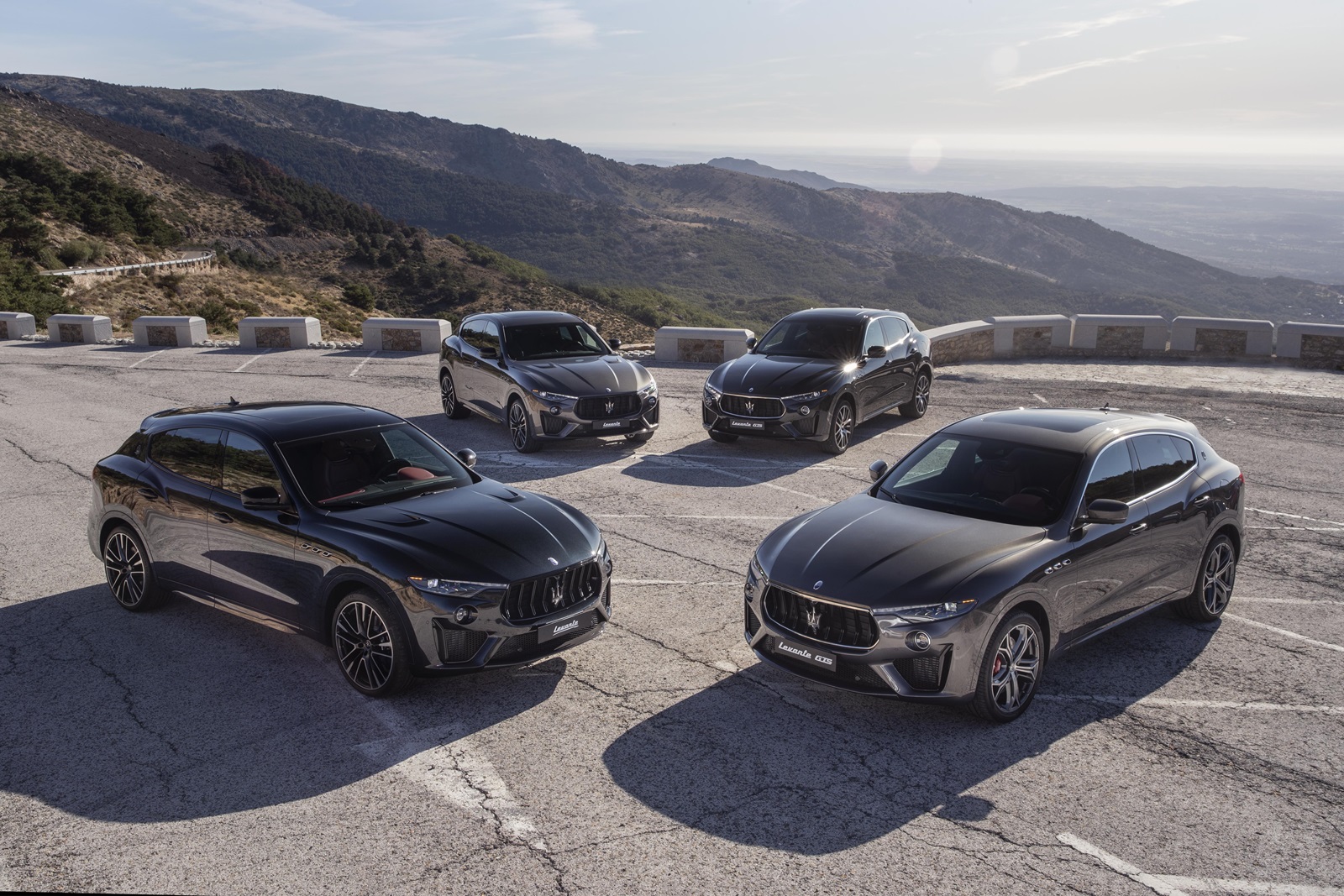
We attended the presentation of the V8-engined versions of the SUV from Maserati to drive and test the Maserati Levante GTS and Levante Trofeo
The arrival of the V8 engine in the range of the best-selling car currently sold by Maserati, the brand’s SUV, the Maserati Levante GTS and the Maserati Levante Trofeo, means nothing other than that this vehicle enjoys iron health. Or rather golden health, since this car accounts for 52 percent of the sales of cars from the trident marque.
A car that has been born out of the desire of Maserati customers and that, with it, seeks to meet the demands of those for whom V6 engines, both diesel and petrol, were not enough.
To achieve this evolutionary leap towards one of the pillars of the centenarian brand, sporting DNA and competition DNA, the FCA group has turned to the award-winning mechanics of Ferrari origin, whose powerplant is the V8 block, of 3.8 litres, twin-turbo, which for the Levante GTS delivers 530 CV and 580 horsepower for the Trofeo, which makes it the most powerful production Maserati ever built, even more than the legendary racing car homologated for use on any ordinary road Maserati MC12.
Two vehicles that share a heart and practically the cabin, but which are clearly differentiated in their behaviour, and not only by the inclusion of the magical “Corsa” mode in the case of the Trofeo; these differences are palpable depending on how one takes the controls of each of these vehicles, as we were able to do in the road test of the Maserati Levante GTS and the Maserati Trofeo that we carried out.
The common link is the cabin, essentially practically identical between both standard versions, although, thanks to the model’s personalisation programme, it is generally possible to make up to 400,000 different combinations.
Apart from subtle differences such as the trident logo on the headrests which, in the case of the more radical one, bears the word Trofeo in its emblem, the general configuration is identical.
The use of the highest-quality materials such as the natural pienofiore leather that covers most of the square centimetres of the cabin, the carbon-fibre inserts on the doors, dashboard or central tunnel, or Alcantara in the roof or pillar trim masterfully combines an atmosphere of luxury and sportiness.
So much so that, once seated inside the car, it invites a mental metamorphosis of how one conceives it, since, even though we are aware of the type of car we are getting into, the sporting context, to say the least, invites one to switch the chip from being about to drive a luxury crossover to driving a sports car.
At the wheel of the Maserati Levante GTS
https://youtu.be/SkNP1FvLhX0
It is, truly, when the test of the Maserati Levante GTS begins that one appreciates the mastery of balance in the behaviour of the 530 CV SUV.
Thus, the Maserati Levante GTS was the first of the two models we enjoyed. A car that, with the extremely high doses of quality and luxury it offers, turns out to be very comfortable, sporty and exciting.
Inside, travelling in a Levante GTS is nothing but a pleasure for all the senses: touch, smell, sight, hearing… even taste, because one appreciates the exquisiteness put into its manufacture.
Whether in the driver’s seat, the front passenger seat, or any of the three rear seats, which are perfectly acceptable for three average-sized adults, one can only enjoy it with a grin from ear to ear, especially when the Sport mode of the Maserati Levante GTS being tested is engaged.
It is true that in the most conservative mode the car’s response becomes slightly more sluggish due to the architecture and nature of an SUV, but it is when the GTS’s sport mode is activated that it becomes a vehicle that justifies the letters of its nomenclature.
On twisty stretches, only the body style of this kind penalises it in terms of agility, but the dynamism and behaviour of this car is sublime, delicious, and it makes up for the fact that we were on board an SUV by conveying emotion to whoever drives and enjoys it.
The engine of the Maserati Levante GTS delivers 530 CV, and responds sensationally with a 0 to 100 km/h time of 4.3 seconds and a top speed of 291 km/h, according to the manufacturer’s figures. And since the test on ordinary roads, and for much of the route, involved secondary roads, which limited the ability to put the Maserati Levante GTS, and even more so the Trofeo, to the test as we would have liked: on a circuit.
As is well known, the same engine installed in two different cars can mean a completely different personality in how a car responds. Well, in this case, with the same base, the setup of a car designed to be enjoyed on a closed circuit makes these two twins something like night and day.
The Maserati Levante Trofeo is not a GTS with more power
https://youtu.be/0UwcXO1CkXs
Although there are distinctive and exclusive visual elements for these two SUVs (logos and emblems, front grille, front and rear bumpers with their own exhausts and diffusers, wheels, bonnet…), they are really two quite different cars in their behaviour.
And the difference between the Maserati Levante GTS and the Maserati Levante Trofeo is not just their final power output; the second is tremendously more incisive, more extreme, more radical, more brutal. Everything more.
Despite wearing a similar suit and shirt, in appearance, made by the same tailor, differentiated by subtle differences and wearing different shoes, they are totally different cars.
So much so that, as you start the car with the Start/Stop button to the left of the steering column, which begins the test of the Maserati Levante Trofeo, a roar envelops the surroundings.
The car deserves to be enjoyed in Corsa mode to the fullest extent possible, even on open road, provided one respects traffic rules and the driver’s common sense takes command of the steering wheel, an SUV capable of reaching 300 km/h and of sprinting from 0 to 100 in 4.1 seconds thanks to the thrust, kick or lunge of a powerful engine that also sends its output to all four wheels, but which, if one is not careful with the feel of the accelerator, is far more sensitive than the GTS and can cause whiplash with astonishing ease.
As I was saying, its behaviour is sharper, more extreme, more radical, more brutal, compared or not with the GTS or with any other machine of its calibre.
Even compared with other SUVs of similar configuration and performance, more civilised at heart, such as the Mercedes-AMG GLC 63 S 4Matic+ or the Porsche Cayenne Turbo S, both also equipped with a V8 engine but whose response is not as extreme as the attack of this trident.
The way it devours straights at speeds that go from minimum to maximum faster than the brain is able to process, the upward gear changes or downshifts, using the paddles behind the steering wheel or moving the gear lever, with the gift of an exhaust sound rarely heard and enjoyed, together with maximum precision from a firm steering that bites into corners, and never truer than here, a firm and taut suspension that allows the body to be lowered by as much as 35 mm between the lower sills and the ground, which favours an aerodynamic measured at a Cd of 0.33; all together make this SUV the most exciting SUV this writer has ever driven.
It is a surprising car that becomes breathtaking when one tries to find out how powerful and furious it is if one seeks the limit. A maximum that only the sanity of the driver seems to set, since, with such sublime power, the combination of emotions at the wheel and emotions inside as a passenger leaves one only unwilling to get out of this car.
Conclusion: test the Maserati Levante GTS and the Maserati Levante Trofeo
The Maserati Levante GTS (from 161,300 euros) may be the perfect alternative, though in SUV bodywork, to the elegant and sporty Maserati Quattroporte. A car that, whenever you ask it, demonstrates a tradition that combines elegance, beauty and sportiness like no other, a “rolling sculpture”.
For its part, the Maserati Levante Trofeo (from 196,900 €) is only suited to people who want to transfer the emotions at the limit experienced on a track day at a circuit that may lead one to sit in the driver’s seat of a machine as beautiful as it is sporty, such as the Maserati GranTurismo MC Challenge Stradale, a track car that adopted the specifications necessary to be a car legalised for use on open roads, but in an SUV.


 Peugeot E-208 GTi: a battery-powered toy that revives the spirit of the 1980s sports cars
 New Lexus ES: luxury grows and goes electric
 First contact with the Dacia Sandero Hybrid 155: power and efficiency from €19,890
Comentarios cerrados