Electric Cars Compact Buying Guides
Best Premium Compact SUVs Under €60,000 in 2026
 Javi Vicente @javivicente
10 May 2026
7 min.
2026 buying guide to the best premium electric compact SUVs for under €60,000: WLTP range, power and equipment, with the Volvo EC40 as the benchmark.
The premium electric compact SUV segment is having its most interesting moment in 2026. The €60,000 psychological barrier has become the real frontier between the well-equipped mainstream car and the premium model with pedigree, and it is precisely there that the fiercest battle is being fought: established European manufacturers, Asian alternatives with solid technical arguments, and emerging brands that are redefining what “premium” means in an electric car. This guide analyses which models are worth considering below that threshold, what real-world range you can expect, and how they stack up against the segment’s benchmark.
Note: all prices mentioned in this article are the manufacturer’s recommended retail price (RRP), without taking into account dealer discounts, promotional campaigns, promotional financing or purchase incentives such as the Plan MOVES.
Why €60,000 is the premium electric frontier in 2026
There is a structural reason why this figure matters. Below it, you find competent electric cars but with clear compromises in materials, refinement or range. Above it, you enter the territory of large electric saloons and upper mid-range SUVs. In the €45,000–60,000 band, premium manufacturers concentrate their most balanced versions: usable battery capacities of 75–85 kWh, WLTP ranges approaching or exceeding 500 km and outputs between 230 and 410 CV. It is the technical sweet spot of the segment.
The segment benchmark: Volvo EC40 Recharge
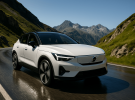
The Volvo EC40 Recharge has established itself as the mandatory reference. Not for being the fastest or the cheapest, but because it offers the most coherent combination of range, perceived quality and brand positioning within budget. Volvo has done its homework with three clearly differentiated variants that cover virtually the entire range.
EC40 variants and configurations
The range starts with the Single Motor 238 CV and a 69 kWh battery, rear-wheel drive and 487 km WLTP, from approximately €50,200. Stepping up, the Extended Range 252 CV with 82 kWh stretches range to 582 km WLTP, one of the best figures in the segment. At the top is the Twin Motor 408 CV with permanent all-wheel drive eAWD and 552 km WLTP, available in Plus trim below the €60,000 ceiling.
| Specification | EC40 Single 238 | EC40 Extended Range 252 | EC40 Twin 408 AWD |
|---|---|---|---|
| Power (kW) | 175 kW | 185 kW | 300 kW |
| Power (CV) | 238 CV | 252 CV | 408 CV |
| Top speed | 180 km/h | 180 km/h | 180 km/h |
| WLTP range | 487 km | 582 km | 552 km |
| Average consumption | ~16.5 kWh/100 km | ~15.8 kWh/100 km | ~17.2 kWh/100 km |
| DGT label | Zero | Zero | Zero |
| Fuel | Electric | Electric | Electric |
Equipment and brand positioning
The EC40 comes as standard with upholstery free of animal leather, an integrated Google infotainment system and one of the best active safety integrations on the market. The difference between Core, Plus and Ultra trims is real: the step up to Plus adds wireless charging, Harman Kardon audio and power seats, while Ultra adds adaptive suspension and Bowers & Wilkins sound, although the latter already goes beyond budget in the Twin version.
Zeekr: the emerging premium alternative from the Geely group
The arrival of Zeekr has changed the rules. As the premium brand of the Geely group, the same conglomerate that controls Volvo, Polestar and Lotus, Zeekr lands in Europe with a hard-to-ignore argument: an 800-volt SEA architecture, batteries from CATL or its own in-house supplier, and an interior finish level that rivals the German brands at prices between 10 and 15% lower. The Zeekr X is positioned as a pure compact SUV, while the Zeekr 7X expands the offer towards more spacious bodies, with outputs in its AWD versions exceeding 400 CV and WLTP ranges of around 480–560 km depending on configuration.
The inevitable question, Volvo EC40 vs Zeekr, has no single answer: the EC40 offers brand maturity, a consolidated after-sales network and a proven residual value; Zeekr brings faster charging technology (real peaks close to 200 kW) and more generous standard equipment per euro invested.
The German rivals: BMW iX1, Mercedes EQA and Audi Q4 e-tron
No honest analysis of the segment can ignore the German trio. The BMW iX1 xDrive30 offers all-wheel drive, around 313 CV combined and a WLTP range of about 440 km, with dynamic behaviour that remains a reference. Its base RRP is around €56,000–58,000, leaving little room for extras within budget.
The Mercedes EQA 250+ focuses on efficiency: front-wheel drive, a 70.5 kWh battery and a declared range close to 560 km WLTP, with a more modest starting price but more modest performance (190 CV). The Audi Q4 e-tron 45, built on the Volkswagen Group’s MEB platform, combines 286 CV in its rear-wheel-drive variant with ranges approaching 550 km WLTP from its 82 kWh usable battery.
| Model | Power | WLTP range | Drive | Indicative price | Score /10 |
|---|---|---|---|---|---|
| Volvo EC40 Extended Range | 252 CV | 582 km | Rear | ~€52,700 | 9.1 |
| Volvo EC40 Twin AWD Plus | 408 CV | 552 km | AWD | ~€58,600 | 9.0 |
| Audi Q4 e-tron 45 | 286 CV | ~550 km | Rear | ~€55,000 | 8.5 |
| BMW iX1 xDrive30 | 313 CV | ~440 km | AWD | ~€57,000 | 8.3 |
| Mercedes EQA 250+ | 190 CV | ~560 km | Front | ~€52,000 | 7.8 |
| Zeekr X AWD | ~428 CV | ~440 km | AWD | ~€50,000 | 8.4 |
| Genesis GV60 Premium | 229 CV | ~470 km | Rear | ~€57,000 | 8.2 |
The Korean card: Genesis GV60
Genesis remains the sophisticated outsider. The GV60 shares the E-GMP platform with the Hyundai Ioniq 5 and Kia EV6, but raises the bar on materials, sound insulation and details such as facial recognition. The rear-wheel-drive Premium version offers 229 CV and around 470 km WLTP, within budget. Its great advantage is the 800-volt architecture, which allows charging from 10 to 80% in under 18 minutes at ultra-fast chargers.
How to choose: real buyer priorities in 2026
If your priority is maximum WLTP range, the Volvo EC40 Extended Range with its 582 km sets the segment’s ceiling under €60,000. If you seek performance and all-wheel drive, the EC40 Twin 408 AWD Plus or the Zeekr X AWD offer hypercar-level figures at civilised prices. For those who value charging speed, the 800 V platforms of Genesis and Zeekr have the edge over the 400 V systems of the Mercedes EQA and BMW iX1.
The best premium electric compact SUV for value for money remains, as of 2026, the Volvo EC40 Extended Range Core: it offers the best range in the segment, Volvo finish and leaves budget room for some extras. If you want to step outside the established script, Zeekr is the technologically most ambitious bet.
Frequently asked questions
Which premium electric SUV has the longest range under €60,000 in 2026?
The Volvo EC40 Recharge Extended Range with its 82 kWh battery is rated at 582 km WLTP, the highest figure in the segment within budget, starting from approximately €52,700 in Core trim.
Is Zeekr worth considering over established premium brands?
Zeekr offers superior fast-charging technology, generous standard equipment and competitive prices, all backed by the Geely group (also the parent company of Volvo). Its weak point remains the after-sales network, still expanding in Spain.
What is the difference between the Volvo EC40 Single and Twin Motor?
The Single Motor fits a single rear motor (238 or 252 CV depending on battery), while the Twin Motor adds a second front motor for a total of 408 CV with permanent eAWD all-wheel drive, sacrificing about 30 km of WLTP range compared with the Extended Range.
What environmental label do these premium electric SUVs have?
All the models analysed are 100% electric and obtain the DGT Zero Emissions label, with free access to low-emission zones, tax advantages in some municipalities and exemption from the circulation tax for several years depending on the autonomous community.

 Peugeot E-208 GTi: a battery-powered toy that revives the spirit of the 1980s sports cars
 New Lexus ES: luxury grows and goes electric
 First contact with the Dacia Sandero Hybrid 155: power and efficiency from €19,890
Deja un comentario