E-Turbos, how they help reduce lag and emissions
 Mónica Redondo @MonicaRedondoD
25 August 2020
3 min.
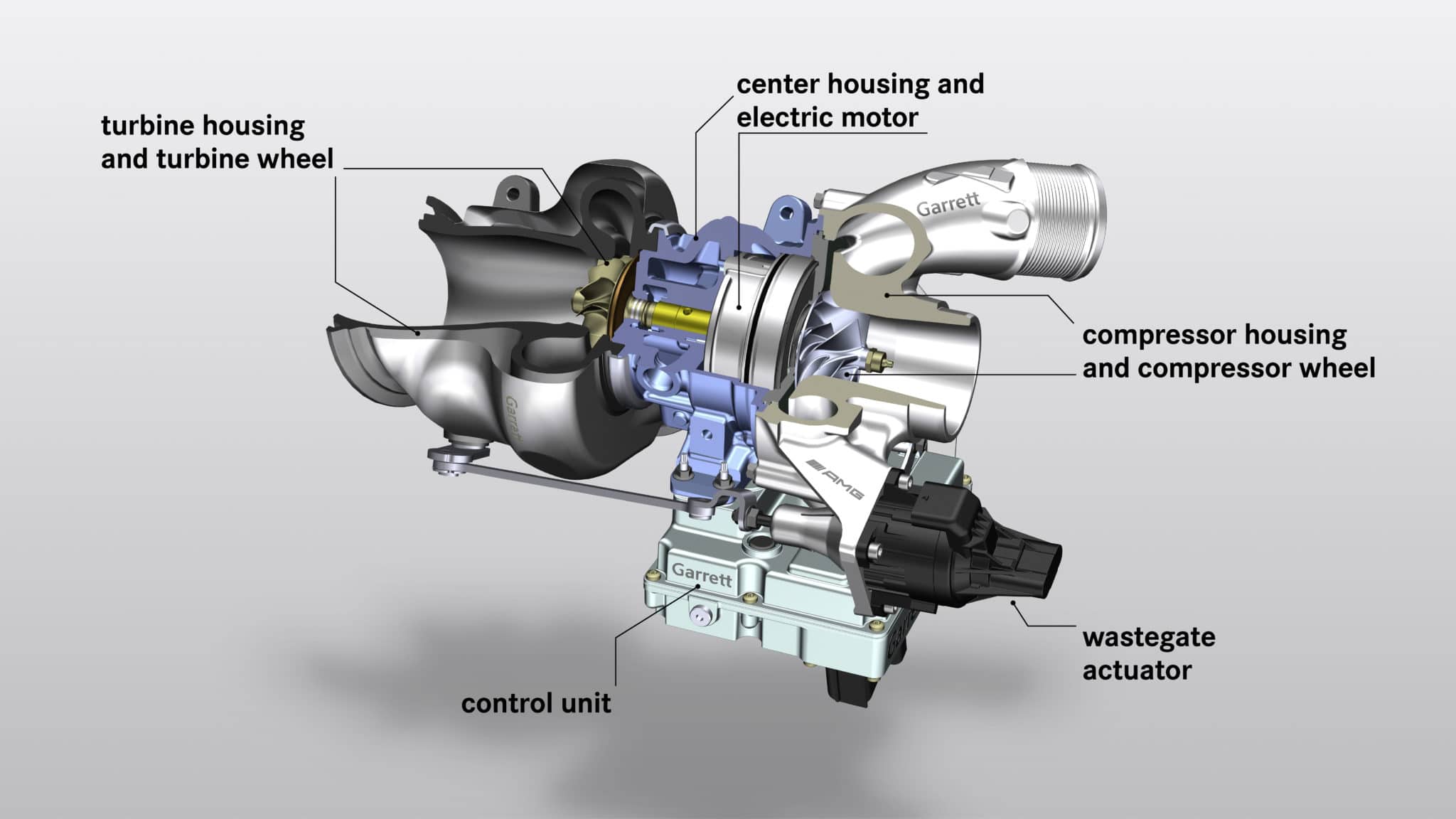
Electric turbochargers, or e-Turbos, will help manufacturers reduce CO2 emissions and turbo lag. How do they work?
Brands such as Mercedes-Benz and, specifically, its performance division, Mercedes-AMG are incorporating electric turbos, known as e-Turbos, into their models. This type of technology offers faster responses, reduces lag and CO2 emissions.
We have heard a lot about the electric boost (e-boosting) of diesel engines in recent years. Several premium brands now use it alongside conventional turbochargers to improve response at low revs and low power, with the conventional turbo taking over control.
However, the latest development, which also aims to help engines comply with future emissions legislation, is the electronic turbocharger. This is already used in Formula 1 and is being developed for road use by Mercedes-AMG together with the turbo manufacturer Garrett Motion.
The E-boosters (or electric superchargers) and the e-turbochargers are quite different animals. A conventional turbo is driven by the energy of the exhaust gases and consists of two main components: a gas-driven turbine and a compressor that actually pressurises the engine’s intake air.
e-Turbos, will they help manufacturers meet future emissions regulations?
E-boosters replace the turbine with a 48 V electric motor, so no exhaust gases are involved. The advantage of an e-booster is that it can generate boost when exhaust gas energy is very low, eliminating the delay to give an immediate throttle response.
Electronic turbochargers retain the turbine and compressor, but add a motor to increase turbo response by overcoming the inertia of the turbine and compressor, which makes them reluctant to accelerate. It also helps response when exhaust gas energy is lower, and recovers it through the turbo equivalent of regenerative braking. When the driver lifts off the throttle, there is still a lot of energy in the rotating parts and, initially, in the exhaust gases.
In fact, there is enough energy for the turbo to keep generating boost when it is no longer needed. An electronic turbocharger takes advantage of that surplus energy to generate electricity, which is stored in the battery of a hybrid.
The Mercedes-AMG Garrett E-Turbo incorporates a motor only 40 mm thick, sandwiched between the turbo’s turbine and compressor housings. The motor spins the turbocharger before the exhaust gases energise the turbine, so that, even at idle, the response is instant, reducing lag.
The turbo can, as Garrett says, be the “right size” for the job, which will be essential for combustion strategies to meet future emissions regulations. Mercedes-AMG, for its part, has not said at this stage whether it will follow F1 practice and use the electrical energy recovery function.
https://www.youtube.com/watch?v=4nLIgb8swGc
Superchargers, what will happen to them?
Superchargers still exist, but their use is declining due to the superior efficiency and improved response of turbochargers. Mechanical drive means they do not suffer delays, thanks to low exhaust gas pressures. They are still used by Jaguar, Land Rover, Lotus and Volvo.


 Peugeot E-208 GTi: a battery-powered toy that revives the spirit of the 1980s sports cars
 New Lexus ES: luxury grows and goes electric
 First contact with the Dacia Sandero Hybrid 155: power and efficiency from €19,890
Deja un comentario