Quick guide: The best ECO-label hybrid cars for city and road driving in 2026
 Iván Navarro
16 March 2026
8 min.
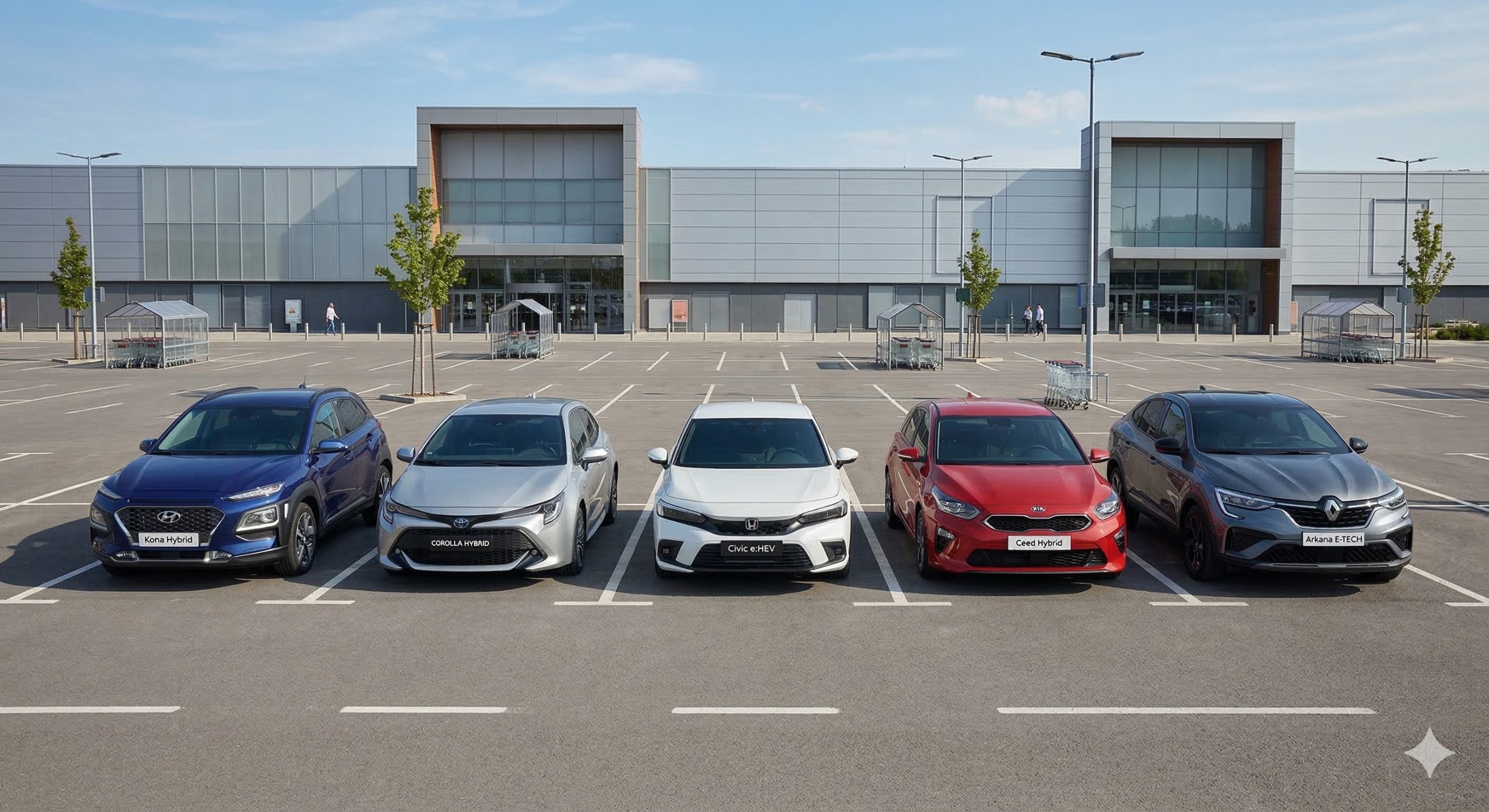
The wide variety available in this segment makes choosing difficult. We have selected five models to make it a little easier for you.
In 2026 the market offers ECO-label hybrids that combine low consumption in town with the capability for interurban journeys, a balance that still raises doubts among those seeking versatility without giving up efficiency. These vehicles are a practical option for those who alternate daily urban trips with motorway journeys, provided that real-world range and conditions of use are clearly specified. “Urban range and the effectiveness of the hybrid system depend as much on driving style as on terrain and climate.” “The total cost of ownership —price, consumption, maintenance and loss of value— defines the real suitability of each model.” These statements summarise the most frequent doubts and serve as a practical reference for comparing alternatives on the Spanish market.
This buying guide is for…
Compact ECO-label hybrid vehicles are ideal for drivers who combine frequent urban trips with occasional road journeys: commuters who make daily trips, small families, and those who value low consumption and flexibility without depending exclusively on charging points. They are not the best choice for those who need a label 0 (pure electric vehicles) because of very strict access restrictions, or for drivers with very long daily distances at sustained speeds, where an efficient diesel or a BEV with reliable charging may prove more economical.
Common options within the segment
Within the compact hybrid segment there are approaches ranging from the classic hybrid to solutions more focused on comfort and aerodynamic efficiency. Some variants prioritise reduced weight and urban efficiency, while others offer greater power and boot capacity at the cost of slightly higher consumption. The usual compromise in this segment involves accepting a moderately sized battery, regenerative braking calibrated for city driving, and a combustion engine configuration designed to balance consumption and responsiveness on the road.
Key criteria for choosing well
Realistic versus homologated range: look at combined (urban and motorway) real-world consumption data and independent tests rather than WLTP figures from the isolated urban cycle. Power and charging speed: in full hybrids, combined power and the combustion engine’s responsiveness when overtaking are key; for PHEVs, charging speed and battery capacity determine electric usability. Stability and comfort on the road: check suspension and weight, as a tuning set up for efficiency may sacrifice some comfort on potholed roads. Genuinely useful technology: well-implemented driver assistance systems, infotainment integration and aids that reduce real consumption (for example, regenerative driving modes). Total cost of purchase and use: includes purchase price, real consumption, maintenance and depreciation; the ECO label helps in restricted zones but does not automatically offset a higher purchase price.
It depends on how you drive
If you drive mainly in the city and make few long journeys, look for a hybrid with good electric response at low speeds and efficient battery management. For profiles that alternate motorway and urban driving, prioritise efficient combustion engines and good inertia recovery for overtaking without forcing the powertrain. Climate matters: in cold winters the electric-mode range decreases and the combustion engine intervenes more; in regions with frequent hills, an engine with low-rev torque is worthwhile. The buyer’s practical profile also shapes the choice: a large boot and ergonomics if you travel as a family; smaller dimensions and manoeuvrability if use is mostly urban.
Real price: what you should know
The “from” price indicates the base price without optional equipment or discounts. The difference between cash and financed price usually varies due to interest and promotions; it is worth calculating the total cost. Equipment has a decisive impact on the final price: safety packs, metallic paint and driver aids raise the figure. Taxes, registration and delivery also add up. In Spain, public aid or dealer discounts reduce the outlay, but the “from” price only serves as an initial reference: compare equivalent configurations and add estimated running costs to obtain a realistic picture.
Reference models on the market
Hyundai Kona Hybrid (from 28,200 €*)
An approach focused on urban efficiency with capability for road journeys thanks to an economical combustion engine and an optimised transmission; a good balance between habitability and compact size, suited to drivers who value low consumption without giving up acceptable interior space.
The best
Efficiency in mixed cycle and a damping setup that favours fuel saving in real use.
Could be better
The boot is adequate but does not stand out against rivals with a more family-oriented approach; acoustic insulation on the road could be improved.
Toyota Corolla Hybrid (from 26,400 €*)
A model with a proven track record in full hybrids, designed for versatile use: efficient urban driving and safe responses on the motorway, with a mature hybrid system and contained maintenance costs.
The best
A proven hybrid system and low consumption in town, with an extensive technical network and widely available spare parts.
Could be better
Dynamics focused on comfort rather than sportiness; the driving feel may seem bland to those seeking a more direct response.
Honda Civic e:HEV (from 29,500 €*)
A hybrid proposition with a technological and dynamic focus, with good acceleration capability and ergonomics geared towards the driver; it suits mixed routes where performance and efficiency are valued.
The best
Hybrid system response and road behaviour, with a very homogeneous traction feel.
Could be better
A slightly higher base price compared with alternatives focused strictly on maximum savings; the total cost depends on the chosen configuration.
Kia Ceed Hybrid (from 24,900 €*)
A practical compact with a good balance between price and equipment, suitable for urban users who occasionally make long trips; competitive interior habitability for its category.
The best
Equipment-to-price ratio and passenger interior space, useful for family and urban journeys.
Could be better
Motorway efficiency is adequate but not as outstanding as in cars specifically oriented to maximum savings.
Renault Arkana E-TECH (from 26,800 €*)
A compact crossover approach with full hybrid technology, designed for those who want an SUV-style design without giving up efficiency; suitable for mixed driving and with a good driving position.
The best
A combination of raised ergonomics and a design with a practical focus for travel and city use.
Could be better
Consumption on high-speed journeys is somewhat higher than comparable compact saloons due to its greater aerodynamic drag.
Purchase incentives
Purchase incentives in 2026: Plan Auto+ and tax benefits. The 2026 Plan Auto+ replaces the previous programmes and provides direct aid for electrified vehicles in Spain.
Main amounts of the 2026 Plan Auto+
– Direct aid of up to 4,500 € for electric passenger cars.
– Up to 5,000 € for light vans in category N1.
– Retroactive effect from 1 January 2026.
– Approximate budget allocation of 400 million euros.
Who can benefit and priority criteria
Beneficiaries include private individuals, self-employed workers and companies. The EEE criterion (Electric, Economic and European) applies, with a greater incentive for BEVs compared with PHEVs. Vehicles priced below 35,000 € receive higher aid; those between 35,000 € and 45,000 € qualify for reduced aid. A maximum incentive is offered when final assembly or the batteries come from the European Union.
Additional requirements and tax advantages
The programme requires a mandatory minimum discount of 1,000 € from the dealer. There is also a 15% deduction in personal income tax (IRPF) up to a maximum of 3,000 €. These tax advantages are valid until 31 December 2026.
Management and possible regional aid
Management is coordinated by the Ministry of Industry together with the Autonomous Communities, and additional regional programmes may exist. For example, the Plan Cambia 360 in the Community of Madrid sometimes complements state aid. At the time of writing, it is not officially confirmed that all regional aid is compatible with the 2026 Plan Auto+.
Common buying mistakes
Buying based solely on the label without assessing the total cost of ownership; ignoring the difference between WLTP and real combined consumption; choosing the best-equipped version without calculating the impact on the final price; not considering the actual usage profile (city versus motorway) or the availability of after-sales service in the area; and assuming that greater combustion power always offsets higher consumption.
With the information and criteria presented, the reader has a solid basis for assessing which ECO hybrid best suits their use. The logical next step is to compare these models with up-to-date rankings and analyses that include real consumption tests and estimated running costs.


 Peugeot E-208 GTi: a battery-powered toy that revives the spirit of the 1980s sports cars
 New Lexus ES: luxury grows and goes electric
 First contact with the Dacia Sandero Hybrid 155: power and efficiency from €19,890
Deja un comentario