The 5 best electric cars for travelling in 2026
 Iván Navarro
3 April 2026
8 min.
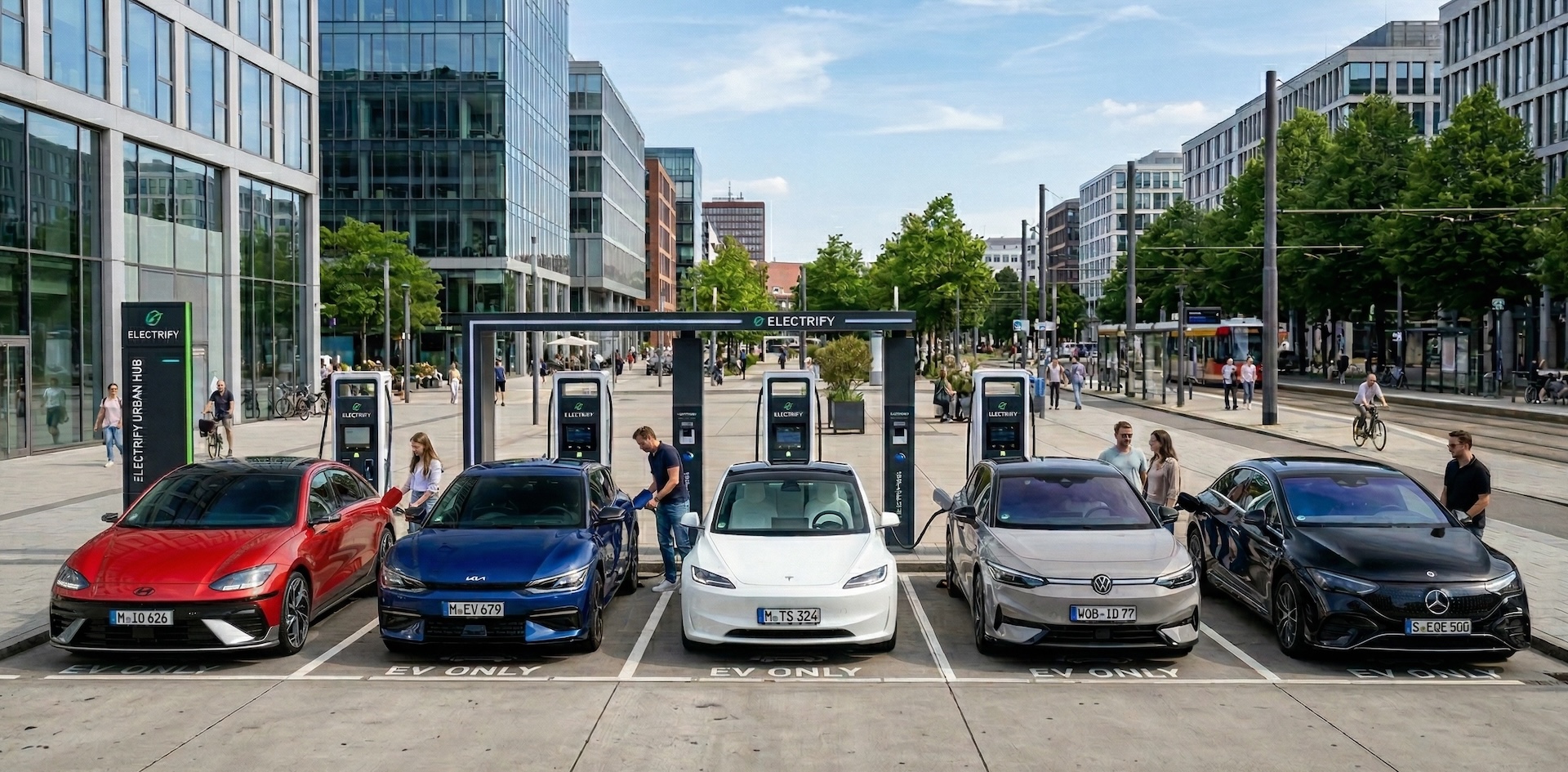
Five market benchmarks that combine aerodynamic design, cutting-edge technology and record-breaking ranges. Which one would you choose?
The electric market in 2026 offers a more mature choice for those planning long journeys: greater real-world range, better battery thermal management systems and support for charging infrastructure. This review focuses on models that combine competitive WLTP range, space for travelling and energy efficiency on the motorway. You will find options that differ in size and technical approach, with clear differences in efficiency, comfort and running costs that shape the experience on the road.
Who is this ranking for?
This ranking is based on market data, official specifications and published road tests. It is designed for drivers who value range, for families who often make long trips, and for professionals who need a reliable electric car for intercity journeys.
If you drive many kilometres a year and want to lower your cost per kilometre; if you prioritise high range over an SUV format; or if you want an electric car with good space and comfort systems for long trips, this list helps you compare alternatives using clear criteria.
What details have we analysed?
We have considered market positioning and price, official technical specifications such as WLTP range and maximum power, homologated consumption, dimensions and space for long distances, as well as expected real-world use on the motorway and the value for money of the technical approach for frequent journeys.
Ranking of the 5 best electric cars for travelling in 2026
Hyundai Ioniq 6 (from 48,500 €*)
Indicative price without applying public aid or the brand’s commercial discounts.
Why it is here: Its aerodynamics reduce motorway consumption, the battery thermal management improves the sustainability of range on long routes, and its chassis offers stable comfort at high speed, which favours long journeys.
Ideal for: Drivers looking for aerodynamic efficiency and good range for intercity journeys.
Pros:
- High WLTP efficiency for long journeys.
- Optimised thermal management system.
- Comfort and stability on the motorway.
Cons:
- Rear seats slightly tight in headroom for three adults.
- Competitive entry price, but superior equipment raises the cost of the model.
Kia EV6 (from 46,900 €*)
Indicative price without applying public aid or the brand’s commercial discounts.
Why it is here: It combines a battery with a capacity aimed at long journeys with an architecture designed for fast charging, which reduces stopping times on the road and maintains a comfortable driving experience.
Ideal for: Users who need a good balance between range and family practicality on the road.
Pros:
- Good balance of range and fast charging.
- Spacious cabin for luggage and occupants.
- Platform with good dynamic behaviour.
Cons:
- Some versions lose range due to higher performance.
- Higher-end finishes increase the price noticeably.
Tesla Model 3 Long Range (from 53,990 €*)
Indicative price without applying public aid or the brand’s commercial discounts.
Why it is here: Its charging network and the combination of range and motorway efficiency make it a clear option for long journeys, especially because of the ease of planning stops and charging times.
Ideal for: Those who prioritise minimising total travel time and using a wide, fast charging network.
Pros:
- Wide compatible charging network.
- Range and efficiency with sustained charging.
- Software with navigation for electric routes.
Cons:
- Minimalist interior finish that does not convince everyone.
- Availability varies by market and configuration.
Volkswagen ID.7 (from 54,000 €*)
Indicative price without applying public aid or the brand’s commercial discounts.
Why it is here: Designed as a long-range saloon, it offers generous space and boot capacity with a focus on road comfort and efficiency over sustained journeys.
Ideal for: Family trips where space, comfort and stable range are the priority.
Pros:
- Great interior space and boot.
- Focus on road comfort and stability.
- Battery options aimed at long range.
Cons:
- Entry-level motors are less efficient on the motorway.
- Handling feels less sporty than alternatives.
Mercedes EQE (from 72,400 €*)
Indicative price without applying public aid or the brand’s commercial discounts.
Why it is here: It offers acoustic insulation and advanced comfort systems that reduce fatigue on long journeys, as well as variants with good range figures for intercity routes.
Ideal for: Those who prioritise comfort, silence and equipment on extended journeys.
Pros:
- High level of comfort and finishes.
- Driver assistance systems for the motorway.
- Range options designed for long journeys.
Cons:
- Entry price noticeably higher than mid-range alternatives.
- Higher maintenance and repair costs.
The prices shown in this ranking are indicative, without applying public aid or the brand’s commercial discounts.
Technical comparison
| Model | Range | ||||
|---|---|---|---|---|---|
| Hyundai Ioniq 6 | 614 km WLTP | 160 kW | ND | 185 km/h | 48,500 €* |
| Kia EV6 | 528 km WLTP | 168 kW | ND | 185 km/h | 46,900 €* |
| Tesla Model 3 Long Range | 602 km WLTP | ND | ND | 233 km/h | 53,990 €* |
| Volkswagen ID.7 | 700 km WLTP | ND | ND | ND | 54,000 €* |
| Mercedes EQE | 600 km WLTP | ND | ND | ND | 72,400 €* |
These data are official and taken from the brands’ official websites.
Purchase aid in 2026: Plan Auto+ and tax benefits
The Plan Auto+ 2026 replaces the previous MOVES programmes and establishes a new system of direct aid for the purchase of electrified vehicles in Spain, with criteria aimed at encouraging production and assembly in Europe. Management combines central support with coordination with the autonomous communities.
Main amounts of the Plan Auto+ 2026
– Direct aid of up to 4,500 € for electric passenger cars.
– Up to 5,000 € for light vans in category N1.
– Retroactive effect from 1 January 2026.
– Approximate budget allocation of 400 million euros.
Who can benefit and priority criteria
Beneficiaries: individuals, self-employed workers and companies. The EEE criterion (Electric, Economic and European) applies. The Plan gives greater incentive to pure battery electric vehicles (BEV) than to plug-in hybrids, with higher amounts for cars priced below 35,000 €, reduced aid for vehicles between 35,000 € and 45,000 €, and an additional priority if the final assembly or the batteries come from the European Union.
Additional requirements and tax advantages
A mandatory minimum discount of 1,000 € from the dealership is required. There is a 15% deduction on income tax (IRPF) up to a maximum of 3,000 €. The tax validity of these deductions extends until 31 December 2026.
Management and possible regional aid
Management is coordinated by the Ministry of Industry together with the Autonomous Communities. Additional regional programmes may exist; for example, the Plan Cambia 360 in the Community of Madrid. At the time of writing, it is not officially confirmed whether these regional aids are compatible with the Plan Auto+ 2026.
FAQ · The 5 questions everyone asks
What range do I need to travel without worries?
For long motorway journeys, a real WLTP range above 400–500 km reduces how often you need to stop; however, the key is combining range with the availability of fast charging along the route and favourable temperatures that do not degrade real-world range.
How long does it take to recharge during a typical stop?
At fast charging stations of 150–250 kW, an intermediate recharge to 80% usually takes 20–30 minutes depending on the vehicle and the thermal management of its battery; the time can vary depending on the condition of the station and the outside temperature.
Is an aerodynamic saloon or an SUV better for long journeys?
An aerodynamic saloon usually offers better efficiency and greater real-world range on the motorway; an SUV provides more space and comfort for passengers and luggage. The choice depends on whether you prioritise range and consumption or load capacity and driving position.
Does using the climate control affect range a lot?
Yes. Intensive use of heating or air conditioning reduces real-world range more in extreme climates; models with a heat pump and advanced thermal management limit this impact compared with less efficient systems.
What factors should I check before choosing an electric car for travelling?
Check the WLTP range but verify real-world figures, maximum charging capacity, the charger network on your usual routes and the useful boot space; also consider seat comfort and driver assistance systems to reduce fatigue.
Expert’s conclusion
This ranking shows that in 2026 there are mature alternatives for travelling electric: the combination of competitive WLTP range, thermal management systems and charging networks makes long journeys viable. For those who travel often, the real-world range figure and fast charging capacity largely determine the experience on the road.
If you want to get the most value for your money, look first at the real entry price and what comes as standard. If you prefer to play it safe, consider models with a wide charging network and higher demand, as they tend to be easier to maintain and resell. And if your use is mainly motorway driving, prioritise efficiency and battery thermal management over power. And if you drive many kilometres, energy cost and efficiency matter more than the power figure. If you won’t charge often, don’t buy from the catalogue: buy for your routine.


 The seven finalists for the 2027 European Car of the Year (COTY) are exclusively electric
 Peugeot E-208 GTi: a battery-powered toy that revives the spirit of the 1980s sports cars
 New Lexus ES: luxury grows and goes electric
Deja un comentario