Aston Martin Sports Cars Historia
The Aston Martin Bulldog aims to break the speed record... 40 years after failing in its attempt
 Miguel Lorente
12 January 2021
3 min.
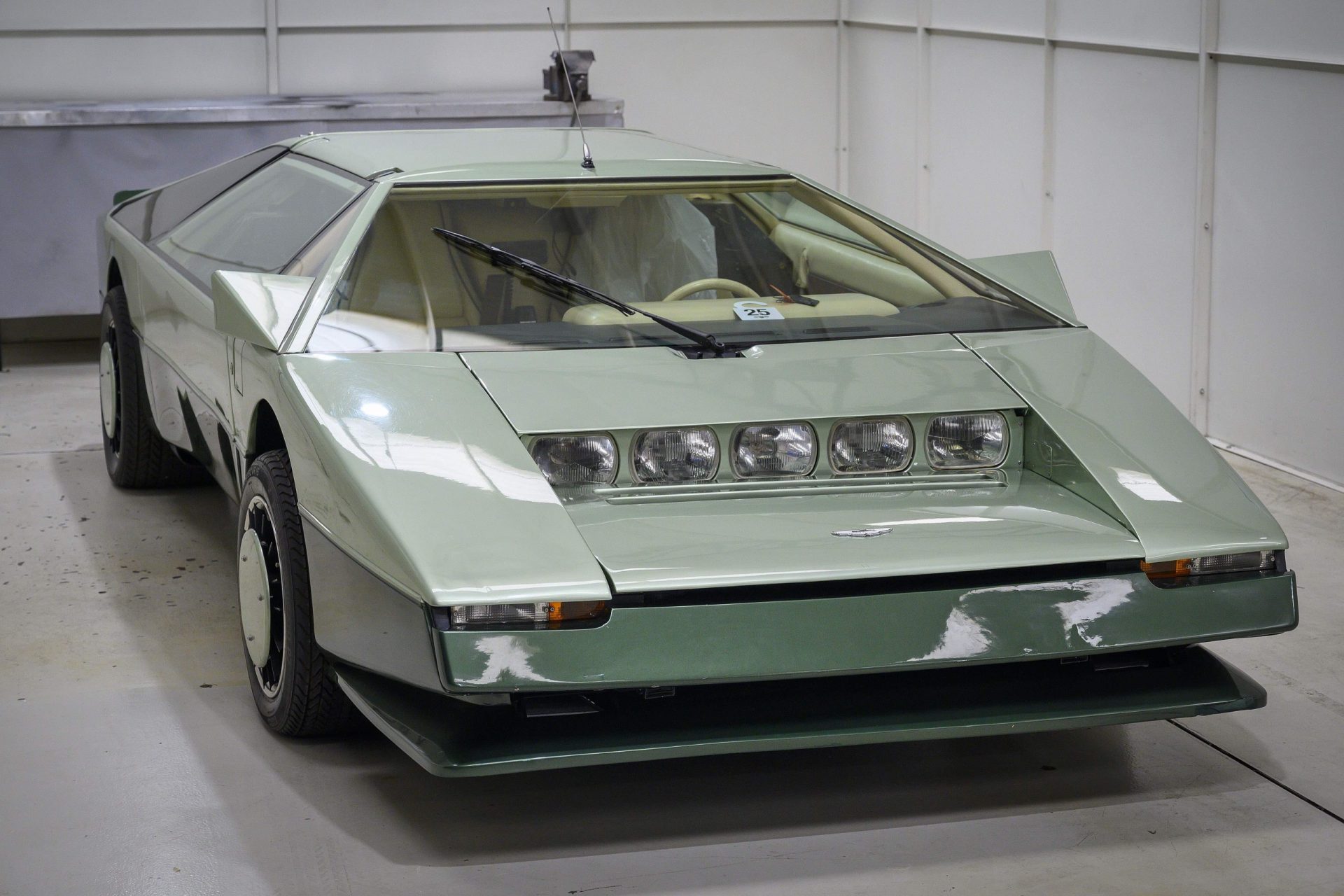
After 40 years of oblivion, the Aston Martin Bulldog, the prototype created to be the first car to exceed 200 miles per hour, is set to return to beat itself
How many prototypes conceived to become icons of the automotive world have ended up, at best, in a garage alongside other collector’s pieces? Something like that happened to the Aston Martin Bulldog unveiled in 1979, which, now, after 40 years of ostracism and oblivion, is making headlines once again.
Not because Aston Martin has decided to revive either its concept or even its name, but because the only unit of the 15 to 25 that the Gaydon firm had planned to build of this machine, unmistakably based on the Aston Martin Lagonda, was the one that William Towns took on to lead in its journey toward a record never before achieved.
https://youtu.be/afZY9YSPcmA
This incisive and inquisitive proposal emerged like the most precise and aseptic surgical scalpel, as if it were set on slicing through whatever wind it encountered, which is why its Cx, or drag coefficient, reached a sensational 0.34. Driven by the most powerful engine available at the time, an 8-cylinder V-configuration block with 5.3 litres of displacement, to which two Garrett-signed turbochargers were added, its final output was 610 CV.
The combination seemed perfect: aerodynamics and power working together to achieve one goal: to be the first car to reach 200 miles per hour, equivalent to 321.87 km/h.
Fortunately, but above all to its misfortune, we must never lose sight of the context: we are at the end of the 1970s, and neither the technological context, nor even the geopolitical one that would shape the economic one, the Aston Martin Bulldog had been born at the wrong time, condemned forever.
So much so that, despite the brand’s efforts, the car did not receive the reception it had hoped for nor did it reach the theoretical speed for which it had been designed, since in 1981, during the tests carried out, this car recorded a top speed of “only” 191 mph (307.39 km/h).
Then, Aston Martin could not shelve the project, since the unit built as an exhibition model was a reality, but it could at least recoup some modest return, or at least recover some of the money invested, and it ended up, first, being sold to a buyer from the Middle East.
40 years wandering through the desert…
Although the Aston Martin Bulldog was not buried beneath the desert sands, like other ill-fated martyrs of delusion, this exclusive example has changed collections and owners until the son of the man who guillotined the project has once again acquired it to give it a second chance.
Now, Richard Gaunlett, after more than a year of work, the son of the then chairman of Aston Martin who managed to pull it out of the pit, and not precisely an oil one, Victor Gaunlett, through his company Classic Motor Cars, CMC hereafter, has seen fit to recover this piece and redeem it.
With the addition to the team of Darren Turner, a professional driver and, at the same time, a development and testing driver for Aston Martin, CMC by Gaunlett announce that, in 2021, after completing the restoration of the Aston Martin Bulldog at its facilities in Shropshire, United Kingdom, this spectacular prototype will return to the track to reach the goal that both Towns and Gaunlett set so high for a vehicle that, more than four decades after being conceived and built, will be given a second chance. A true journey through time.


 Peugeot E-208 GTi: a battery-powered toy that revives the spirit of the 1980s sports cars
 New Lexus ES: luxury grows and goes electric
 First contact with the Dacia Sandero Hybrid 155: power and efficiency from €19,890
Deja un comentario