The biodegradable car, a long-term possibility
 JL Arboledas
2 May 2011
3 min.
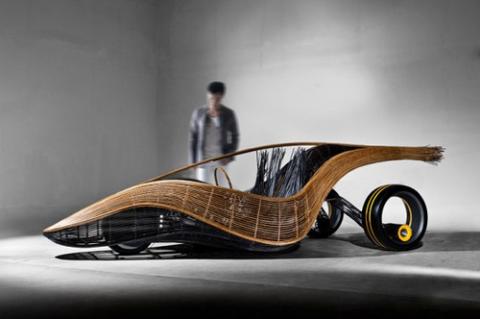
From time to time, HighMotor publishes entries in which our editors show us real monstrosities: genuinely exclusive cars in terrible condition, mostly due to the neglect of their owners, who seem to forget that they have true automotive treasures left out in the open, filling with rust in every corner of their bodywork.
To remedy this, and it doesn’t matter in this case whether the car stands alone or sits among a pile of companions in a scrapyard waiting its turn to be crushed while manufacturers keep producing millions of new units every year, the concept of biodegradable car appears.
Unfortunately, there is only one Earth, and little by little, just as we think about reducing emissions, consumption and so on, we should also think about what happens to all those vehicles once we no longer want them. In other words, we should look for much more optimal solutions for getting rid of that unhealthy number of vehicles we no longer want and that are gradually piling up.
Because of this need, there is increasingly talk about biodegradable cars, vehicles like the one you can see on screen, which has been built by the designers Kenneth Cobonpue Birkner and Albrecht, and which stands out precisely because, for example, it has been built entirely from materials such as bamboo.
According to its designers, the useful life of this vehicle will be 5 years for owners who drive it in highly industrialised countries, extending to 10 or 20 years in countries where pollution is much lower. After that time, instead of being a rusted piece of scrap, the car will decompose like any other plant, returning to the earth that, in its time, “created” it.
Unfortunately, for now this type of project has a very big drawback: a vehicle lasting 5 years is perhaps not the most suitable option. Perhaps the picture would look much better if, as we have discussed above, the vehicle’s longevity were set at 10 or 20 years for all countries.
On the other hand, in my opinion a car of these characteristics would ideally use an electric system or something similar as its means of propulsion (its creators do not specify), with the consequent problem of fitting the motor, batteries and other elements into a “wicker” chassis. Even so, this kind of initiative should be highlighted and above all praised, since those electric vehicles that some designers ahead of their time began to show once seemed curious to us, and today they are a short-term reality.
Source: motorauthority


 The seven finalists for the 2027 European Car of the Year (COTY) are exclusively electric
 Peugeot E-208 GTi: a battery-powered toy that revives the spirit of the 1980s sports cars
 New Lexus ES: luxury grows and goes electric
Deja un comentario