The DGT is preparing the first section speed camera in the Guadarrama tunnel
 Diego G. Moreira
10 August 2009
2 min.
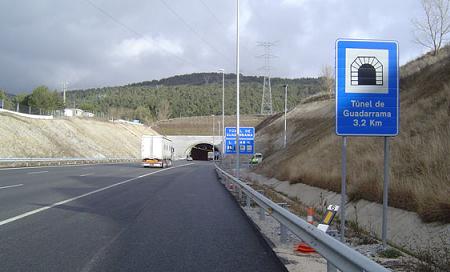
For some time now, the DGT has been announcing that it would install section speed cameras, to prevent many drivers from only easing off the accelerator when passing a fixed speed camera and then carrying on as if nothing had happened. Well then, the Dirección General de Tráfico has installed the first section speed camera in Spain, in the Guadarrama Tunnel.
The device will be installed in October or November in the third Guadarrama tunnel, in the direction of Madrid, and will monitor a 3.1-kilometre stretch. The operation is simple: at the entrance to the monitored section, a sensor detects the vehicle’s number plate and the time it enters the section; on leaving the monitored section (after 3.1 kilometres in the case of Guadarrama), another twin device records the exit data, number plate and speed.
That data is sent to the DGT, which analyses it using a software application. Depending on the time taken to cover the distance, they can calculate the average speed, and if it turns out to be higher than the limit on the road (in the case of the Guadarrama Tunnel it is 100 km/h), a fine is issued from just 1 km/h above the limit.
The cameras, mounted on two elevated gantries, read every number plate using infrared and are therefore operational 24 hours a day. This system is already used in some European countries such as the United Kingdom (where it has been in use since 1999), and according to statistics it catches an average of 400 drivers per hour. In Spain this mechanism was tested on the A-1, Madrid–Burgos.
For the time being, although it will go into operation in October–November, no fines will be issued and it will be in a testing phase until the end of the year, or even until the new Traffic Law is approved. Furthermore, under the current legislation they cannot, for now, fine drivers for exceeding the limit by 1 km/h, at least until the reform of the Traffic Law is definitively approved by the Senate.
The DGT’s plans involve controlling tunnels first and then extending it to other routes such as motorways and expressways. I would also like to point out that this tunnel is especially monitored, since at the exit of the tunnel there is also a fixed speed camera (with a 100 km/h limit), which is signposted at the tunnel entrance and inside it.
Source | El País


 Peugeot E-208 GTi: a battery-powered toy that revives the spirit of the 1980s sports cars
 New Lexus ES: luxury grows and goes electric
 First contact with the Dacia Sandero Hybrid 155: power and efficiency from €19,890
3 comentarios
Deja un comentario
Esta puede llegar a ser una muy buena idea ahora tendremos que ver que tan correcto es lo que marca, saludos
El gobierno en vez de invertir en salvar vidas humanas y soloprimendo su afan de recaudacion y no mejorando los miles de puntos negros de nuestra red de carreteras, claro esta esto costaria dinero y generaria empleo y eso no interesa verdad.
1km x ora eke se o teu automovil ten o contador de toa a vida jodeste tendo k ir o mellr a 90 x ora pa que non salte iso o miro fatidico o radar ste novo seica m dixeron k era ata mais barato k o fixo