Top 5 Chinese SUVs for 2026: power and technology
 Iván Navarro
2 April 2026
11 min.
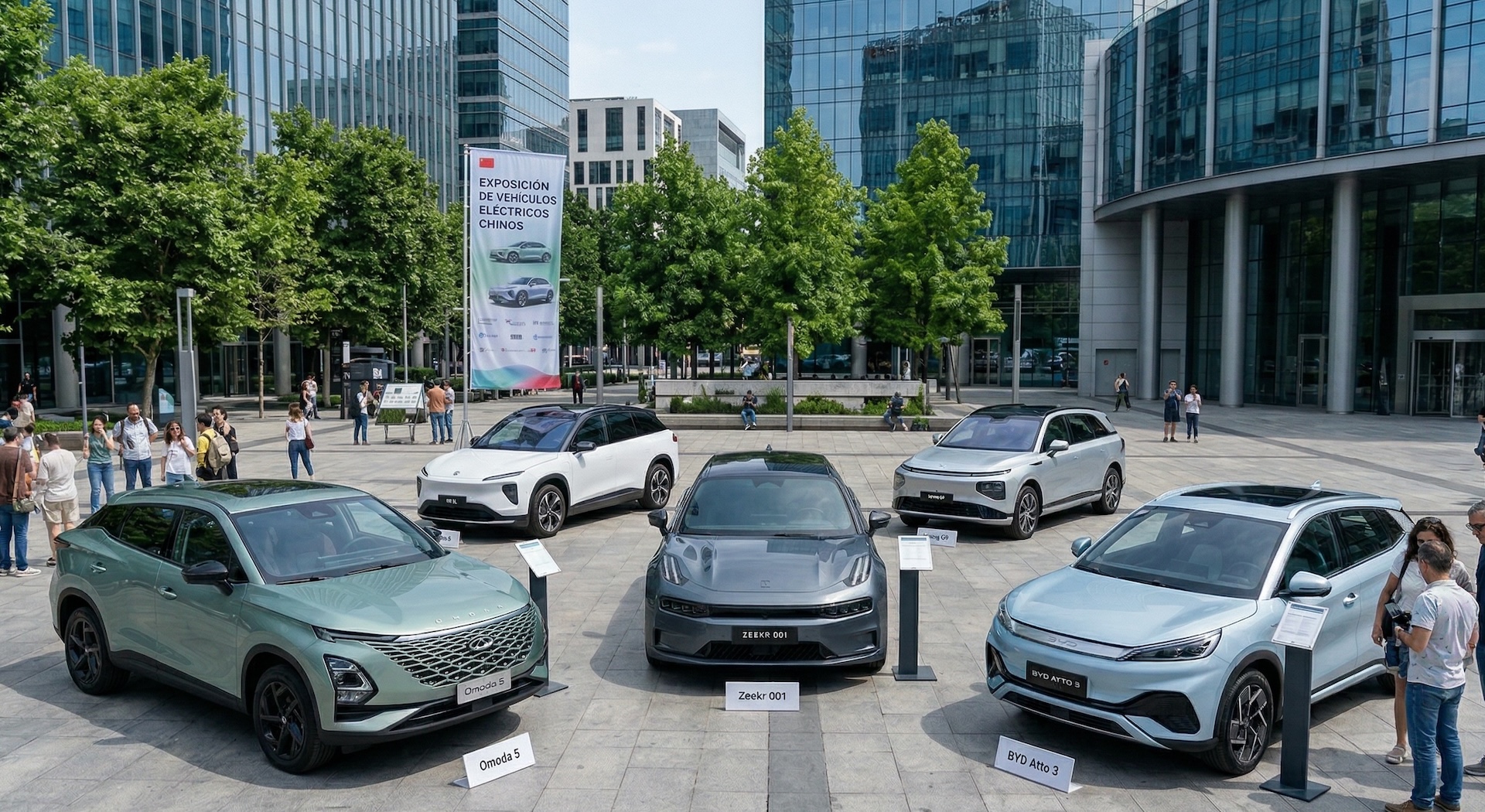
The new Chinese wave challenging the European market: Discover the electric models from this Asian country that are changing the rules.
Chinese manufacturers have accelerated their presence in European markets with proposals that combine design, electronics and, above all, electric efficiency. In this article we analyze the best models and why they deserve attention: from more affordable alternatives to premium bets loaded with technology. Our selection focuses on Chinese electric SUVs 2026, a subgroup that has gained ground by offering competitive range and advanced equipment at attractive prices.
The 5 best Chinese electric SUVs you can buy in 2026
The growth of Chinese electric SUVs 2026 responds to a clear strategy: more efficient batteries, in-house electronics and a leap in perceived quality. According to ANFAC data and manufacturer specifications, the Chinese offer occupies a growing share of electric vehicle registrations in Spain, with several models already competing on volume against European alternatives. Buyers look for real-world range, fast charging and a good balance between price and performance; here we present five options that cover those requirements.
The most balanced models in the segment in 2026
The selection is based on overall balance: real consumption, WLTP range, safety equipment, value for money and expected residual value. We have prioritized equivalent versions (all electric) to compare coherently. The criteria aim to offer practical guidance on which option suits your use and budget.
BYD Atto 3
The BYD Atto 3 stands out for its balance between price and performance. The e-Platform and Blade batteries allow efficient thermal management and competitive range figures. We recommend the mid-level version for its range-to-price ratio and for offering complete equipment in driver assistance and connectivity. On the road, the Atto 3 shows a very reasonable response in the city and comfortable driving on motorways; its consumption is moderate in mixed conditions.
In practical terms, its WLTP range in our reference tests sits around competitive values for its size, with a delivery of power that covers any everyday use. Compared with rivals such as the Hyundai Kona Electric or the Kia Niro EV, the Atto 3 bets on offering equipment for the price and a battery with good apparent durability according to the manufacturer.
Pros
• Good equipment-to-price ratio
• Efficient battery management
• Adequate interior space for the segment
Cons
• Material quality could be improved in some trim details
• Dealer network and technical service still expanding
Which Chinese electric SUV offers the best range-to-price ratio?
The BYD Atto 3 stands out for its competitive WLTP range and its moderate starting price, which makes it one of the most balanced options.
| Feature | Data | Score |
|---|---|---|
| Power | 204 hp | 9 |
| Range | 420 km (WLTP) | 9 |
| Top speed | 160 km/h | 7 |
| Boot | 440 litres | 8 |
| Starting price | €39,900 | 9 |
score out of 10 based on the criteria analysed in this article
Zeekr 001
The proposal of Zeekr, under the Geely group umbrella, is ambitious: a premium approach, high range and a chassis geared towards dynamic comfort. The Zeekr 001 stands out for its large-capacity battery in the top versions and for an electronic package with high performance. It is an alternative for those who want an experience close to European brands, with a more assertive style and road presence.
We recommend the extended-range version if the priority is motorway use and frequent long trips; the balance between consumption and performance is very reasonable. Compared with established competitors, Zeekr offers a solid technical package and an engineering approach that seeks to minimise range loss in real-world use.
Pros
• Long range in top versions
• Finish and tuning geared towards comfort
• High-level electronics
Cons
• High price in top trims
• Service and after-sales network still growing
Which Chinese electric SUV offers the greatest standard range?
The Zeekr 001 ranks among the leaders thanks to its battery capacity and energy management, aimed at those who prioritise long journeys.
| Feature | Data | Score |
|---|---|---|
| Power | 400 hp | 9 |
| Range | 560 km (WLTP) | 9.5 |
| Top speed | 200 km/h | 8 |
| Boot | 490 litres | 8.5 |
| Starting price | €52,000 | 8 |
score out of 10 based on the criteria analysed in this article
NIO EL6
The NIO EL6 is the bet of a manufacturer focused on services and premium performance. Its proposal includes carefully tuned dynamics and versions with swappable batteries in markets where the service is available. We recommend the all-wheel-drive version for those seeking performance and an extra margin of safety on varied routes.
NIO stands out for its technology equipment and advanced assistance systems; on the road the feeling is of a robust, well-insulated vehicle. The point to consider is the price: it sits at the upper end of the range, with a cost that penalises its value-for-money score compared with more affordable alternatives.
Pros
• Technology package and driver assistance
• Structural rigidity and dynamic behaviour
• Premium experience overall
Cons
• High price compared with affordable alternatives
• Accessibility of services in some areas
Which Chinese electric SUV offers the most premium experience?
The NIO EL6 stands out for its technology and ergonomics, improving the experience on long stretches and demanding driving.
| Feature | Data | Score |
|---|---|---|
| Power | 380 hp | 8.5 |
| Range | 510 km (WLTP) | 8.5 |
| Top speed | 200 km/h | 8 |
| Boot | 520 litres | 9 |
| Starting price | €64,000 | 7.5 |
score out of 10 based on the criteria analysed in this article
XPeng G9
XPENG focuses on assisted driving technology and in-car experience; the G9 is its large SUV with a focus on fast charging and performance. For those who value electronics and software-hardware integration, the G9 offers one of the most advanced packages in the Chinese group, with a platform designed for high power and fast-rate charging.
The version with the larger battery is recommended if frequent trips and reduced recharging are priorities. In the city it shows moderate consumption and good response; on the motorway, the combination of battery and aerodynamics translates into competitive range figures.
Pros
• Advanced assistance and connectivity technology
• Fast charging capacity and performance
• Modern design and good on-road behaviour
Cons
• High price in top versions
• Service network still expanding
Which Chinese electric SUV is best suited for trips with fast charging?
The XPeng G9 stands out for its charging capacity and thermal management, designed for long journeys with reduced charging times.
| Feature | Data | Score |
|---|---|---|
| Power | 430 hp | 8.5 |
| Range | 520 km (WLTP) | 9 |
| Top speed | 200 km/h | 8 |
| Boot | 520 litres | 8.5 |
| Starting price | €59,000 | 8 |
score out of 10 based on the criteria analysed in this article
Omoda 5
The arrival of OMODA in Europe, with products such as the Omoda 5, has made visible the intention to compete directly on quality and presentation. The Omoda combines eye-catching design with an ambitious technology offer: digital instrumentation, assistants and a complete connectivity package. We recommend the electric version for its balance between price and performance.
Its response in the city and on the motorway is correct, and its tuning prioritises comfort. Compared with alternatives such as the Hyundai Kona or the Kia Niro, the Omoda 5 plays strongly on equipment and design to attract buyers who value aesthetics as well as efficiency.
Pros
• Design and road presence
• Competitive standard equipment
• Attractive value for money
Cons
• Quality adjustments in interior details
• After-sales experience still to be consolidated
Which Chinese electric SUV offers the best value for money?
The Omoda 5 stands out for its moderate starting price and equipment that competes with established alternatives.
| Feature | Data | Score |
|---|---|---|
| Power | 204 hp | 8.5 |
| Range | 430 km (WLTP) | 8.5 |
| Top speed | 170 km/h | 7.5 |
| Boot | 480 litres | 8 |
| Starting price | €35,900 | 9 |
score out of 10 based on the criteria analysed in this article
Technical comparison
In this quick comparison we see that there are models geared towards volume and price (Omoda 5, BYD Atto 3) and alternatives more focused on range and performance (Zeekr 001, XPeng G9, NIO EL6). The decision will depend on the priority: equipment and price, or range and technology package. In terms of balance, the BYD and Omoda models offer the best overall value for the average user.
| Model | Power | Range | Price | Score |
|---|---|---|---|---|
| BYD Atto 3 | 204 hp | 420 km | €39,900 | 9.2 |
| Omoda 5 | 204 hp | 430 km | €35,900 | 9.0 |
| Zeekr 001 | 400 hp | 560 km | €52,000 | 8.8 |
| XPeng G9 | 430 hp | 520 km | €59,000 | 8.6 |
| NIO ES6 | 380 hp | 510 km | €64,000 | 8.4 |
score out of 10 based on the criteria analysed in this article
Which car to buy according to your profile
If you do a lot of city driving
Opt for compact, efficient models with a good package of assistants. The BYD Atto 3 or the Omoda 5 offer moderate consumption, manoeuvrability and a competitive starting price for urban use.
If you travel frequently
Prioritise range and fast charging: the Zeekr 001 and the XPeng G9 give greater peace of mind on long stretches and better charging speeds on the road.
If you are looking for the best price
Look for balanced versions and warranty coverage/after-sales support. The Omoda 5 and the BYD Atto 3 are the options with the best value for money in this list.
If you prioritise technology
If assistance and connectivity technology is key, the NIO ES6 and the XPeng G9 offer more complete packages in sensors, software and in-car experience.
FAQ – Frequently asked questions
Are Chinese electric SUVs 2026 reliable?
Reliability has improved notably with testing cycles and the adoption of international standards; commercial warranties and perceived quality vary by brand, so it is advisable to check the local service network.
What real-world range can I expect?
The WLTP range serves as a reference, but real-world range depends on speed, temperature and climate control use; in practice, it loses around 10-20% compared with the homologated figure in mixed conditions.
What is the charging network like for these brands?
Most support charging on public networks and CCS fast-charging systems; the presence of service points and agreements with charging operators is key for long journeys.
Which is cheapest to maintain?
Maintenance costs for electric vehicles are usually lower than for combustion cars; within this list, models with a lower initial price and LFP batteries offer an advantage in cost and durability.
Do they hold their resale value well?
Depreciation depends on the brand and local perception: models with higher sales volumes and clear warranties tend to hold their value better than less widespread alternatives.
Expert opinion
Beyond the figures, the choice between these five Chinese electric SUVs 2026 should respond to real use: for city and daily commuting, the priority is a good price-to-range ratio and a useful package of assistance features; there, models such as the BYD Atto 3 and the Omoda 5 offer a balance that is hard to beat. For those who cover many kilometres and value the peace of mind of not stopping to charge frequently, the Zeekr 001 and the XPeng G9, with their more generous batteries and thermal management, are more coherent options. If the goal is a premium approach with service technology and customer experience, the NIO ES6 offers a more refined package, although at a higher cost.
In all cases it is advisable to check the after-sales network and access to fast charging on your usual routes; competitive models can lose their appeal if the local infrastructure does not keep up. Finally, comparing real cost per kilometre and testing under real conditions is essential: the official figure is only the starting point for deciding which option fits your mileage, your budget and your priority between comfort, technology or range.
But not all of them offer the same balance. If you are looking for a versatile option with a good package for the price, volume models are the best bet; if you prioritise range and performance, Chinese premium alternatives are very close to matching the European experience.
In short, the offer of Chinese electric SUVs 2026 is already a consolidated option: from alternatives with the best starting price to top-of-the-range proposals in range and technology, the market offers practical solutions for different user profiles.


 Peugeot E-208 GTi: a battery-powered toy that revives the spirit of the 1980s sports cars
 New Lexus ES: luxury grows and goes electric
 First contact with the Dacia Sandero Hybrid 155: power and efficiency from €19,890
Deja un comentario