2026 Buying Guide: 7-Seater SUVs for Spain
 Iván Navarro
6 May 2026
9 min.
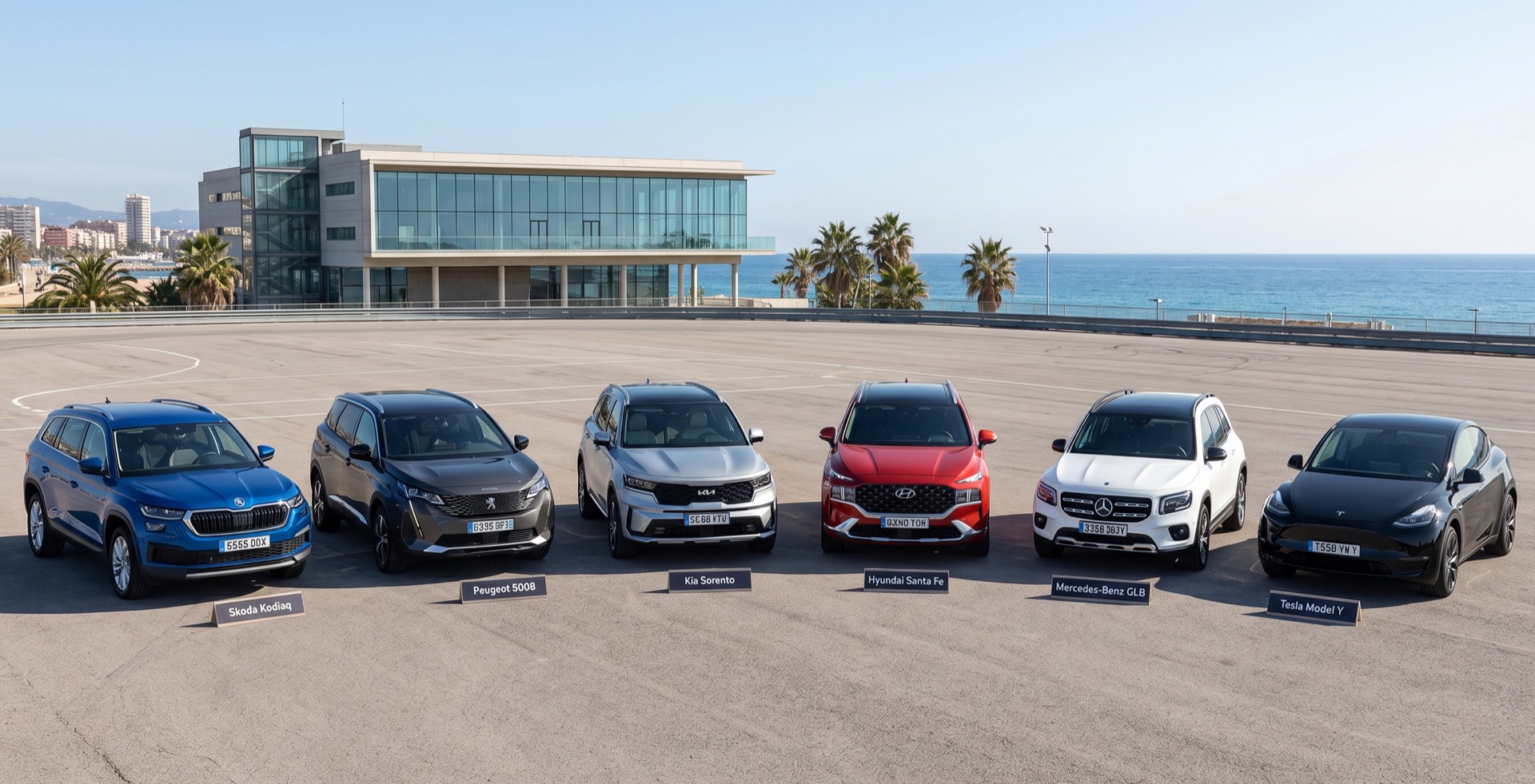
Today’s market for large 7-seater SUVs offers a wide range of options that combine versatility, design and cutting-edge technology for today’s families.
7-seater SUVs remain the preferred choice for families who need space without giving up a current design and a convincing driving experience. In 2025 SUVs accounted for more than 55% of the passenger car market in Spain, and within that demand, models with a 5+2 configuration stand out for offering versatility on trips and in everyday use. Buyers look for real usable space in all three rows, a practical boot, driver-assistance technology and contained running costs; that is why this guide covers petrol, diesel, hybrid, PHEV and electric options to suit different profiles and budgets ranging from 36,000 to more than 60,000 €.
The average starting price for a 7-seater SUV in Spain falls within a wide range: from around 36,000 € for the more sensible alternatives to more than 60,000 € for premium or fully electric options. Market trends show that buyers value both travel comfort and low consumption per kilometre, which is why many brands offer hybrid or PHEV versions that balance economy and range.
These are the most well-rounded models if you are looking for space, comfort and versatility
If you are looking for an SUV with good capacity and efficiency, the best alternatives combine updated combustion engines with hybrid versions that reduce urban consumption and emissions; electric models cover the need for a ZERO label and journeys without local emissions.
What a 7-seater SUV needs to have for this purpose
A 7-seater SUV designed for the family should prioritise three aspects: real space in the third row (for use by children or adults on short journeys), an acceptable boot with all seven seats in use and simple modularity to transform the space. Technologies such as hybrid or PHEV platforms help reduce cost per kilometre in mixed use; a modern diesel or an efficient petrol engine remains a good option if you drive many kilometres. Expect starting prices from 36,000 € for mainstream models and around 45,000–60,000 € for hybrids or premium options.
Model selection
Škoda Kodiaq
The Škoda Kodiaq is one of the benchmarks for space-to-price ratio. Available with modern petrol and diesel engines, it offers a third row capable of carrying children and adults on short trips, as well as a practical boot when the rear seats are folded. It is a solid alternative if you are looking for family versatility without technological complications.
Why is it a good option?
• Room in all three rows.
• Good boot space and modularity.
• Competitive value for money.
A family profile that values space and running cost.
| Data | Value |
|---|---|
| Engine | Petrol / Diesel |
| Environmental label | C |
| Power | 150 CV |
| Consumption | 6.6 l/100 km (WLTP, combined) |
| Starting price | 36,200 € |
Peugeot 5008
The Peugeot 5008 blends a modern interior with good seating and a friendly, dynamic drive. Its styling stands out and the driving position is geared towards comfort. Available mainly with efficient petrol engines, it is a choice for those who want a 7-seater SUV that does not give up design or low consumption.
Why is it a good option?
• Carefully designed interior.
• Comfortable seating positions in every row.
• Moderate consumption from small turbo engines.
Buyers who value style and practical roominess.
| Data | Value |
|---|---|
| Engine | Petrol |
| Environmental label | C |
| Power | 130 CV |
| Consumption | 6.4 l/100 km (WLTP, combined) |
| Starting price | 36,850 € |
Kia Sorento
The Kia Sorento is a large SUV that focuses on hybrid engines alongside diesel in some markets. Its approach is clearly family-oriented: three rows with easy access, good finish and standard safety equipment. In hybrid versions it earns the ECO label and noticeably reduces urban consumption.
Why is it a good option?
• Real seats in the third row.
• Complete safety equipment.
• Good balance between comfort and consumption in HEV versions.
Large families who prioritise efficiency and comfort on long journeys.
| Data | Value |
|---|---|
| Engine | Hybrid (HEV) / Diesel |
| Environmental label | ECO |
| Power | 230 CV (combined in HEV) |
| Consumption | 6.4 l/100 km (WLTP, combined HEV) |
| Starting price | 45,000 € |
Hyundai Santa Fe PHEV
The Hyundai Santa Fe PHEV offers the versatility of a large SUV with the advantage of a plug-in engine: a reasonable daily electric range and capacity for seven occupants. It is an alternative for anyone who wants to reduce emissions in urban use without losing range for long journeys.
Why is it a good option?
• Electric range for daily journeys.
• Great roominess and comfort.
• Enough power for overtaking and loaded trips.
Families who combine urban journeys with frequent long trips and want to save fuel.
| Data | Value |
|---|---|
| Engine | PHEV (Plug-in) |
| Environmental label | ECO |
| Power | 265 CV (combined) |
| Range | ~57 km (WLTP, electric) |
| Consumption | 1.3 l/100 km (WLTP, combined) |
| Starting price | 47,000 € |
Mercedes-Benz GLB
The Mercedes-Benz GLB is the compact premium option with the possibility of 7 seats: a premium steering wheel, good front seats and a third row more suitable for children or adults on occasional trips. It is an alternative if you want a more sophisticated finish and advanced driver-assistance features.
Why is it a good option?
• Premium finish and fit.
• Reasonable access to the third row.
• Standard technology equipment.
Families who want a 7-seater SUV with a premium focus and refined driving.
| Data | Value |
|---|---|
| Engine | Petrol / Mild-hybrid |
| Environmental label | C |
| Power | 163 CV |
| Consumption | 7.0 l/100 km (WLTP, combined) |
| Starting price | 44,000 € |
Tesla Model Y (7 seats)
The Tesla Model Y with the seven-seat option is the electric alternative for those who prioritise a ZERO label and range. The third row is compact and designed mainly for children, but the electric drivetrain drastically reduces cost per kilometre and offers a different experience on long journeys.
Why is it a good option?
• Real-world range and efficiency on the road.
• Reduced cost per kilometre.
• Convenient technology and charging network for trips.
Users who want a 7-seater SUV with a ZERO label and low running costs when electric.
| Data | Value |
|---|---|
| Engine | Electric |
| Environmental label | ZERO |
| Power | ~380 CV (varies by version) |
| Range | ~533 km (WLTP, Long Range) |
| Starting price | 64,990 € |
Which car to choose for your case
If you do a lot of city driving
Choose a hybrid or a PHEV with good urban electric range: they reduce consumption and local emissions. The Hyundai Santa Fe PHEV or the Kia Sorento in HEV form are practical options. However, not all offer the same balance between cost and versatility.
If you drive many kilometres
Prioritise modern diesel engines or efficient hybrids with a C or ECO label and good motorway performance: the Škoda Kodiaq or the Peugeot 5008 perform well on consumption at sustained speeds.
If you want to save money
PHEVs with electric range for day-to-day use and electric cars with a good charging network reduce the cost per kilometre: the Tesla Model Y is one of the most balanced 7-seater SUVs in this respect.
If you want technology
Opt for versions with advanced assistance systems and connectivity: the Mercedes-Benz GLB and the Tesla Model Y stand out for their technology offering and assistance systems.
Interesting alternatives within the same budget
Ford S-Max (MPV with a dynamic focus), Renault Espace (space and comfort), Toyota Highlander (large hybrid) and Volkswagen Touran (if you want modularity) are alternatives to consider if you prioritise roominess and practicality over SUV styling.
FAQ – FREQUENTLY ASKED QUESTIONS
Which 7-seater SUV is the cheapest to maintain?
Generally speaking, diesel versions and HEV hybrids with low consumption tend to be the cheapest per kilometre; models such as the Škoda Kodiaq or the HEV versions of the Kia Sorento stand out in this respect.
Are the seven seats useful for adults?
The third row in most 7-seater SUVs is suitable for children and occasionally for adults on short trips. If you need rear seats always occupied by adults, consider larger options or check the actual space in person.
Which DGT label do these models usually carry?
Modern petrol and diesel engines usually carry a C label, hybrids an ECO label, PHEVs can be ECO or ZERO depending on their electric range, and electric models carry ZERO.
Is a PHEV worth it compared with an HEV?
If you drive many intercity kilometres, an HEV may be simpler and cheaper. If you combine frequent urban journeys and can charge daily, a PHEV greatly reduces petrol consumption by minimising journeys with the combustion engine.
Does a 7-seater electric like the Tesla Model Y make sense for a family?
It depends on use: if you have access to charging points and drive a mix of city and road, the ZERO label and lower cost per kilometre can justify the initial investment; the third row is usually small for adults.
Expert opinion
Beyond official figures, choosing a 7-seater SUV depends on real-world use. If your priority is everyday family use with occasional getaways, an HEV hybrid such as the Kia Sorento offers a balanced combination of consumption, comfort and space. For those who drive many motorway kilometres and prioritise fuel economy, a modern diesel engine in the Škoda Kodiaq or the Peugeot 5008 remains a sensible option. If you want to reduce your fuel bill and your daily journeys are urban, a PHEV such as the Hyundai Santa Fe PHEV lets you cover trips without burning petrol while keeping range for long journeys.
For higher budgets and a complete technological and electric driving experience, the Tesla Model Y with the seven-seat option is the alternative offering Zero Emissions and significant range for long trips; however, the third row is more suited to children. And if you want premium finish and advanced driver-assistance features, the Mercedes-Benz GLB offers a more refined approach.
In short: for families with mixed use and a limited budget, choose mainstream models with good modularity; if your priority is efficiency in the city, opt for PHEVs or electric cars; and if you drive many kilometres a year, consider efficient combustion engines or hybrids with good motorway performance. Always test drive in real conditions and check the boot and third-row access before deciding.


 Peugeot E-208 GTi: a battery-powered toy that revives the spirit of the 1980s sports cars
 New Lexus ES: luxury grows and goes electric
 First contact with the Dacia Sandero Hybrid 155: power and efficiency from €19,890
Deja un comentario