Citroen Coches clásicos Curiosities
Classic Cars with History: Citroën CX
 Fernando Alvarez
21 September 2012
3 min.
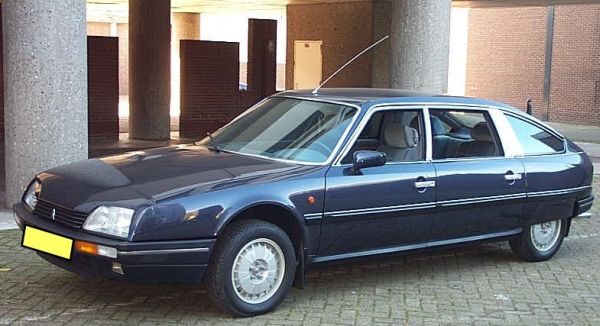
The Citroën CX was one of the most representative models of the brand in its entire history. We tell you everything you need to know about this classic, the last genuine Citroën before the arrival of Peugeot.
In this instalment of Classic Cars with History we travel back to 1974, when Citroën began selling the CX, the car that for some has been the last true Citroën, the last exponent of a standard of design and engineering that had always stood out, before the French brand became fully involved in what is now the PSA Group, alongside Peugeot.
The Citroën CX was designed by Robert Opron, a figure who won’t be very familiar to those of us outside the design world. Suffice it to say that Opron designed legendary models for Renault, such as the Fuego and the Renault 25, as well as the final design of the Alpine A310 and many others for Citroën, such as the GS. But alongside a design that was one of the most striking of those years, the CX incorporated the famous hydropneumatic suspension, which had been Citroën’s trademark since 1953.
The Citroën CX was conceived as the basis for three different body styles: a four-door fastback, the station wagon or break model, and a stretched saloon built on the estate’s chassis. Initially, Citroën planned to equip it with rotary engines, which were eventually abandoned for reasons of cost; consequently, the CX made use of the four-cylinder engines of the DS, of 2 and 2.2 litres, later moving to fuel-injected engines for the GTI model.
Although sales were good, the development of the CX lagged somewhat behind the trends of those years. Moreover, Peugeot was already pressing to formalise a union with Citroën, to which the brand of the chevrons could not resist for long. Thus, in 1976 it merged with Peugeot to form what we now know as the PSA Group. Some have claimed that the production and launch costs of the CX were the real culprits behind Citroën having to ally itself with Peugeot.
Returning to our CX and its variants, sales were going well despite the fact that it was not a cheap car; it cost more than 1 million pesetas in Spain at 1979 values. The years went by and the CX had to evolve. Therefore, in 1983 it received the turbo diesel engine that would turn the CX into the fastest diesel in Europe at the time: 195 km/h top speed, in markets where diesel was beginning to be seen as a more than interesting option. That same period also saw the launch of the GTI Turbo, with its 220 km/h, which now fully exploited the aerodynamic capabilities of the CX’s design.
The CX also had special models, such as ambulances and load-carrying variants fitted with a twin rear axle, used in some parts of Europe. It was used as a limousine by several heads of state, in the stretched version, thanks to its excellent ride quality.
In 1985 came what would be known as the CX Series 2, losing along the way some of the details that set it apart, such as the suspension, which now became firmer, and suffering the replacement of its metal bumpers with plastic ones. This series did not achieve much in terms of raising the CX’s sales figures, and Citroën was already beginning to glimpse the future model, the XM, which would no longer be a Citroën in the strict sense, but would be clearly influenced by the Peugeot 605.


 The seven finalists for the 2027 European Car of the Year (COTY) are exclusively electric
 Peugeot E-208 GTi: a battery-powered toy that revives the spirit of the 1980s sports cars
 New Lexus ES: luxury grows and goes electric
Deja un comentario