Comparison Omoda 5 SHS-H vs Hyundai Kona Hybrid: key differences between two ECO hybrid SUVs
 Óscar Sanz
31 January 2026
6 min.
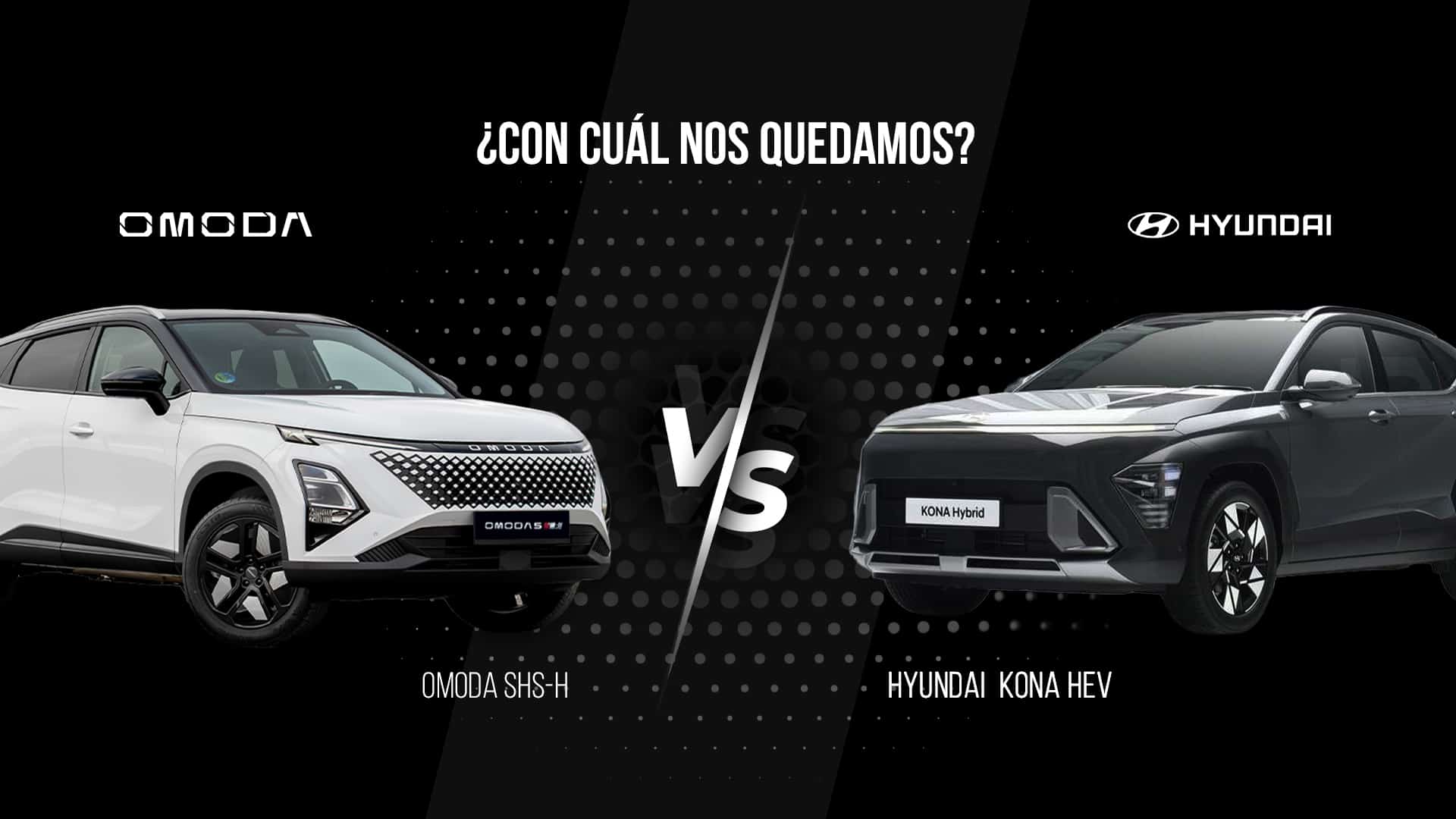
The segment of compact ECO-labelled hybrid SUVs has become one of the most competitive on the market. Very different models now compete for the same type of buyer: someone looking for efficiency, technology and a reasonable price without giving up comfortable everyday use.
In this comparison we pit the Omoda 5 SHS-H against the Hyundai Kona Hybrid, two non-plug-in hybrid SUVs that share the environmental label but take clearly different technical approaches and product concepts.
General approach and positioning
The Omoda 5 SHS-H is a compact hybrid SUV that relies on an advanced technical architecture and a very streamlined range. Its proposition focuses on offering more power, more technology and more standard equipment than its rivals in this category at a competitive price, making the purchase process as simple as possible.
The Hyundai Kona Hybrid, by contrast, represents a more conservative option. It is a non-plug-in hybrid SUV with a long commercial track record, focused on efficiency and everyday use, especially in the city, with a more graduated range and more modest power.
Exterior design and dimensions
In terms of design, the Omoda 5 SHS-H features a modern, distinctive look, with a frameless parametric grille, sharp LED lighting and a silhouette shaped with aerodynamic criteria. Its dimensions —4,447 mm long, 1,824 mm wide and 1,588 mm high, with a wheelbase of 2,610 mm— place it squarely in the C-SUV segment, offering a good balance between presence and agility.
The Hyundai Kona Hybrid takes a more compact and urban approach, with angular lines and a very personal aesthetic language. It is noticeably smaller: 4,350 mm in length, 1,825 mm in width and 1,580 mm in height, with a wheelbase of 2,660 mm. These dimensions make it especially manageable in the city, although they slightly penalize interior space compared with the Omoda.
Interior, technology and space
The interior of the Omoda 5 SHS-H stands out for its clearly tech-focused approach. The dashboard is dominated by a curved dual 12.3-inch + 12.3-inch screen, integrated into a single surface oriented towards the driver. The multimedia system, based on the Qualcomm 8155 processor, offers quick response and a smooth experience, with Apple CarPlay, Android Auto and 50 W wireless charging in the Premium trim.
In terms of space, the Omoda offers a cabin that is roomy for four adults and a boot of 372 litres, a figure that is adequate for its segment and sufficient for family use.
The Hyundai Kona Hybrid has a more functional and less eye-catching interior, though well executed. It features digital instrumentation and a central screen of 12.3 inches in the most recent versions, with a clear and easy-to-use interface. Its boot, with 466 litres, is one of its strong points compared with the Omoda, especially for those who prioritise load capacity.
Hybrid system and performance
This is where one of the main differences between the two models lies.
The Omoda 5 SHS-H uses the Super Hybrid System (SHS-H), which combines a 1.5 turbo petrol engine, two electric motors, a dedicated hybrid transmission and a 1.83 kWh LFP battery. Combined power reaches 224 CV, with acceleration from 0 to 100 km/h in 7.9 seconds and a homologated consumption of 5.3 l/100 km (WLTP).
The Hyundai Kona Hybrid uses a more traditional hybrid system, made up of a 1.6 naturally aspirated petrol engine and an electric motor, with a total power of 141 CV. Its homologated consumption sits at around 4.7–4.9 l/100 km, standing out especially in urban driving, although with clearly more modest performance.
Everyday use and driving experience
In everyday use, the Hyundai Kona Hybrid stands out for its smoothness and ease of driving in the city. The hybrid system prioritises efficiency, with very smooth transitions between combustion and electric power and a response designed for relaxed driving.
The Omoda 5 SHS-H, without giving up comfort, offers a more dynamic experience. Its higher power and greater role for the electric system translate into a more immediate throttle response and more confident driving on country roads and motorways, while maintaining a good level of acoustic insulation.
Price and equipment
The Omoda 5 SHS-H starts at around 24,000 euros, with a very simplified range of two trims and high standard equipment from the entry version. This reduces the need for extras and makes it easy to know the final price from the outset.
The Hyundai Kona Hybrid has a starting price close to 29,000 euros, with a more graduated range. Although the equipment is adequate, some technology and comfort elements depend on the chosen trim level, which can raise the final cost.
Quick comparison table
| Feature | Omoda 5 SHS-H | Hyundai Kona Hybrid |
| Type | SUV hybrid HEV | SUV hybrid HEV |
| Power | 224 CV | 141 CV |
| Combustion engine | 1.5 turbo | 1.6 naturally aspirated |
| WLTP consumption | 5.3 l/100 km | 4.7–4.9 l/100 km |
| Boot | 372 l | 466 l |
| Screens | 12.3” + 12.3” | Up to 12.3” |
| Price from | ~24,000 € | ~29,000 € |
| Label | ECO | ECO |
Conclusion: which is the better buy?
The Hyundai Kona Hybrid is a very balanced option for those who prioritise urban efficiency, compact size and ease of driving in town, with very tight consumption and proven reliability.
The Omoda 5 SHS-H, however, stands out as a more complete alternative for those seeking more power, more technology and a better price-to-equipment ratio, while keeping the ECO label and a simple range that avoids unexpected extra costs.
In terms of performance, technological level and overall approach, the Omoda 5 SHS-H emerges as the more interesting choice for those looking for a compact hybrid SUV with a more advanced approach and greater value for money.
Frequently asked questions: Omoda 5 SHS-H vs Hyundai Kona Hybrid
What type of hybrid is the Omoda 5 SHS-H?
It is a non-plug-in hybrid SUV (HEV) with ECO label and the Super Hybrid System.
What type of hybrid is the Hyundai Kona Hybrid?
It is a non-plug-in hybrid SUV (HEV) with a conventional hybrid system from Hyundai.
Which one has more power?
The Omoda 5 SHS-H, with 224 CV, compared with the 141 CV of the Kona Hybrid.
Which one consumes less?
The Hyundai Kona Hybrid has a lower homologated consumption, especially in the city.
Which one is cheaper?
The Omoda 5 SHS-H starts at a noticeably lower price.
Which one has more standard technology?
The Omoda 5 SHS-H stands out for a more streamlined range and more complete equipment from the outset.
Quick summary
- Omoda 5 SHS-H: compact ECO hybrid SUV with 224 CV, advanced technological approach, 12.3” dual screen, competitive price and high standard equipment.
Hyundai Kona Hybrid: compact ECO hybrid SUV with 141 CV, low consumption, more urban size and a more graduated range


 Kia offers an electric range of 10 models, 50 versions and 400 possible combinations
 The seven finalists for the 2027 European Car of the Year (COTY) are exclusively electric
 Peugeot E-208 GTi: a battery-powered toy that revives the spirit of the 1980s sports cars
Deja un comentario