Daimler and Bosch reach an agreement to accelerate autonomous driving
 Guillermo Lopez
11 July 2018
4 min.
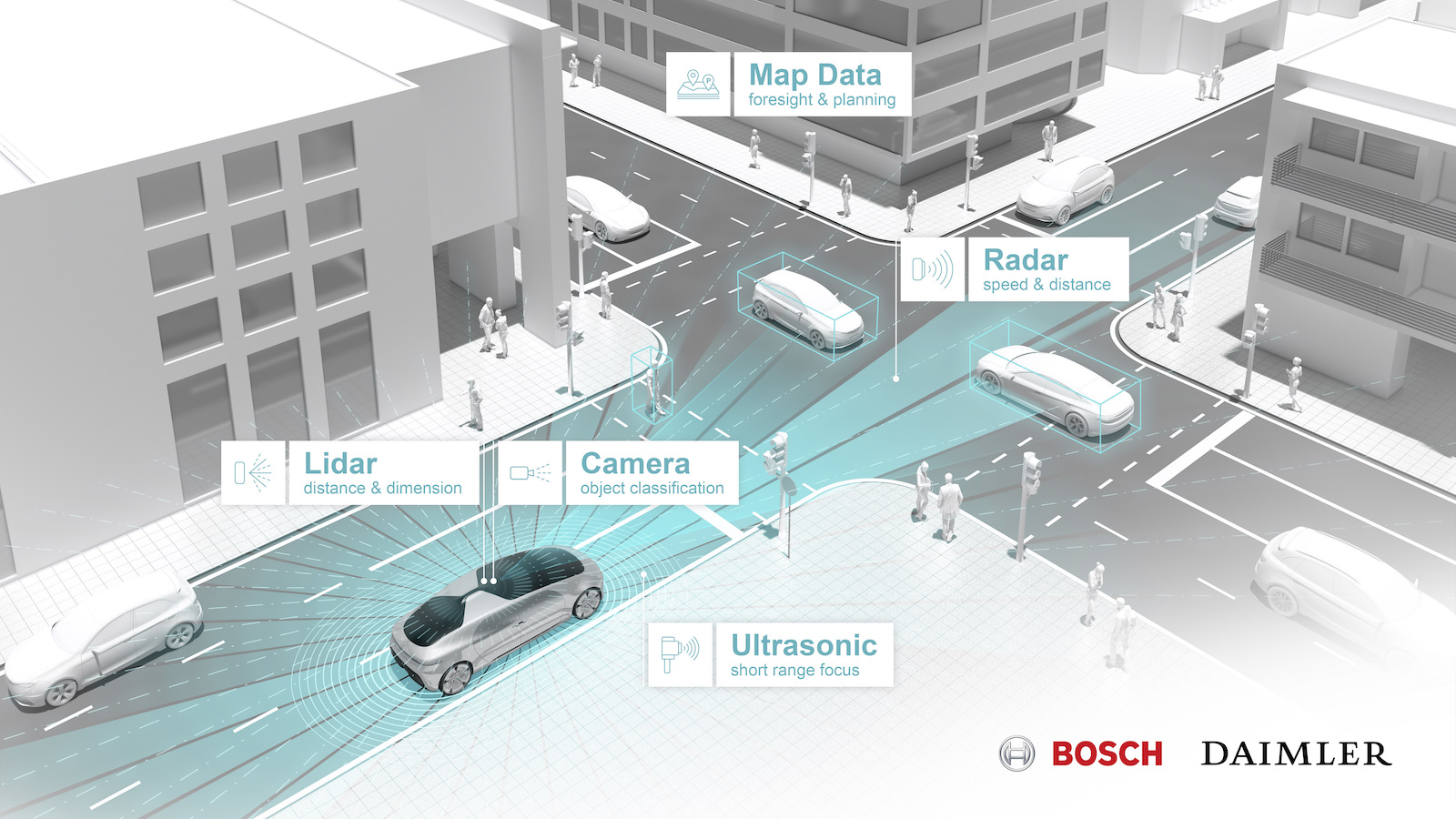
The Daimler and Bosch groups have reached an agreement to accelerate the deployment of fully automated driving without a driver in cities.
Daimler and Bosch will create a pilot fleet of fully autonomous vehicles in California (USA) to carry out tests that verify their correct operation. The goal of both groups is to offer on the market, by mid-2019, a transport service with fully autonomous vehicles on specially selected routes within a city in California.
The idea is to demonstrate how mobility services can be intelligently connected to shape the future of urban mobility. The services of the car-sharing platforms of Car2Go, the ride-hailing of MyTaxi and the multimodal platforms such as moovel can collaborate and connect intelligently to shape the future of mobility systems in large cities.
The reliable recognition of everything happening around the vehicle through the various sensors and systems on board is a decisive factor for the development of fully autonomous, driverless driving in urban areas. Analysing and interpreting quickly the huge variety of incoming data and translating it just as quickly into accurate instructions (commands) for driving the vehicle requires enormous computing capacity. To achieve this, Daimler and Bosch have chosen the American company Nvidia as the main technology supplier for the control units of the new artificial intelligence platform.
Nvidia must develop a redundant and versatile system architecture with the highest level of functional safety, allowing the safety levels necessary to guarantee the total reliability of autonomous driving to be reached. To this end, all the necessary computing operations must be carried out in parallel through different circuits in order to guarantee that the system has an instantaneous resource running in parallel with the computing results when needed. In short, the autonomous car will be a supercomputer on the move.
The system devised by Daimler and Bosch consists of creating a network of control units, itself composed of several individual control units. Nvidia will supply the technology platform that allows the various artificial intelligence (AI) algorithms generated by Bosch and Daimler to be run in order to execute the vehicle’s movements with absolute precision. This network control unit must collect all the data from the sensors on board the vehicle (radar, video cameras, LIDAR, infrared, ultrasound, …), fuse and evaluate them in milliseconds, with sufficient advance notice to plan the vehicle’s precise driving movements. This means the control platform must have enough computing capacity to process hundreds of billions of data points and operations per second.
Bosch and Daimler want to have this control unit network available as soon as possible in order to fit it into the fleet of autonomous vehicles they will put on the roads of California during the second half of 2019, to form the automated transport service they plan to establish on a series of predefined and selected routes within a city in Silicon Valley. The basic idea of the service they intend to create is for the vehicle to come to the driver, rather than the driver, as is the case until now, having to go to the vehicle. Users will be able to conveniently order from their mobile devices a driverless autonomous vehicle to come and pick them up, either in a shared ride, using vehicles circulating nearby, or on an individual basis.
The Bosch and Daimler project aims to improve traffic flows in large cities, road safety, and to establish the foundations for how traffic will work in the future by integrating autonomous vehicles into a single multimodal transport network (carsharing, ride-hailing, shared cars, etc.), thereby encouraging the shared use of vehicles and opening their use to people without a driving licence.
The California experience could also be carried out in Beijing, since the Daimler Group has been the first to receive permission from the Chinese authorities to test the operation of autonomous vehicles in Beijing. Daimler’s chairman, Dieter Zetsche, recently highlighted in Hong Kong, on the occasion of the RISE technology conference, the German group’s satisfaction with this news: “It is not one of the easiest challenges, but it is a good test for us. We are pleased because China is our largest market, so when we seek to develop autonomous driving we must therefore make sure it also works in China. This test will therefore be extremely valuable for us.” Daimler already holds similar test permits for the development of its automated autonomous vehicles in the Sunnyvale region (California, USA) and in Sindelfingen (Germany), since 2014 and 2016 respectively.


 The seven finalists for the 2027 European Car of the Year (COTY) are exclusively electric
 Peugeot E-208 GTi: a battery-powered toy that revives the spirit of the 1980s sports cars
 New Lexus ES: luxury grows and goes electric
Deja un comentario