How a variable geometry turbocharger works: advantages, failures and maintenance
 Antonio Roncero @roncero_antonio
9 February 2022
5 min.
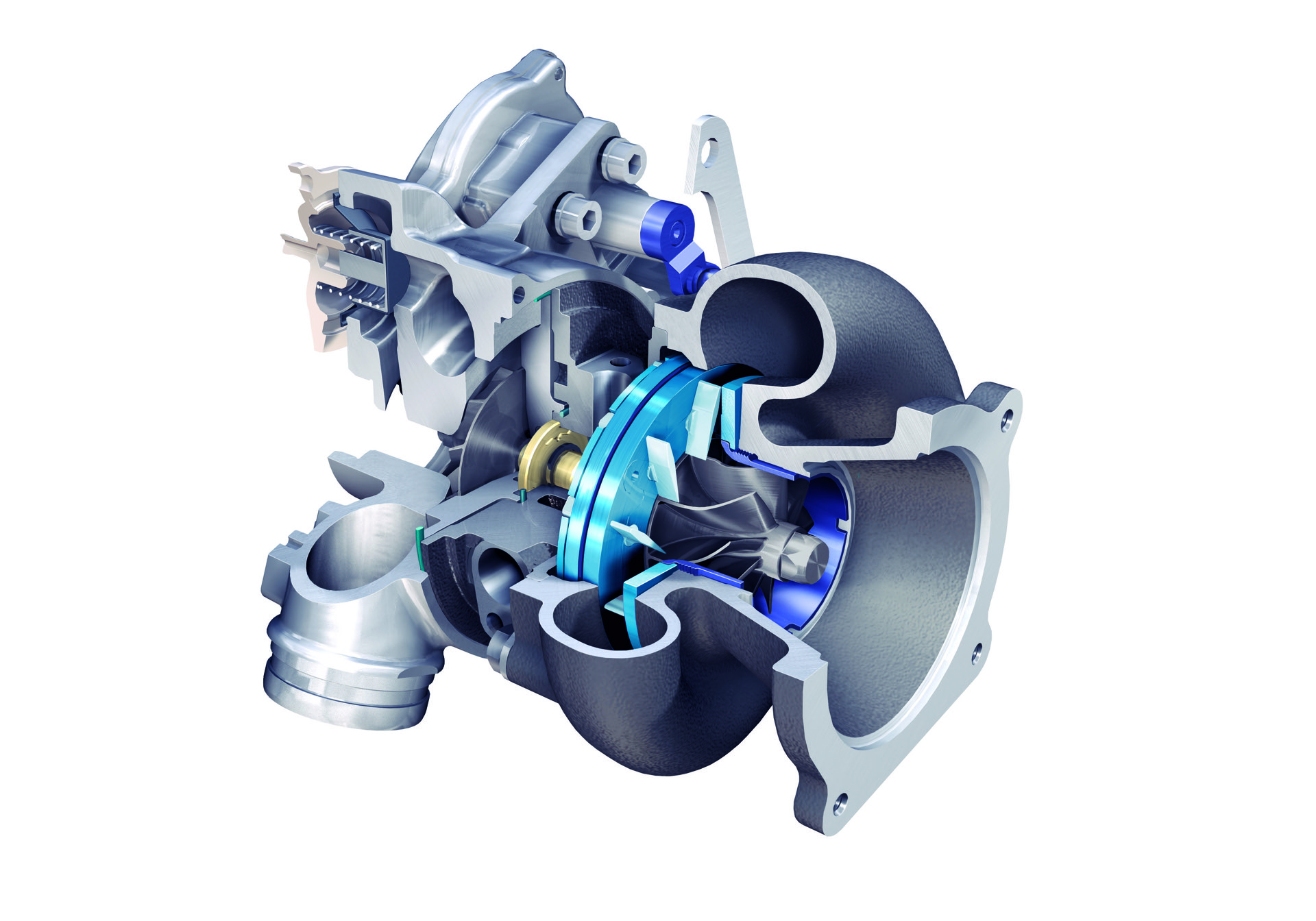
Variable geometry turbochargers improve the response of turbocharged engines from low revs, which benefits both performance and fuel consumption.
Among the various forced induction systems in an engine, there are fixed geometry or variable geometry turbochargers, known as VGT. In both cases the goal is the same: to harness the inertia of the exhaust gases to force more air into the cylinders than the engine can draw in on its own, thereby increasing efficiency.
However, one of the main drawbacks of engines supercharged with conventional turbos is that when the engine runs at low revs, the exhaust gases lack enough force to spin the turbine that compresses the intake air. Conversely, with the engine running at high speeds the flow of exhaust gases is so large and drives the turbine with so much energy that it becomes necessary to activate a wastegate, wasting part of the energy carried by the exhaust gases.
This is the problem that variable geometry turbochargers solve, which, as we will see, have a greater capacity to compress the intake air efficiently at both low and high revs.
The first developments of variable geometry turbochargers date from the mid-1950s, although the first mass-production vehicle to incorporate one was the Fiat Croma turbodiesel in the early 1990s, with its 1.9 engine, which was also one of the first diesels to feature direct injection. Today, solutions have also been developed that use small electric motors directly to spin the turbine. Another type of turbocharger used to improve the response of supercharged engines at low revs is the Twin-Scroll turbo.
How does a variable geometry turbo work?
The difference between a fixed turbocharger and a variable VGT is that the latter has a mechanism that varies the speed at which the exhaust gases hit the turbine, so that it accelerates more quickly. They do not change the amount of air, but rather its inlet cross-section.
To do this, they have a system of variable vanes or blades that close when the engine runs at low revs, accelerating the exhaust gases, which increase their thrust on the turbine. When the engine works at high revs the blades open, enlarging the inlet cross-section for the exhaust gases, so the speed is reduced. This allows the maximum boost pressure to be reached at higher engine speeds.
The blades can be adjusted by a mechanical system using a pressure or vacuum actuator, although the norm in more modern engines is to use a small electric motor operated by the engine’s electronic control unit (ECU).
You can see in more detail how a variable geometry turbocharger works in this video:
https://www.youtube.com/watch?v=AuQor-YnbZ8
What advantages does a variable geometry turbo offer?
Knowing the operating principle of a variable geometry turbocharger, its advantages are clear:
- They reduce or eliminate the “turbo-lag” or response delay characteristic of turbocharged engines when accelerating from low revs.
- They optimise the operation of the boost system at all engine speeds, allowing a flatter torque curve.
- By controlling boost pressure through the movable vanes, a waste gate or “wastegate” valve is not necessary.
- It is a simpler solution than a twin sequential turbo. Even so, there are high-performance engines with more than one turbocharger in which at least one is variable geometry.
- By optimising torque delivery, they improve performance and therefore also fuel consumption and emissions
What disadvantages does a variable turbo have?
Being a more complex mechanism with a greater number of moving parts, variable geometry turbochargers are more expensive than conventional ones. For the same reason, they are also more prone to failure.
Another disadvantage is the complexity involved in using them on petrol engines, where the higher exhaust gas temperatures require more sophisticated and more expensive developments.
Porsche was one of the first brands to use a variable geometry turbocharger in a petrol engine, although today they can also be found in small engines as a solution to improve efficiency rather than to achieve high performance. A recent example is the 1.5 hybrid engine in the new Alfa Romeo Tonale.
Maintenance, care and failures of variable geometry turbos
With a greater number of moving parts, which are also exposed to high temperatures and the passage of exhaust gases, variable geometry turbochargers present more problems than fixed geometry turbos.
The most common failure is for the variable vane system to seize. The problem in this case is that the variable turbo does not switch to working like a fixed geometry one; the blocked vanes mean the engine only runs properly within a certain range of revs. Symptoms include a clear loss of performance, with a consequent increase in consumption. In these cases it is also common to notice jerks in power delivery, or dead zones where the engine seems not to push.
As with mass airflow sensors, EGR valves and particulate filters, one of the main causes of a variable geometry turbo seizing up is driving mainly in town, or with the engine always at very low revs, which is when combustion produces the most soot.
The best way to avoid failures in a variable geometry turbocharger is, therefore, not to limit driving to urban routes, getting out onto the open road from time to time and running the engine at medium or high revs as well. Of course, it is also essential to use an appropriate engine oil and to respect the maintenance intervals.


 Peugeot E-208 GTi: a battery-powered toy that revives the spirit of the 1980s sports cars
 New Lexus ES: luxury grows and goes electric
 First contact with the Dacia Sandero Hybrid 155: power and efficiency from €19,890
Deja un comentario