How does a petrol engine work?
 Chema
30 October 2012
4 min.
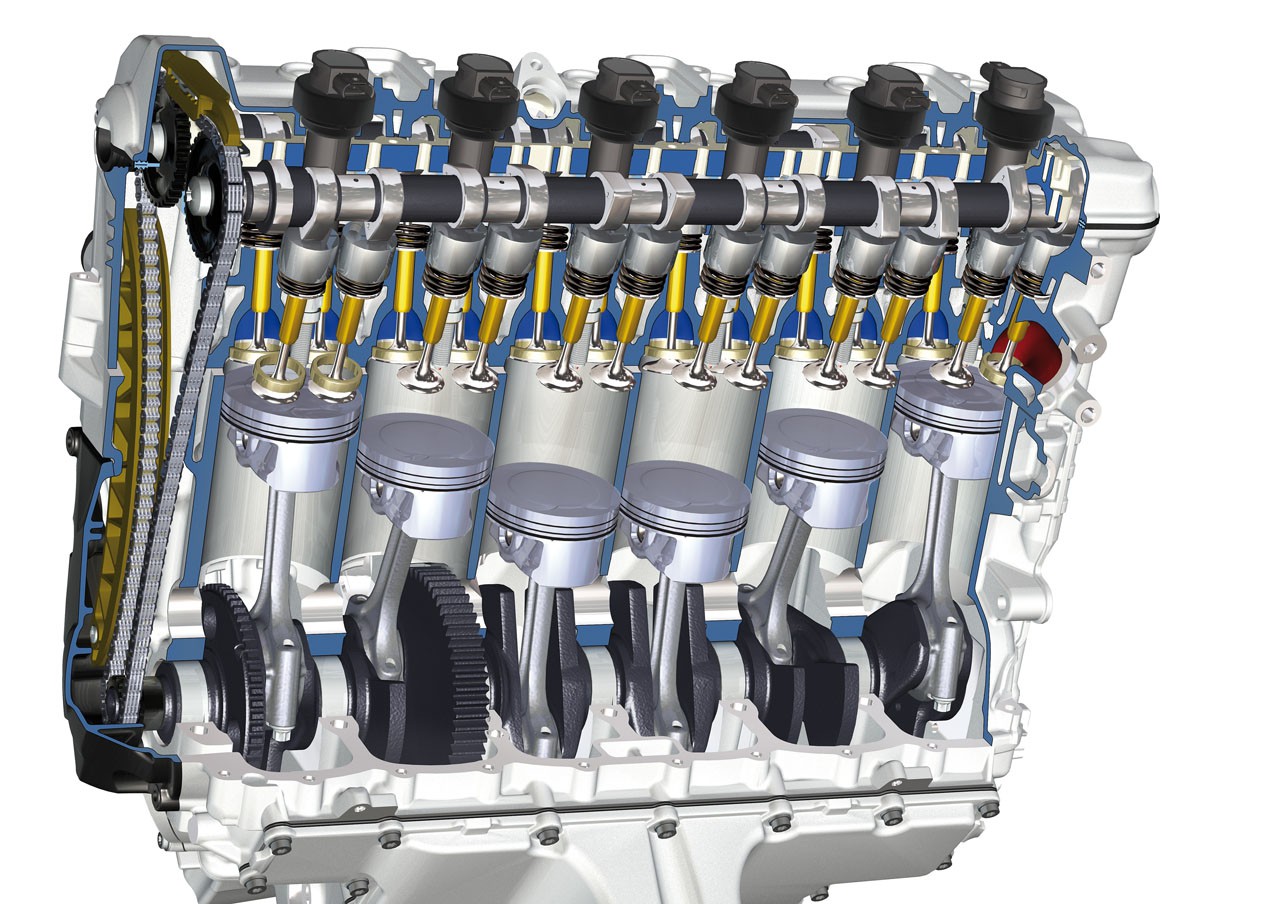
We explain how a naturally aspirated petrol engine works. The four stages of its operation are: intake, compression, combustion and exhaust.
Most of you who read us daily, or not so often, are probably enthusiasts and lovers of cars, and possibly of everything that has wheels and moves thanks to the power of an engine, especially a petrol one, I’m sure.
Today I would like to set aside the usual news we normally talk about here at Highmotor, to offer a gentle, brief introduction, without going deep into more specific topics, to something we all enjoy: the basic operation of a petrol engine. After reading the following paragraphs you will surely be able to better understand the engines we love so much.
To begin, we will take as our basis a naturally aspirated four-stroke petrol engine working on the Otto cycle. Put simply, a petrol-fuelled internal combustion engine uses the explosion of fuel and air, ignited by a spark, to expand the gas and push the piston up and down, creating a movement that eventually reaches the wheels and makes them turn.
That could be said to be a good summary of what follows. Petrol engines come in two types, two-stroke and four-stroke. The former were fitted in the past and today are only used by field motorbikes or 50 cm³ mopeds. The latter are what power all the petrol engines in today’s cars and, as its name indicates, works in four strokes: intake, compression, combustion and exhaust.
Let’s go step by step, because although it is simple, it must be understood well so that later on you can understand how to properly prepare an engine, and so on.
Intake: Air from the atmosphere, hence the word “naturally aspirated”, enters through the throttle butterfly and, via the intake manifold, is directed to the cylinder head, where it will later reach the combustion chamber mixed with petrol, while the piston is at its highest point. The fuel reaches this part of the cylinder thanks to the injectors.
Compression: Once the petrol mixed with air reaches the cylinder, the piston starts moving down to its lowest point while the intake valves close. With the force from the piston’s downward stroke it rises again, compressing the mixture, raising the temperature inside the block and potentially causing an uncontrolled explosion, with the long-term consequences that this would have (detonation).
Combustion: Once the piston is at the top, the valves are closed and the mixture is compressed as much as possible, the spark plug, which is nothing more than a resistor that switches on and off when the engine control unit decides, ignites the petrol and air, forcing the piston down with great force after the explosion to its lowest point again. This force, torque, is what we later use to measure the engine’s performance.
Before moving on to the last stroke, I would like to make clear that what actually causes the explosion is not the petrol but the oxygen found inside the combustion chamber. The droplet of petrol that reaches the cylinder only makes the oxygen able to combust. That is why we speak of a lean or rich mixture. The mixture is lean when there is a high concentration of air and little petrol, and rich in the opposite case. The first case makes the car go much faster but in exchange causes the engine temperature to rise, so we could say that the amount of petrol we inject into the cylinder is measured to control the temperature inside it.
Exhaust: The last stroke occurs once the explosion has taken place and the piston has moved down for the second time. At that moment the camshaft begins to open the exhaust valves so that the gases produced by that explosion can leave through the exhaust manifold and later through the exhaust pipe.
The movement of the piston is turned into the movement of the wheels by means of the crankshaft, to which the connecting rod is attached, and the connecting rod in turn is attached to the piston. In short, this is how a conventional naturally aspirated four-stroke petrol engine works. Later we will look at how to increase power, the different modifications that can be made to the engine, and forced induction.


 Peugeot E-208 GTi: a battery-powered toy that revives the spirit of the 1980s sports cars
 New Lexus ES: luxury grows and goes electric
 First contact with the Dacia Sandero Hybrid 155: power and efficiency from €19,890
5 comentarios
Deja un comentario
Genial, espero con ganas mas artículos como este
Muchas gracias. En breves prepararemos nuevos artículos similares.
gracias me sirvio mucho
gracias me servirá mucho en mi investigacion documental!!!
gracias miy informativo