How has the evolution of racing steering wheels been? Porsche shows us
 Redacción
11 April 2020
5 min.
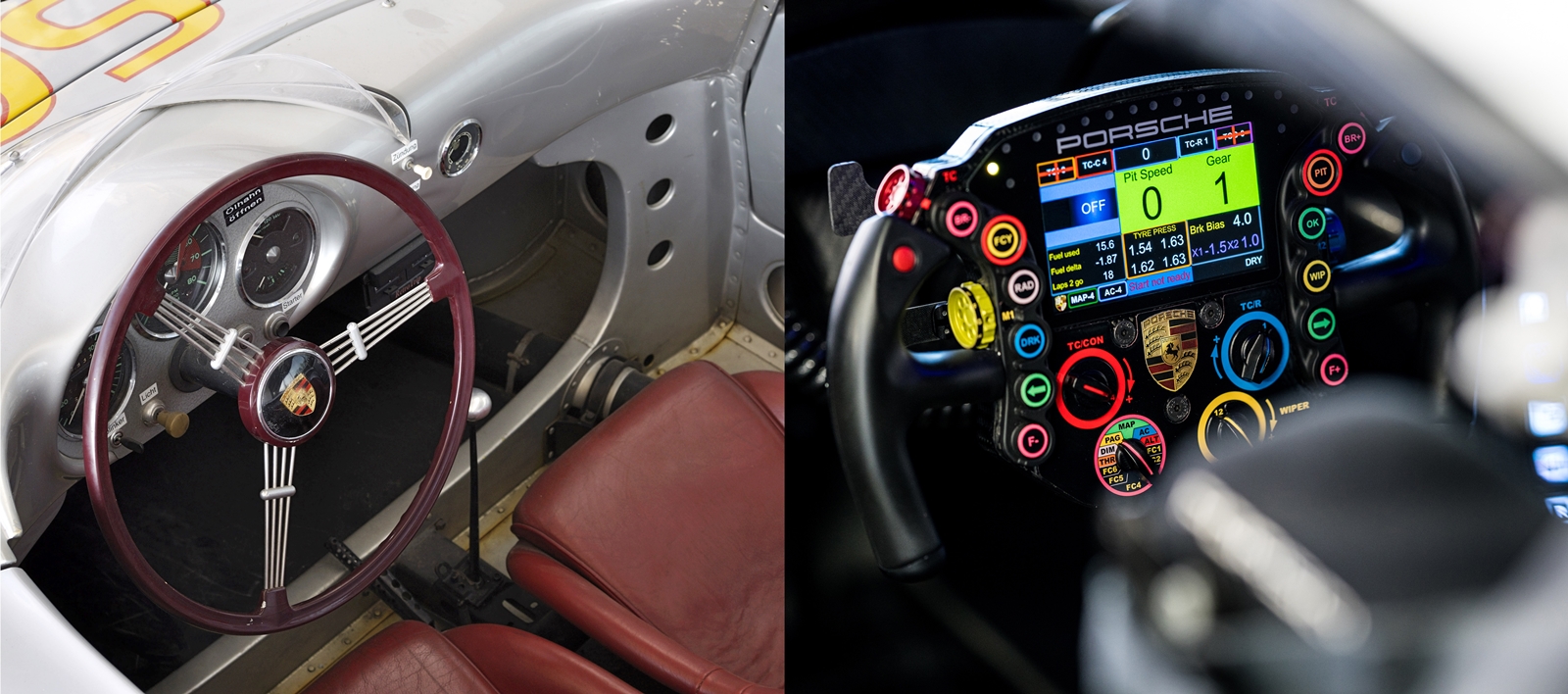
The evolution in the world of motorsport has been dramatic, and one of the elements that has changed the most is the steering wheel, so Porsche shows us its trajectory
The world of motorsport is very important in every respect, because the demanding setting of a circuit race is perfect for testing the latest technologies for road cars in the most extreme way.
Porsche has had this lesson learned for many years, so Ferdinand Porsche himself was already referring to this more than 60 years ago: “The extreme demands we face on the track very quickly highlight weak points and encourage engineers to seek new and better solutions.”
For this reason, the people from Stuttgart have used championships and circuits as a testing laboratory throughout their history. When we told you about the history of the Turbo at Porsche, we already saw that competition had a great influence on its development.
One of the most important elements in any vehicle is the steering wheel, an element that is even more important in racing cars. In just a few years, they have gone from being mere instruments for steering the car to also becoming control centres for handling a large number of parameters.
Of course, the materials they are made from have also changed, so they have gone from the round wooden wheel to one with a steel base and a shape closer to that of a modern Formula 1 car.
The first buttons began to be installed only 20 years ago
The Porsche 917, one of the brand’s most legendary racing cars, had a austere three-spoke metal steering wheel covered in turned leather. There is no need to go back to the 70s to find spokes without buttons, as these small selectors only began to be integrated at the start of this century.
Pascal Zurlinder, Competition Director at Porsche, says: “It is hard to believe that developments in this direction did not really begin until the year 2000. Since then, the enormous progress made in steering wheels is evident.”
Of course, the people who can best speak about this evolution are the drivers, so Timo Bernhard, one of the most decorated in endurance championships and a Porsche driver, said the following: “In 1999 I took part in the Carrera Cup as a junior driver for Porsche. At that time, the steering wheel had no buttons, no radio, no gearshift paddles, and no speed limiter. We had to drive through the pit lane with one eye on the speedometer.”
The 2001 edition of the Porsche Cup was the first to incorporate modern steering wheels
It was not until 2001 that the Porsche Cup cars incorporated the first button: the one for the radio. They remained like this until 2004, when the Porsche 911 GT3 RSR cars taking part in the American Le Mans Series increased this number to six buttons. At that time, these switches were installed on simple racing steering wheels, so much so that they could be bought at any specialist shop.
As with everything, over time this trend has evolved at a rapid pace. As technology advanced in racing vehicles, steering wheels gradually incorporated controls.
In addition, the design of these wheels began to play a truly important role, because drivers must be able to operate them intuitively and without having to take their eyes off the track. Porsche has for years sought to follow one same pattern, so that drivers who move from one model to another can quickly adapt to their steering wheel.
What are the most important steering wheel buttons?
When it comes to developing steering wheels, it is important to bear in mind that the four controls used most often must always be in a comfortable position for the driver. These are the buttons for the pit lane limiter, for yellow flag situations, and the on/off switches for the engine and the radio.
In addition, modern steering wheels are easily removable so that the driver can get in and out of the cockpit without great effort. This is made possible by the CAN bus, an interface that allows the entire flow of data handled by the steering wheel to be transmitted in both directions through a single cable.
As well as advanced, steering wheels must be simple
Romain Dumas, the brand’s official driver, bitterly suffered from the development of button placement: “I learned the hard way how important it is to have the right design and optimal ease of use under race conditions. I was driving a Porsche 911 GT3 R at Pikes Peak and was on my way to winning when rain appeared, followed by snow at the highest altitudes. That is where I lost everything.”
“Why? A windscreen wiper button was fitted to the steering wheel, which you had to press for one second to activate the intermittent function and for three seconds to make the sweep continuous. The layout was too complicated, and at Pikes Peak you face one bend after another. By the time the wipers were working correctly, I had already lost a lot of time.”
To prevent situations like this from happening again, the drivers are fully involved in the design and in writing the instruction manual. Just to give one example, the manual for the Porsche 911 RSR currently racing has no fewer than 27 pages, and the one for the Porsche 99X Electric competing in Formula E offers even more functions. Despite this, the brand’s engineers have managed to find a layout that is simple for both official drivers and the brand’s customer/privateer racers.


 Peugeot E-208 GTi: a battery-powered toy that revives the spirit of the 1980s sports cars
 New Lexus ES: luxury grows and goes electric
 First contact with the Dacia Sandero Hybrid 155: power and efficiency from €19,890
Comentarios cerrados