Hyundai Bayon hybrid vs MG ZS EV: Comparison between urban hybrid and electric SUV
 Iván Navarro
31 March 2026
10 min.
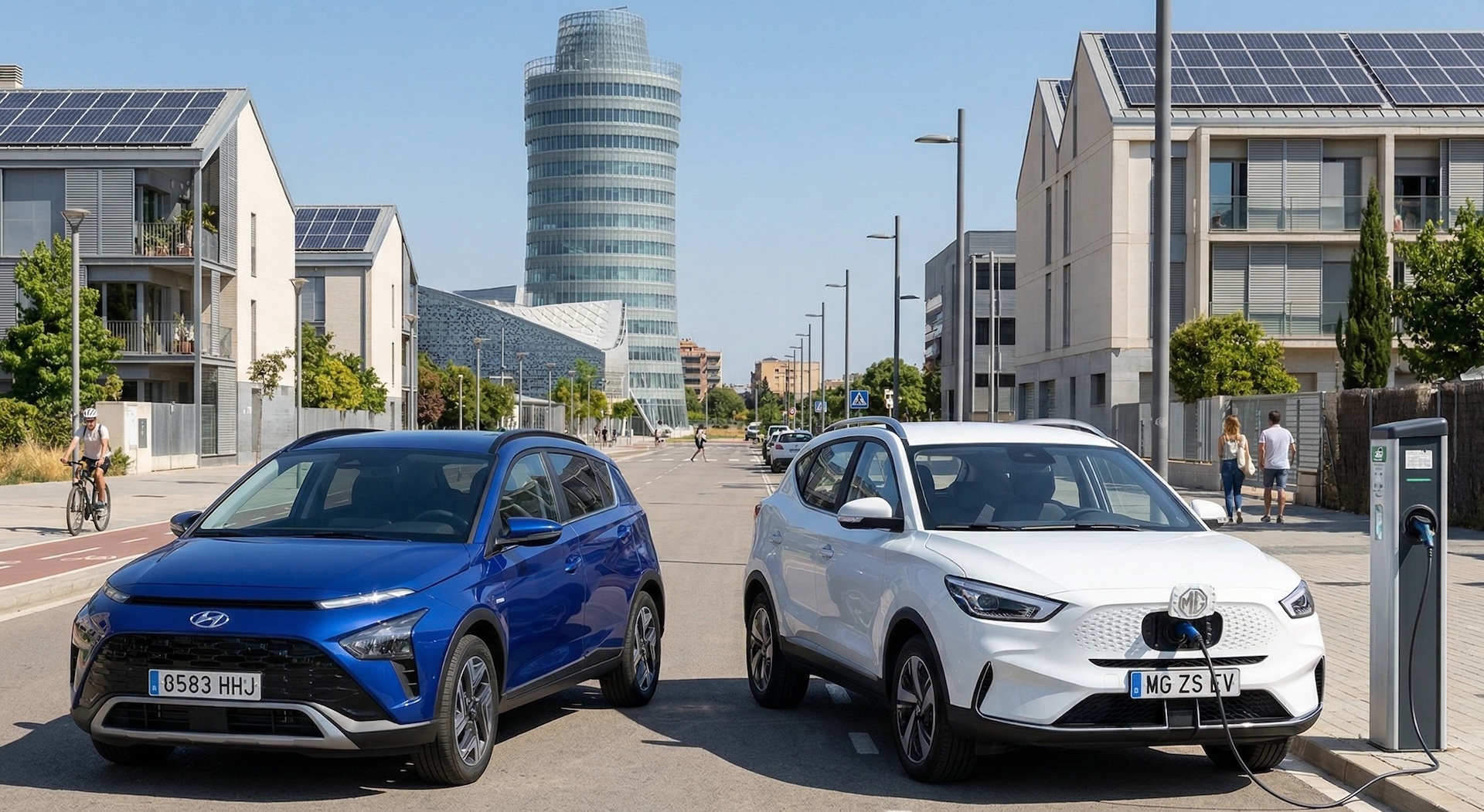
The urban hybrid versus the affordable electric. Traditional efficiency or zero emissions with style? Head-to-head between two smart compact SUVs.
The comparison between the Hyundai Bayon hybrid vs MG ZS EV pits two different approaches to urban mobility against each other: a B-SUV with a 48 V mild-hybrid system that reduces consumption and emissions in everyday use, versus a 100% electric SUV that eliminates fuel and relies on its WLTP range for daily usefulness. This face-off is not only technical: it defines running costs, energy replenishment, limitations on long trips and compatibility with the city’s charging infrastructure.
The urban SUV segment remains one of the most sought-after in Spain, where compact and urban SUVs account for a substantial share of new registrations. Buyers in this niche look for interior space, real-world economy in the city, ease of parking and reasonable equipment below the mid-range price bracket. Compared with other technologies, hybrids like the Bayon offer efficiency with existing infrastructure, while electrics like the ZS EV promise a lower cost per kilometre and quiet running, but are conditioned by the charging and fast charging available.
On average price, an urban hybrid sits below 100% electric alternatives of the same size, although running costs favour electrics in intensive use. But not all arguments weigh the same: the availability of charging points, mostly urban use or the need for frequent long journeys determine the final decision. This practical comparison analyses performance, consumption, equipment and price in Spain to guide the real buyer.
The most balanced models in the segment in 2026
To decide between the Hyundai Bayon hybrid vs MG ZS EV we have prioritised balance between price, efficiency in real use, sufficient performance and equipment value. The Bayon stands out for its urban suitability and lower purchase cost; the ZS EV offers silence, instant response and a driving experience with no local emissions. The evaluation also considered reliability, practical space and how easy it is to find charging or refuelling.
Hyundai Bayon
The Hyundai Bayon in its mild-hybrid (48 V) version is a proposal aimed at the urban buyer who wants to reduce consumption without giving up mechanical simplicity and a moderate price. It stands out for a generous boot for its class, a high driving position and a set-up geared towards comfort. The recommended version to balance consumption and performance is the one fitted with the 1.0 T-GDi engine with 48 V assistance and 100 hp, which reduces urban consumption compared with the naturally aspirated alternative and keeps maintenance costs similar to a conventional combustion engine.
In real use the Bayon is efficient in town, where the mild-hybrid system allows smoother energy recovery and stop-start management; on the motorway its limitations appear on long trips at sustained speeds, where the absence of fuller electrification is a disadvantage compared with full hybrid alternatives. In equipment it offers safety systems and driver assistance that are competitive for its class, and a cabin with materials that are decent for its price.
Pros
• Moderate consumption in urban settings and moderate purchase cost.
• Generous boot for the segment (approx. 411 litres according to the manufacturer’s data sheet).
• Agile handling and high visibility in town.
Cons
• Limitations on long journeys at high speed.
• It is not a full self-charging hybrid; energy recovery is limited to the 48 V system.
Which urban hybrid SUV offers the best spending-to-use ratio in the city?
The Hyundai Bayon stands out for its moderate consumption in the urban cycle and for a reasonable purchase cost, which makes it a very practical option for drivers who prioritise short daily journeys and low upfront outlay.
| Feature | Data | Score |
|---|---|---|
| Power | 100 hp | 8.0 |
| Range | Depends on tank (efficient mixed use) | 7.5 |
| Top speed | ≈ 180 km/h | 7.0 |
| Boot | 411 litres | 8.5 |
| Price from | ≈ €19,000 (Spain, base version) | 8.2 |
score out of 10 based on the criteria analysed in this article
MG ZS EV
The MG ZS EV is the most affordable electric offer in the urban SUV format. With a technical proposal geared to practicality —a battery sized for daily journeys and a motor with enough punch for everyday use— the ZS EV targets the driver who wants to forget about fuel and cut local emissions. The version common in Europe has a battery that offers an indicative range, and a competitive assistance and connectivity package for its price bracket.
On a day-to-day basis the ZS EV shines with its instant torque, comfortable ride and a boot that in practice rivals the Bayon’s. Its limitations lie in its dependence on the charging network: charging times and access to fast chargers condition the experience on frequent trips outside the city. According to the manufacturer’s data sheet, the WLTP range sits at a level sufficient for most urban users, and the cost per kilometre is usually lower than any combustion car under intensive use.
Pros
• Quiet driving and instant response.
• Reduced cost per kilometre in urban use.
• Competitive boot and passenger space.
Cons
• Dependence on charging infrastructure and charging times.
• Purchase price higher than equivalent combustion models.
Which electric SUV is most worth it for urban use?
The MG ZS EV positions itself as a solid entry option thanks to its price-to-range ratio in an urban context, especially for users who have easy access to charging at home or at work.
| Feature | Data | Score |
|---|---|---|
| Power | ≈ 156 hp | 8.5 |
| Range | ≈ 320 km WLTP (depending on version) | 7.8 |
| Top speed | ≈ 140 km/h | 6.8 |
| Boot | ≈ 448 litres | 8.3 |
| Price from | ≈ €36,000 (Spain, base electric version) | 7.0 |
score out of 10 based on the criteria analysed in this article
Technical comparison
In a direct comparison between the Hyundai Bayon hybrid vs MG ZS EV clear differences emerge: operating efficiency versus range and energy freedom. The Bayon offers a lower entry cost and familiar operation at any petrol station; the ZS EV reduces cost per kilometre and local emissions, but requires planning for charging. In terms of comfort and response, the ZS EV has the edge in town; in flexibility of use and total range, the Bayon can be more versatile if you make frequent long journeys.
| Model | Power | Range | Price | Score |
|---|---|---|---|---|
| Hyundai Bayon (mild-hybrid) | 100 hp | — (depends on tank) | ≈ €19,000 | 8.2 |
| MG ZS EV | ≈ 156 hp | ≈ 320 km WLTP | ≈ €36,000 | 7.9 |
score out of 10 based on the criteria analysed in this article
Which car to buy according to your profile
If you do a lot of city driving
Prioritise the MG ZS EV if you have easy access to charging: its quietness, low local pollution and cost per kilometre are clear advantages in urban settings. But if you have no regular charging, the Bayon avoids dependencies.
If you travel frequently
Choose the Hyundai Bayon for its greater total range without planning stops and for the quick refuelling on long journeys between cities.
If you are looking for the best price
The Bayon offers the most affordable entry into the segment and a lower purchase cost, making it the right choice for tight budgets.
If you prioritise technology
The ZS EV offers the technology experience associated with electrification (instant driving, energy management and software updates in some grades), which makes it more interesting for those who value on-board innovation.
Frequently asked questions
Which uses less in urban driving, the Bayon hybrid or the MG ZS EV?
In direct energy consumption the MG ZS EV is cheaper per kilometre in urban use if you have access to cheap charging; the Bayon reduces consumption compared with a standard combustion engine but still depends on fuel prices.
Which has the bigger boot for family luggage?
Both offer competitive boots; the Bayon declares around 411 litres and the ZS EV approximately 448 litres according to the manufacturers’ data sheets, which gives the electric a practical advantage in loading volume.
Is the ZS EV expensive to maintain compared with the Bayon?
Maintaining an electric car is usually simpler (fewer moving parts), and the cost per kilometre can be lower, although battery replacement (in the long term) or high-cost interventions are considerations different from those of a combustion engine.
Do I need to install a charging point at home for the ZS EV?
It is not mandatory, but it is highly recommended to ensure comfort in daily use and reduce the time spent searching for public chargers; the experience improves noticeably with home charging.
Which offers better standard safety equipment?
Both models include modern safety aids in their intermediate trim levels; the choice will depend on the trim and packs selected, since advanced systems may be tied to specific levels.
Expert opinion
Beyond the official figures, the choice between the Hyundai Bayon hybrid and the MG ZS EV comes down to two practical questions: what your routine of use is and what charging resources you have. If your day-to-day is limited to urban journeys and you have a charging point at home or work, the ZS EV offers a more refined driving experience and a lower cost per kilometre, as well as the advantage of running with no local emissions. For users who make frequent intercity trips or who value the simplicity of refuelling at any point, the Bayon with its 48 V system is an efficient and economical solution to buy. In terms of interior space and boot, both meet expectations for the B-SUV segment, although the ZS EV may offer slightly more usable volume.
Tight budgets and ease of use point to the Bayon; those who prioritise comfort, smoothness and lower long-term running costs will find more sense in the ZS EV. It is also key to assess local infrastructure: cities with a good charging network favour the electric option, while rural areas or places without charging points push towards the mild-hybrid. Ultimately, the decision should start from real use rather than the badge: both are valid options within their strengths, and the smart decision depends on combining price, annual kilometres and access to charging.
Models such as the Hyundai Kona or the Kia Niro are also among the alternatives to consider if you value hybrids or electrics with different ranges and technical approaches, while the Toyota C-HR or the Volkswagen T-Cross may be rivals in the segment’s combustion and hybrid offering.


 Peugeot E-208 GTi: a battery-powered toy that revives the spirit of the 1980s sports cars
 New Lexus ES: luxury grows and goes electric
 First contact with the Dacia Sandero Hybrid 155: power and efficiency from €19,890
Deja un comentario