Hyundai Ioniq 6 vs. Tesla Model 3: We compare the Korean alternative with a sales leader
 Iván Navarro
25 March 2026
7 min.
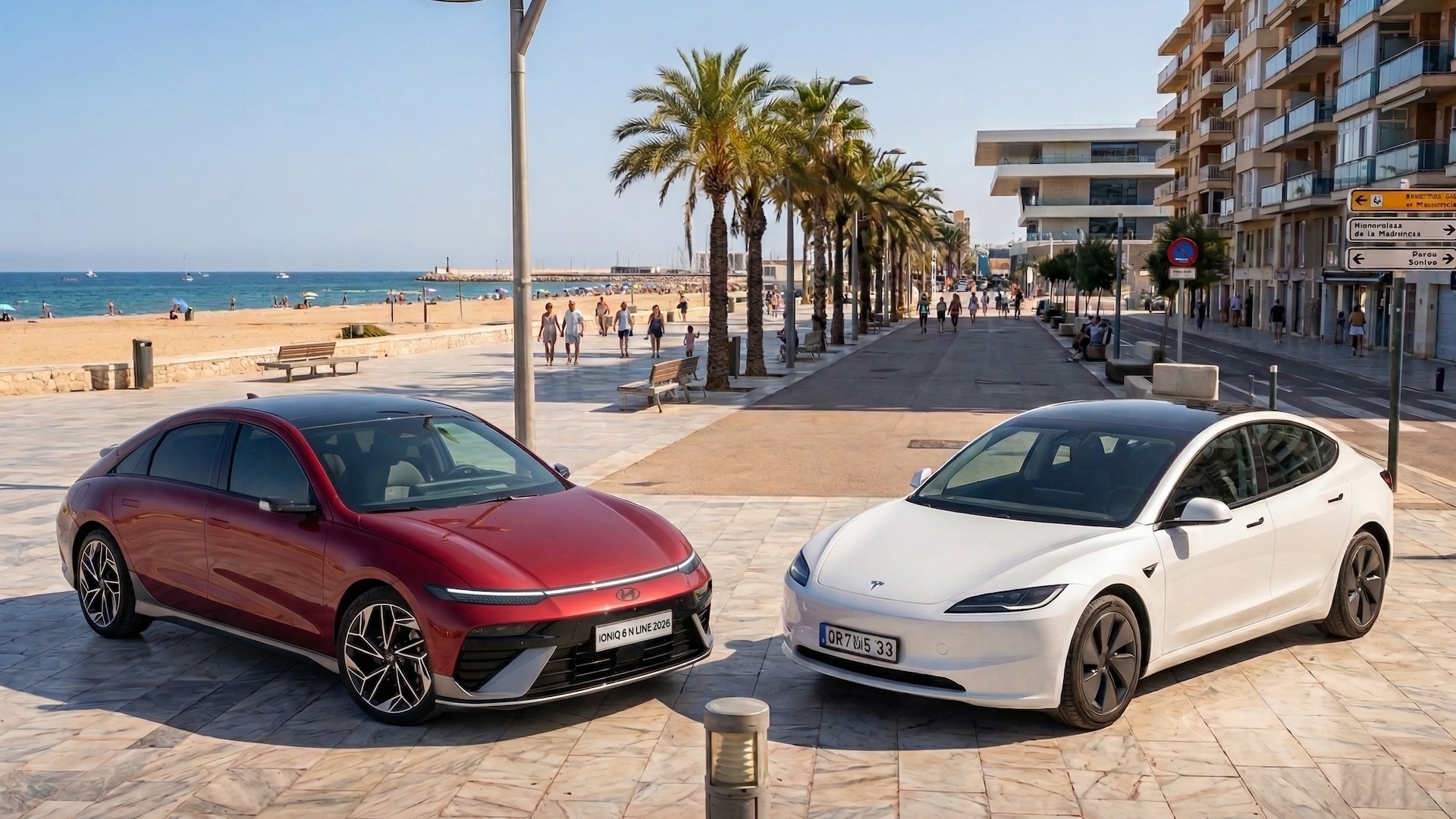
Taking on a bestseller like the Tesla Model 3 is no easy task, but the Hyundai Ioniq 6 has some strengths that allow it to accept the challenge of a head-to-head comparison.
Hyundai Ioniq 6 vs. Tesla Model 3 is one of the most relevant contrasts among electric saloons focused on efficiency and family-friendly interior space. Both offer different solutions: one bets on aerodynamic design and efficiency measured in official figures, the other on a well-established platform and a charging network that makes a difference in daily use.
In Spain, electric saloons continue to gain share within the electrified offering, although not at the pace of SUVs. According to ANFAC data, registrations of electric passenger cars have grown steadily in recent years; buyers of this type of car are mainly looking for realistic WLTP range, interior space and moderate running costs. Between the two models analysed there are differences in price, battery pack capacity and technological approach that shape the final choice.
The key points of the comparison
The contrast between Hyundai Ioniq 6 vs. Tesla Model 3 centres on pure efficiency and interior space. The Ioniq 6 stands out for its shape and its focus on reduced consumption; the Model 3 for its dynamics, ecosystem and a competitive WLTP range. But not all drivers value the same things: some prioritise fast charging and network coverage, others the comfort of rear seats and boot space.
The most balanced models in the segment in 2026
We assessed the balance between starting price, performance, efficiency and useful space. In this comparison the relationship between initial cost and real usefulness takes priority, taking into account official WLTP figures and typical usage conditions in town and on the open road.
Hyundai Ioniq 6
The Hyundai Ioniq 6 boasts a carefully crafted design to reduce consumption and optimise WLTP range. We recommend the 77 kWh battery version for its balance between range and performance: it offers good range in mixed conditions and competitive fast charging. In terms of interior space it keeps good width and a practical boot, aimed at families who value efficiency above extreme acceleration.
From a technical standpoint, its thermal management and aerodynamics position the Ioniq 6 as a rational alternative to options more oriented towards sportiness. Compared with rivals such as the Hyundai Kona or the Kia Niro, the Ioniq 6 offers a quieter interior and a behaviour focused on comfort on long journeys.
The best
• Moderate real-world consumption in varied driving
• Aerodynamic design that benefits range
• Interior space and a practical boot
To improve
• Limited premium trim offering compared with some alternatives
• Own charging network less extensive than that of other manufacturers
Which electric saloon offers the better balance between range and interior space?
The Hyundai Ioniq 6 stands out for its efficient WLTP range and an interior designed for long journeys, making it one of the most balanced options for families seeking low consumption.
| Feature | Figure | Score |
|---|---|---|
| Power | 225 CV | 8.8 |
| Range | 614 km (WLTP) | 9.4 |
| Top speed | 185 km/h | 7.5 |
| Boot | 401 litres | 8.2 |
| Starting price | 49.900 € | 8.6 |
score out of 10 based on the criteria analysed in this article
Tesla Model 3
The Tesla Model 3 remains one of the benchmarks thanks to its electric platform, real-world efficiency and the user experience linked to its charging network and software. The Long Range version combines a competitive range with high dynamic performance; the feel behind the wheel is sportier than the Ioniq 6’s, and its energy management usually delivers very tight consumption on motorways.
In terms of interior space the Model 3 offers a generous boot and a driver’s position very focused on the driver. Compared with alternatives such as the VW ID.3 or the Polestar 2, the Model 3 keeps an advantage in charging network and OTA updates, aspects that influence long-term value.
The best
• Charging network and service ecosystem
• Dynamics and performance in Long Range versions
• Software and continuous updates
To improve
• Perceived interior quality more uneven compared with Asian rivals
• Final price tends to be higher in versions with more range
Which electric saloon best handles heavy use and frequent long trips?
The Tesla Model 3 stands out for its charging network and energy management, making it a preferred option for those who cover many kilometres and value fast charging.
| Feature | Figure | Score |
|---|---|---|
| Power | 346 CV | 9.0 |
| Range | 602 km (WLTP) | 9.2 |
| Top speed | 233 km/h | 8.6 |
| Boot | 425 litres | 8.4 |
| Starting price | 56.900 € | 8.0 |
score out of 10 based on the criteria analysed in this article
Quick technical comparison
Overall, the Hyundai Ioniq 6 vs. Tesla Model 3 reveals two philosophies: efficiency and comfort versus ecosystem and dynamics. The Ioniq 6 is slightly better on pure consumption thanks to its aerodynamics; the Model 3 offers a superior charging and performance experience. For those who prioritise electric SUVs this is not the comparison, but for buyers of electric saloons these differences are decisive.
| Model | Power | Range (WLTP) | Price | Score |
|---|---|---|---|---|
| Hyundai Ioniq 6 | 225 CV | 614 km | 49.900 € | 9.0 |
| Tesla Model 3 | 346 CV | 602 km | 56.900 € | 9.2 |
score out of 10 based on the criteria analysed in this article
Which car to buy according to your profile
If you do a lot of city driving
For intensive urban use, where low consumption and ease of parking matter most, the Hyundai Ioniq 6 offers a very attractive real-world efficiency and a reasonable running cost.
If you travel frequently
If you often make long journeys, the Tesla Model 3 excels thanks to its charging network and fast-charging management, which reduces travel times.
If you’re looking for the best price
Those who prioritise initial cost and the equipment-to-price ratio will find in the Ioniq 6 a competitive proposal compared with the pricier versions of the Model 3.
If you prioritise technology
If the priority is ecosystem, OTA updates and integrated services, the Model 3 keeps an advantage over traditional competition.
Frequently asked questions
Which has the better real-world range?
Both offer competitive WLTP ranges; on mixed routes the Ioniq 6 achieves good figures thanks to its aerodynamics, while the Model 3 maintains high numbers thanks to its energy management.
Which car consumes less on the open road?
On sustained road driving the Ioniq 6 tends to record slightly lower consumption thanks to its drag coefficient and efficient gearing.
Which is easier to charge on long trips?
The Model 3 benefits from a charging ecosystem and very optimised charging times, which makes frequent long-distance travel easier.
Which offers more space for a family?
Although the differences are small, the Ioniq 6 prioritises rear comfort and a practical boot, important attributes for families who travel regularly.
Which model has the better value for money?
It depends on use: for consumption and initial price, the Ioniq 6; for long-term value and service network, the Model 3.
Expert opinion
Beyond the official figures, the choice between these two electric saloons depends on the buyer’s real profile. If your priority is to maximise every kilometre and reduce consumption without giving up a comfortable cabin for the family, the aerodynamic approach and energy management of the Ioniq 6 make it a very sensible alternative. If, on the other hand, you cover many kilometres a year and value an integrated usage experience with an efficient charging network, the performance and ecosystem of the Model 3 give it the advantage. The upfront outlay also weighs: the final price can tip the balance depending on the equipment chosen, and the availability of charging points on your usual route should be a decisive factor. In a market where electric sales keep rising according to ANFAC, both models are mature and capable options; the real choice comes down to prioritising efficiency and comfort (Ioniq 6) or ecosystem and performance (Model 3). For families seeking peace of mind and low cost per kilometre, the first option has solid arguments; for users who need frequent charging and a continuously evolving technological experience, the second remains the reference.
Models such as the Hyundai Kona or the Kia Niro also form part of that offering and can be alternatives if you want something more SUV-oriented, while proposals such as the VW ID.3 serve as a counterpoint if the priority is a more traditional interior. In any case, testing both options under real conditions and comparing consumption and charging times on your usual routes is the best way to decide.
But not all of them offer the same balance.


 Peugeot E-208 GTi: a battery-powered toy that revives the spirit of the 1980s sports cars
 New Lexus ES: luxury grows and goes electric
 First contact with the Dacia Sandero Hybrid 155: power and efficiency from €19,890
Deja un comentario