If you want safety at the wheel, keep an eye on your tyres. Michelin reminded us of this at the Jarama circuit
 Diego G. Moreira
19 March 2013
3 min.
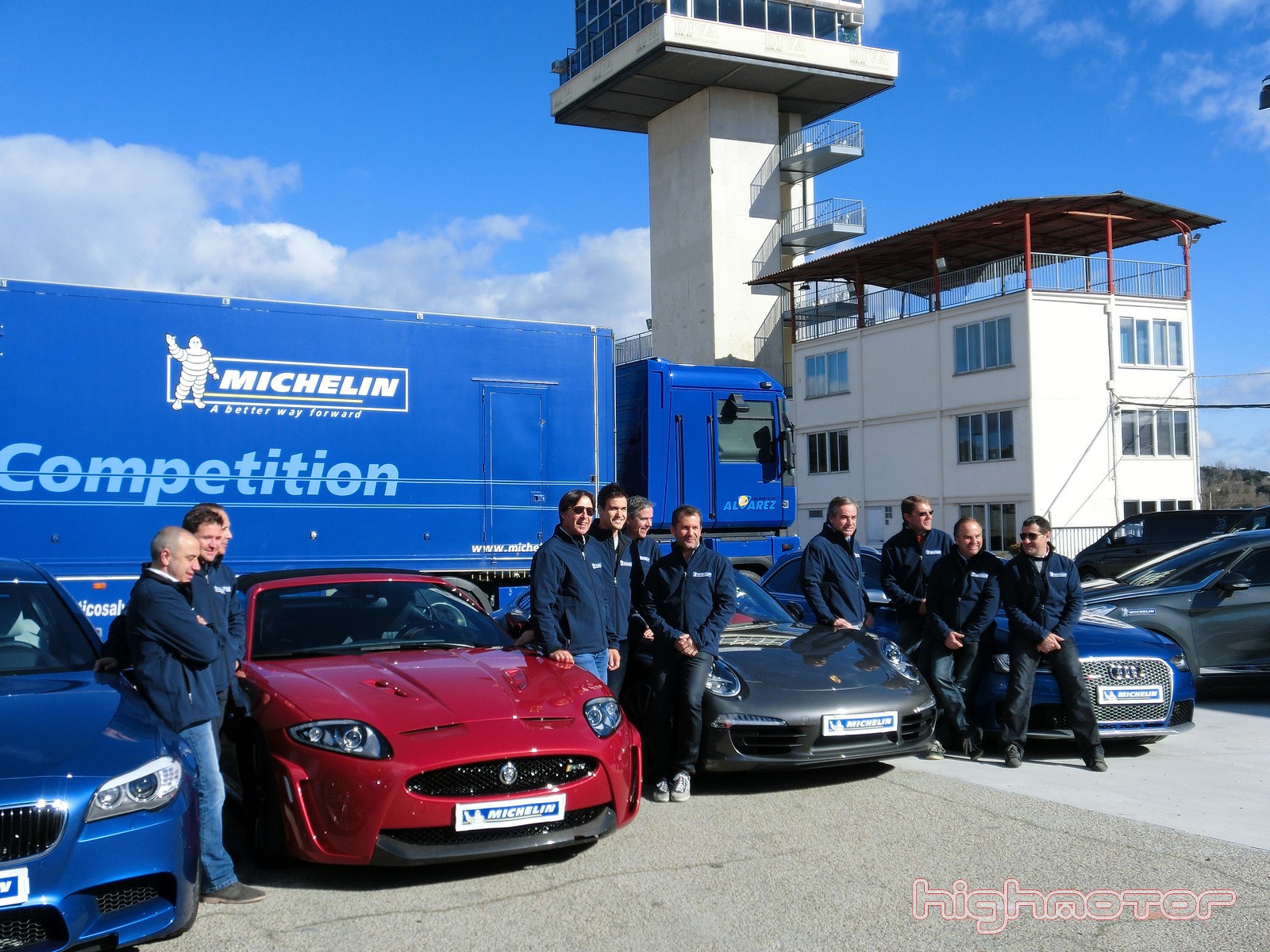
A few days ago we attended a Michelin event at the well-known Jarama circuit, in Madrid. What the French tyre company had to tell us was nothing new, but it is important because in these times of crisis there are still many drivers who are not aware of the condition of their tyres and their role in accidents.
To do so, Michelin brought in some top ambassadors and two tests to demonstrate the impact of worn tyres compared with new ones in a wet corner and during a braking manoeuvre. The highlight came from the drivers, who shared all their know-how and experience at the wheel of several supercars on the Jarama track. The drivers were the winners of the Spanish Rally Championship over the last 25 years.
Some facts about the condition of tyres
Michelin carried out several free tyre inspection campaigns in 2009 and 2011, and as part of these campaigns the driver was given a sheet listing all the defects detected on the tyres of their vehicle. From this series of analyses of more than 150,000 cars inspected, it was found that 15% of the cars analysed had at least one wheel with tread wear below the legal minimum (according to 2011 data).
At the different MOT inspection stations, between 20 and 25% of vehicles are rejected every year for problems in the “axles, suspension and tyres” section. And this is not only a problem for the driver who uses worn tyres, but also affects general safety, because in the event of an emergency stop a car with at least one tyre in poor condition or several worn tyres does not brake properly and can be a danger to other drivers.
Wet corner and wet braking with new and worn tyres
As always, knowing the theory is one thing, but testing it in practice is another, fortunately on a circuit and without endangering anyone. Michelin gave us the opportunity to experience how a car behaves with tyres whose tread is at the legal limit and to compare the results with the same tyres when new.
The first test was simple, a corner at about 60 km/h with a car fitted with rear tyres with little tread and the same test with the same car but with new wheels. In the first case the car lost control (none of them had ESP activated), and in the second case the car could be controlled without great difficulty.
The second test was a braking manoeuvre on a wet surface, with old tyres and with new tyres on the front wheels. Here the difference in braking was obvious, and therefore the safety that a new tyre can provide in an emergency situation is total: our only link with the asphalt.
Personally, I remember a simple braking incident at a roundabout: you’re about to pull out, but then you see a car and decide not to, and the person behind you doesn’t have time to brake and gives you the typical “little bump.” There was hardly any damage, beyond a “scrape,” and when we got out of the car to look at the damage, I noticed that their tyres were completely bald. To save a few euros, they ended up having to paint the bumper and report it to the insurance…
In short, we once again remind you that the tyre is one of the most important safety elements, since it is the only point of contact between the car and the road. If we save money on them, driving more than we should or even stretching the life of a tyre to unsafe limits, we are putting our safety and that of other drivers at risk.


 Kia offers an electric range of 10 models, 50 versions and 400 possible combinations
 The seven finalists for the 2027 European Car of the Year (COTY) are exclusively electric
 Peugeot E-208 GTi: a battery-powered toy that revives the spirit of the 1980s sports cars
Deja un comentario