Electric Cars Comparisons Tests
Jeep Avenger vs Peugeot e-2008: which electric SUV-B handles better in heavy urban traffic
 Dani Montesinos
5 August 2026
7 min.
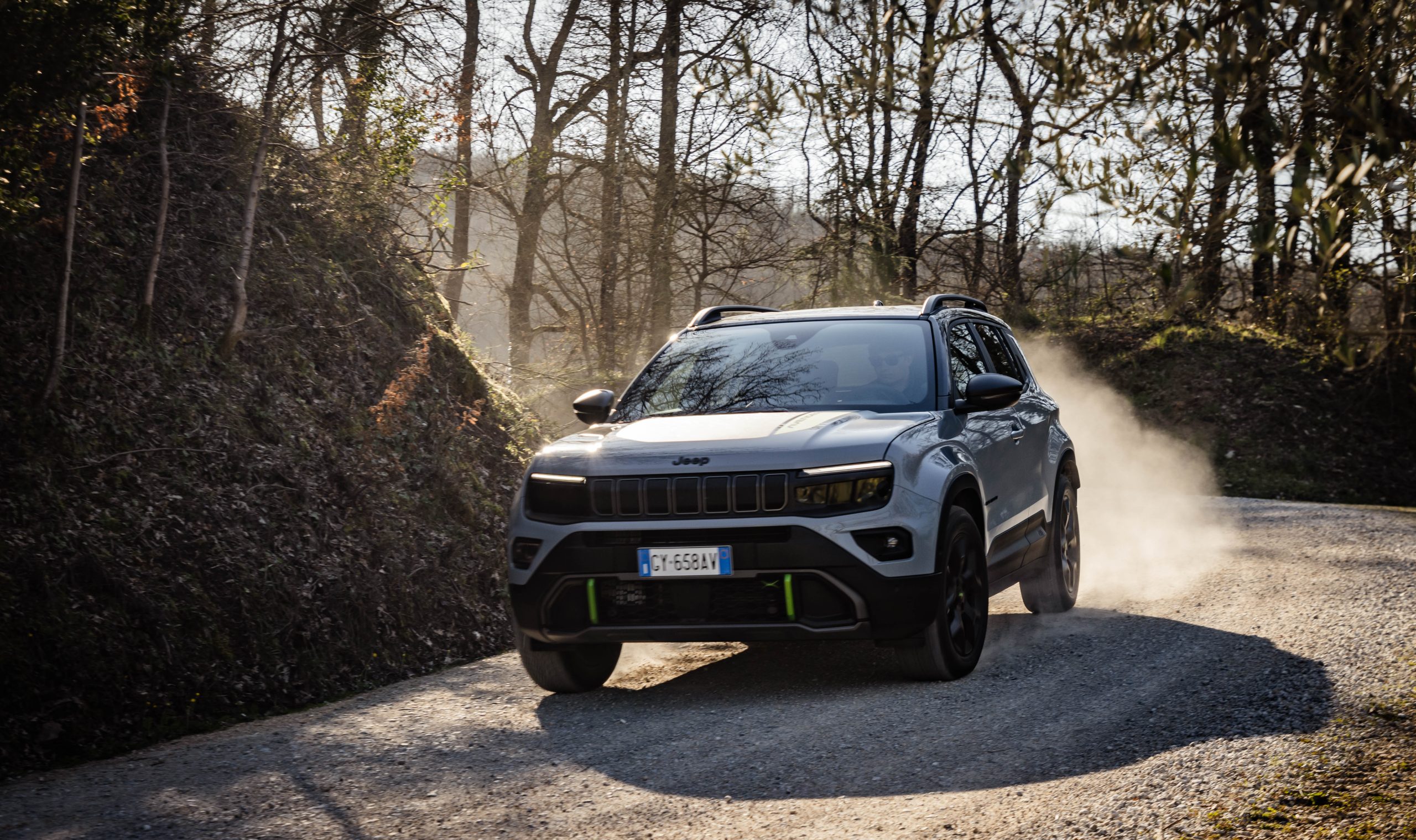
We compare the Jeep Avenger and the Peugeot e-2008 in a dense traffic scenario in a major city. Dimensions, electric response and low-speed ADAS.
Some cars are sold on their spec sheet, while others win the driver over through small gestures. Electric SUV-Bs are almost always in the second group. Nobody buys a Jeep Avenger vs Peugeot e-2008 thinking about the Nürburgring: they are bought to get around Madrid, Barcelona, Valencia or Seville without suffering, without scraping wheels and without finishing the journey with tense shoulders. And that is where two close cousins from Stellantis’s CMP platform take different paths.
Why compare two Stellantis siblings
They share architecture, components and part of their DNA. But the approach is opposite. The Avenger plays the card of compact robustness, with a block-like Jeep styling and a clear focus on agility. The e-2008 bets on comfort, technology and a more premium air — the typical Peugeot move of stepping up a rung without changing segment.
The scenario: dense traffic in a major Spanish city
We are talking about roundabouts with three poorly marked lanes, traffic lights that eat 40 minutes of a 10 km journey, ZBE low-emission zones with cameras every two streets, and kerbside parking with 20 cm of clearance on each side. Here the 0-100 figure does not matter. What matters is how the car behaves between 0 and 30 km/h, whether it knows how to brake by itself when a scooter cuts in from the right, and whether the steering requires force or can be handled with two fingers.
Jeep Avenger: compact robustness with an urban focus — from €28,001
In the current range, the Avenger that reaches Spanish dealers as the entry-level option is the e-Hybrid variant with an ECO label. A petrol/electric mild hybrid that handles pulling away from a standstill very well — the electric motor kicks in before the combustion engine has to wake up — and which, in pure traffic jams, suffers less than its spec sheet suggests.
At 4.08 metres long, it sits among the shortest in the segment. In practice, this translates into a turning circle that welcomes any manoeuvre that would otherwise take three points turned into two. Front visibility is good, with a flat bonnet and easily identifiable corners. The C-pillar is thick, yes, but the optional 360º cameras cover that shortcoming well.
| Power kW | Power hp | Top speed | Range | Consumption | Label | Fuel |
|---|---|---|---|---|---|---|
| 81 kW | 110 hp | 184 km/h | data not available | 4.9 l/100 km | ECO | Petrol/electric mild hybrid |
Peugeot e-2008Peugeot e-2008: technology focus and premium comfort — from €39,945
The e-2008 in its 156 hp version with a 54 kWh battery targets a different buyer. One who wants a fully electric car, the CERO label to enter any ZBE without questions, and a cabin with the i-Cockpit that — in my view — remains a success in the city: instrumentation above a small steering wheel, which allows you to see the speedometer and the lane line at the same time without lowering your gaze.
It is longer (4.30 m), heavier because of the battery, and its turning circle is not as compact as the Avenger’s. Even so, the electric response of the motor — with those 120 kW available from the first millimetre of throttle — makes pulling away from a traffic light on a slope a smooth gesture, without the thermal jolt of the rival mild hybrid. Regenerative braking, managed with the paddle on the gear selector in B mode, handles 90% of decelerations without touching the pedal. A luxury for the right foot in rush hour.
| Power kW | Power hp | Top speed | Range | Consumption | Label | Fuel |
|---|---|---|---|---|---|---|
| 115 kW | 156 hp | 150 km/h | 405 km | 15.3 kW/km | CERO | Electric (battery ≈54 kWh) |
Dimensions, turning circle and real-world manoeuvrability
On paper, the Avenger wins on length. In practice, the e-2008 compensates with more assisted steering at low speed — you need less force to park in a bay. If your daily routine involves narrow underground car parks and city centre streets with badly parked cars, the Jeep has the edge; if your journey is mostly wide roads with frequent stops, the Peugeot does not penalise you.
Electric response and regenerative braking in dense traffic
Here there is no debate. The e-2008 is a pure electric and drives as such: well-tuned one-pedal driving, no vibration at idle and absolute silence while stationary. The Avenger e-Hybrid helps with its electric motor at pull-away, but ends up relying on the combustion engine once the jam clears. In a ranking of urban agility, the Peugeot comes out ahead on smoothness; the Jeep on size.
Low-speed ADAS and 360º cameras
Both share the Stellantis catalogue: autonomous urban emergency braking, blind-spot detection, lane keeping and a rear camera as standard. The 360º view and semi-automatic assisted parking are optional on both, and work in practically identical fashion — logical, since they share hardware. That said, the pedestrian alert calibration is somewhat more conservative on the e-2008: it brakes earlier, which is appreciated in the city.
Cabin, visibility and comfort in rush hour
The Avenger plays the practical card: hard plastics but well assembled, physical controls for climate, high seats with good view of the road. The e-2008 raises the bar with softer-touch materials, ambient lighting and an overall feel that — in our opinion — justifies part of the price premium. Not all of it, though.
Real cost, environmental label and ZBE access
The RRP difference is around €6,200, and here a warning is in order: prices are the manufacturer’s recommended RRP, without dealer discounts, one-off campaigns or Plan MOVES aid. The e-2008’s CERO label gives unlimited access to Madrid Central and equivalents; the Avenger’s ECO label brings occasional restrictions at certain times or in certain zones. For anyone living inside the ring of a major ZBE, it is a decisive factor. For everyone else, less so.
Summary table and urban score
| Model | Length | Engine | Label | RRP from | Urban agility (1-10) | City comfort (1-10) | ZBE access (1-10) | Total urban |
|---|---|---|---|---|---|---|---|---|
| Jeep Avenger e-Hybrid | 4.08 m | 110 hp mild hybrid | ECO | €28,001 | 9 | 7 | 7 | 7.7 |
| Peugeot e-2008 54 kWh | 4.30 m | Electric 156 hp | CERO | €39,945 | 7 | 9 | 10 | 8.7 |
Verdict: which suffers less in dense traffic
If the criterion is “which suffers less”, the Peugeot e-2008 wins by a landslide on comfort, silence and regulatory access. If the criterion is “which fits better and costs less to get into”, the Avenger is the clear winner. It depends on whether your city has an aggressive ZBE and whether the initial extra cost — discounting fuel savings — pays off for your usage profile. As often happens in the segment, the “best small electric SUV Spain” is not a car, but an answer to a question only you can answer.
FAQ
Which has the better turning circle in parking manoeuvres?
The Jeep Avenger, thanks to its 4.08 m length versus the 4.30 m of the Peugeot e-2008, turns in less space. The difference is especially noticeable in narrow underground car parks.
Is the Jeep Avenger electric available in Spain?
The fully electric variant of the Avenger exists in the group’s catalogue, but the most common entry version at Spanish dealers right now is the e-Hybrid 1.2 145 with an ECO label, from approximately €33,700 RRP.
Is it worth paying the price premium of the Peugeot e-2008 over the Avenger?
It depends on three factors: whether you live inside a ZBE that requires a CERO label, whether you drive more than 15,000 km a year, and whether you have a charging point at home or work. If all three apply, yes, it pays off; if not, it is debatable.
What differences are there in low-speed ADAS between the two?
The hardware is practically identical — they share suppliers within the Stellantis group — but the calibration of the autonomous urban braking system is somewhat more conservative on the e-2008, which acts earlier with pedestrians and cyclists.

 Peugeot E-208 GTi: a battery-powered toy that revives the spirit of the 1980s sports cars
 New Lexus ES: luxury grows and goes electric
 First contact with the Dacia Sandero Hybrid 155: power and efficiency from €19,890
Deja un comentario