Peugeot E-208 GTi: a battery-powered toy that revives the spirit of the 1980s sports cars
 Rafa Guitart @GuitartRafa
3 October 2026
7 min.
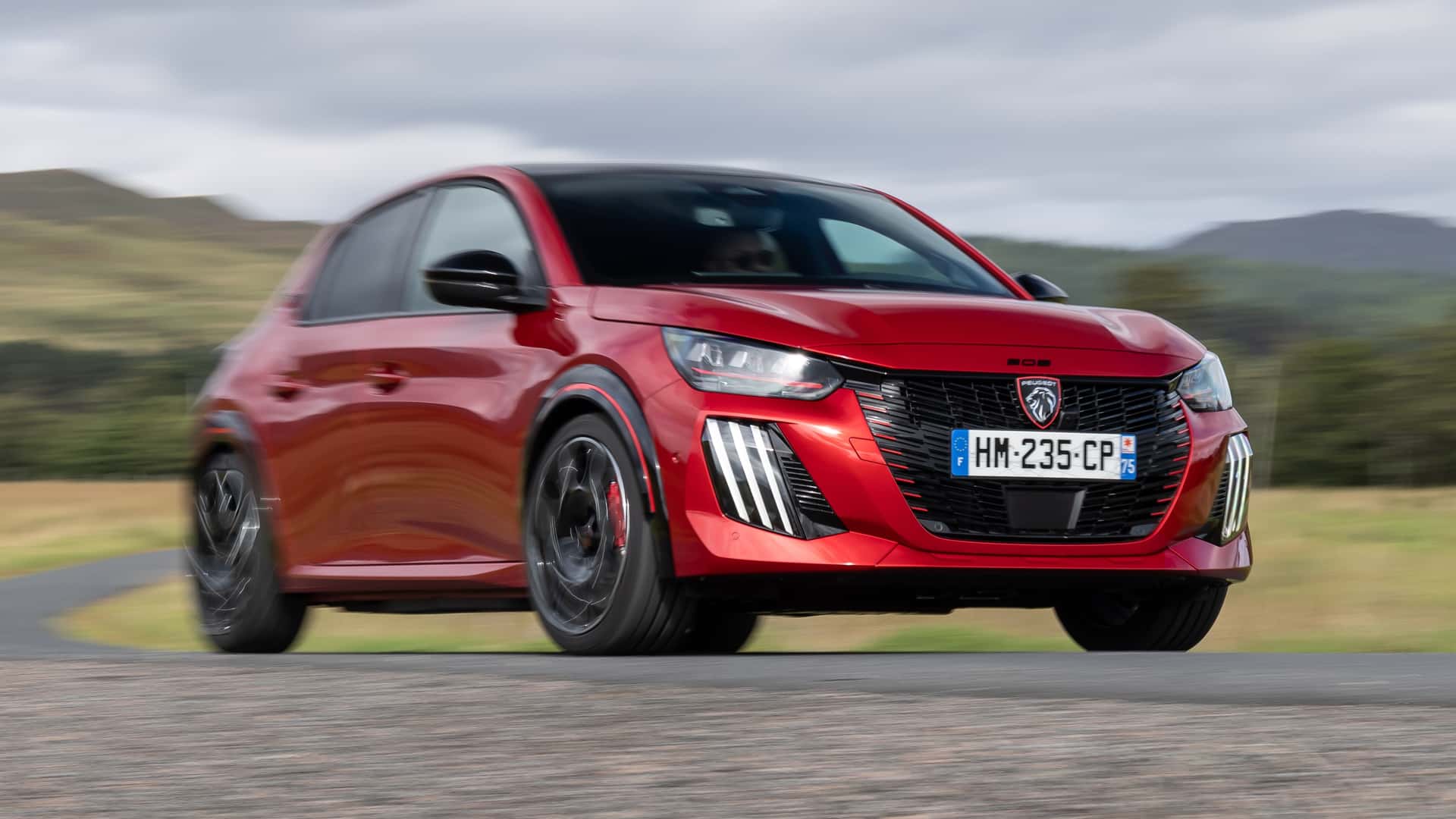
The legendary GTi badge returns to Peugeot with a small, fully electric sports car producing 281 CV. We have driven the new E-208 GTi, a model developed by Peugeot Sport that proves electrification can also deliver driving thrills behind the wheel.
Forty years after the Peugeot 205 GTi became one of the most admired compact sports cars of its era, the French brand revives a badge that is part of its history. It does so with an interpretation adapted to modern times, one that drops the petrol engine but keeps the philosophy that made those small sports cars true objects of desire: plenty of power, compact dimensions, an effective chassis and, above all, fun behind the wheel.
The new Peugeot E-208 GTi is the first fully electric model to carry this name. Its development was handled by Peugeot Sport, the brand’s competition division, whose specialists also work on the 9X8 prototype that competes in the World Endurance Championship. This experience has been carried over to many of this small sports car’s mechanical components, from the electronic engine management to the tuning of the suspension.
The transformation starts with its mechanics. The electric motor produces 281 CV and delivers a peak torque of 345 Nm, sent exclusively to the front wheels. With these figures, the E-208 GTi accelerates from 0 to 100 km/h in 5.5 seconds, recovers from 80 to 120 km/h in just 3.2 seconds and reaches an electronically limited top speed of 180 km/h.
But Peugeot Sport has worked especially hard to ensure all that power can be used effectively, even when driving demandingly. To achieve this, it has developed specific electronic management and fitted a mechanical limited-slip differential, which is essential for transferring the engine’s force to the tarmac.
A chassis that matches its power
The changes made to the standard E-208 are far more profound than its appearance might suggest. The bodywork has been lowered by 25 millimetres, while the track has been widened by 56 millimetres at the front and 28 at the rear. It also features specific springs, dampers with hydraulic bump stops and a new rear anti-roll bar of 31 millimetres, which considerably changes how the car behaves in corners.
The brakes have also been upgraded, with 355-millimetre front discs and four-piston fixed calipers. In addition, 18-inch wheels come as standard with Michelin Pilot Sport 4S tyres, particularly suited to exploiting this version’s dynamic capabilities.
The result is a car that responds with remarkable speed to the driver’s inputs. The steering stands out for its precision and lets you place the car exactly where you want it, while the suspension effectively controls the body’s movements. The low centre of gravity, helped by the battery’s position beneath the floor, also contributes to a notable sense of stability.
During our first drive, one of the aspects that caught our attention most was the ability to deliver all the power to the road without significant loss of traction. The limited-slip differential plays a decisive role here, especially when accelerating firmly out of corners.
The effectiveness of the brakes is also striking, both in terms of deceleration and the resistance they show under repeated use. In Sport mode, regenerative braking is also switched off, a solution designed to provide a more consistent response from the system during spirited driving.
The E-208 GTi is quick, precise and inspires great confidence. Its acceleration makes overtaking remarkably easy, and the immediate response of the electric motor allows you to link corners at a high pace. It doesn’t need an abrupt delivery of power to be fun: much of its appeal lies precisely in how easily you can make use of its performance.
Sportiness inside and out
Peugeot has sought to revive many of the styling elements of its historic GTi models, without resorting to an overly flamboyant transformation. The widened wheel arches, the perforated alloy wheels inspired by those of the 205 GTi, the front spoiler and the rear diffuser clearly set this version apart from the rest of the range.
Red once again becomes one of its main identifying features. It appears on the grille, wheel arches, brake calipers and various bodywork details, creating an immediate visual link with the brand’s sporting past.
Inside, the dedicated front seats offer excellent lateral support, which is especially important when using the chassis’s full potential. The compact steering wheel, partly trimmed in Alcantara, together with the red accents on the dashboard, seatbelts and upholstery, complete a distinctly sporty ambience.
The 10-inch digital instrument cluster features graphics and information specific to this version. It also has ambient lighting and an artificial sound linked to the electric motor’s speed, which can be switched off. For connectivity, it retains features such as wireless Apple CarPlay and Android Auto, connected navigation and a voice assistant.
All this without giving up its status as a city car. The E-208 GTi keeps five doors and a 265-litre boot, the same capacity as the other electric versions of the model, though less than the 309 litres of the petrol and mild-hybrid variants.
Range that depends on how you drive
The battery has a gross capacity of 54 kWh, of which 51 are usable. Peugeot Sport has modified its thermal management to maintain performance even when high power is demanded over long periods. The aim is to avoid the performance limitations that can occur in some electric sports cars as battery temperature rises.
The homologated range depends on the tyres chosen. With the standard Michelin Pilot Sport 4S it reaches 352 kilometres on the WLTP cycle, while with the Hankook Ventus S1 Evo3, available at no extra cost, it rises to 375 kilometres.
Naturally, these figures vary considerably depending on use. In normal driving with the Michelins, the range can be estimated at around 310 kilometres, while continuous use of its sporting performance can drop it noticeably below 300 kilometres.
As for charging, it accepts AC at 7.4 kW, with a quoted time of four hours and forty minutes, and DC of up to 100 kW, which allows the battery to go from 20 to 80 % in under thirty minutes.
The Peugeot E-208 GTi also arrives at a particularly significant moment for the model, whose next generation is scheduled for 2027 and will be inspired by the Polygon prototype.
With a price announced for Spain from €41,800, this version represents a very distinctive proposition within the sporty city car segment. It shares its technical approach with other high-performance electric models from the Stellantis group, such as the Lancia Ypsilon HF and the Opel Corsa GSE, but retains a personality rooted in Peugeot’s history.
The E-208 GTi does not aim to reproduce exactly the feel of those light petrol sports cars of the 1980s. Its weight, the absence of gear changes and the instant response of the electric motor make for a different experience. Nevertheless, it keeps something fundamental from that philosophy: the ability to turn a winding road into a genuinely entertaining experience. And that, whatever technology drives it, remains the essence of a GTi.
Image gallery
Technical specifications of this car

 Peugeot E-208 GTi: a battery-powered toy that revives the spirit of the 1980s sports cars
 New Lexus ES: luxury grows and goes electric
 First contact with the Dacia Sandero Hybrid 155: power and efficiency from €19,890
Deja un comentario