Porsche 911 Turbo S: some insights into its aerodynamics that will surprise you
 Antonio Roncero @roncero_antonio
15 April 2020
3 min.
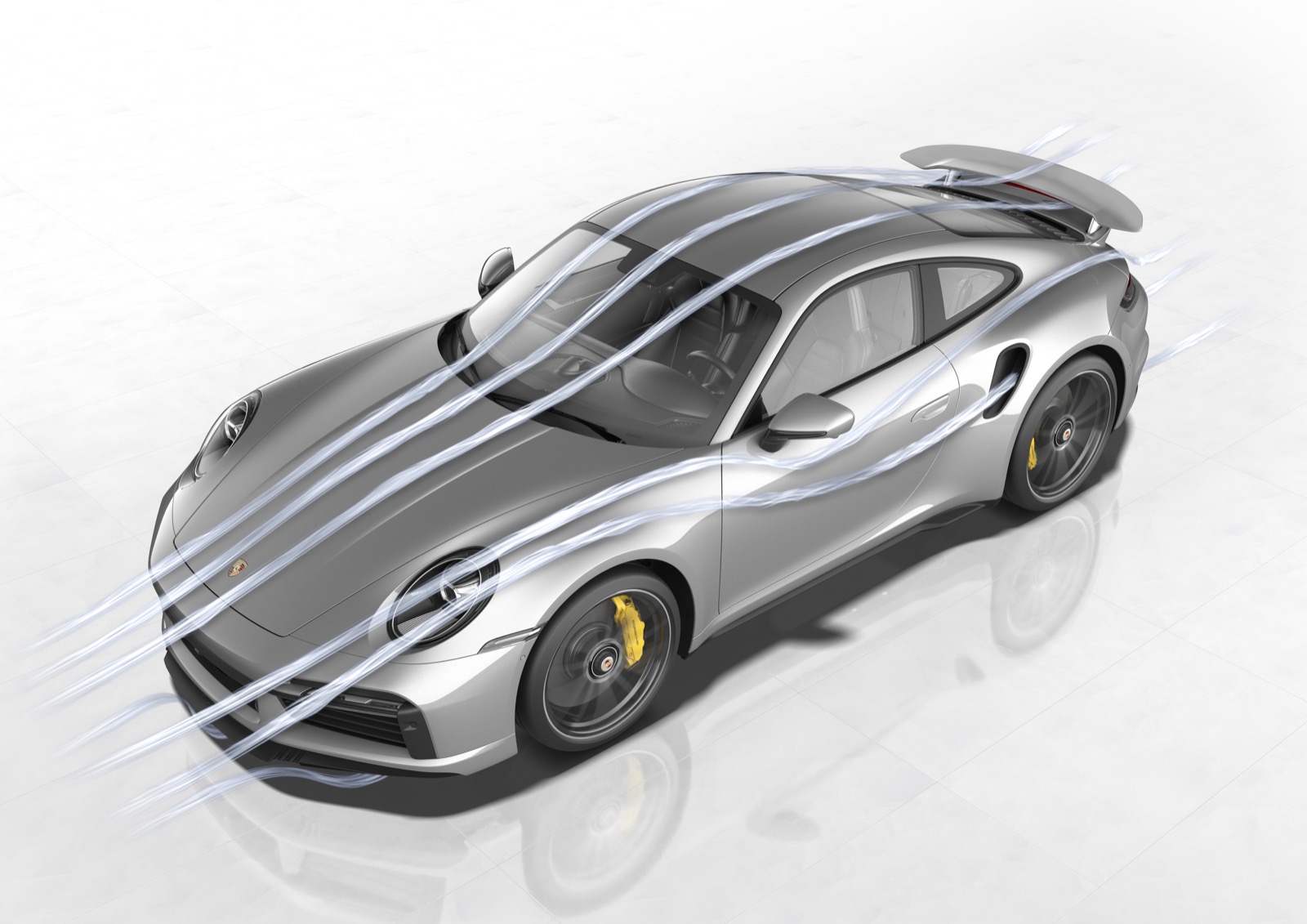
Active aerodynamics is the key to achieving low drag with high downforce, without compromising the cooling needs of the powerful engine in the Porsche 911 Turbo S.
In a high-performance sports car, aerodynamics plays an essential role. But this takes on special prominence in a car like the new Porsche 911 Turbo S, for various reasons you will have already imagined.
Indeed: the position of the rear-mounted engine, and the fact of remaining faithful, to a greater or lesser extent, to a silhouette that must remain recognisable over the years, make the goal of achieving a low drag coefficient with high downforce a real challenge for the engineers responsible for aerodynamic development.
The front deflector and the rear wing generate 15% more aerodynamic downforce, which in Performance mode reaches around 170 kg
In the end, the solution lies in active elements. Porsche calls it PAA (Porsche Active Aerodynamics), a technology first introduced in the previous generation of the 911 Turbo launched in 2014. The new Porsche, both the 718 as well as the Panamera and the Taycan, rely on active aerodynamics when it comes to fighting wind resistance.
Active air grilles
This feature is now common even on compact cars and mid-range city cars, as a solution for reducing fuel consumption. On the 911, the active grilles are placed in the front side air intakes. From 70 km/h the deflectors close to improve consumption, and open again progressively above 150 km/h.
Whenever the driver selects a sporty driving mode (Sport, Sport Plus or Wet), or with the stability control PSM switched off, these deflectors remain open.
Front deflector: three positions
The new front deflector on the 911 Turbo S now allows a greater extension and retraction range in less time. To achieve this, pneumatic actuators are used on three segments that can be deployed separately. The central one is made of flexible plastic, allowing this part to extend or retract even with the two side sections extended.
This deflector can be set in three positions. The lowest keeps it attached to the bodywork by means of the pneumatic system and magnets on the underside. In the “Speed” position, only the outer segments are deployed, reducing the nose’s tendency to lift. In the “Performance” position, all three sections extend, providing the maximum possible downforce on the front axle.
Rear wing: new functions
In addition to offering 8% more effective surface area, the new rear wing reduces weight by 440 grams. To achieve this, it uses a two-panel structure, one of CFRP and one of GFRP, carbon fibre reinforced plastic and glass fibre reinforced plastic, respectively. The base is a foam core.
In this case, there are five functions, three of them new, added to the existing Speed and Performance modes. Eco mode is for driving with the lowest drag, so the wing is retracted. In “Performance II” mode, a small angle of attack of the wing is used above 260 km/h, so as not to excessively increase the load on the rear axle, avoiding unnecessary pressure on the tyres.
In Wet mode the wing extends fully but does not tilt. It is combined with the retracted front spoiler to achieve an aerodynamic balance that ensures safety on wet asphalt.
In addition, the Porsche 911 Turbo S features a new air brake function, which deploys the front spoiler and rear wing in Performance mode when braking hard from high speed. In this way, aerodynamic drag and downforce increase, helping to improve stability and braking distance.
Technical specifications of this car


 The seven finalists for the 2027 European Car of the Year (COTY) are exclusively electric
 Peugeot E-208 GTi: a battery-powered toy that revives the spirit of the 1980s sports cars
 New Lexus ES: luxury grows and goes electric
Comentarios cerrados