Range in Electric SUVs: Geely Starray EM-i vs. Jaecoo 7SHS
 Iván Navarro
5 May 2026
10 min.
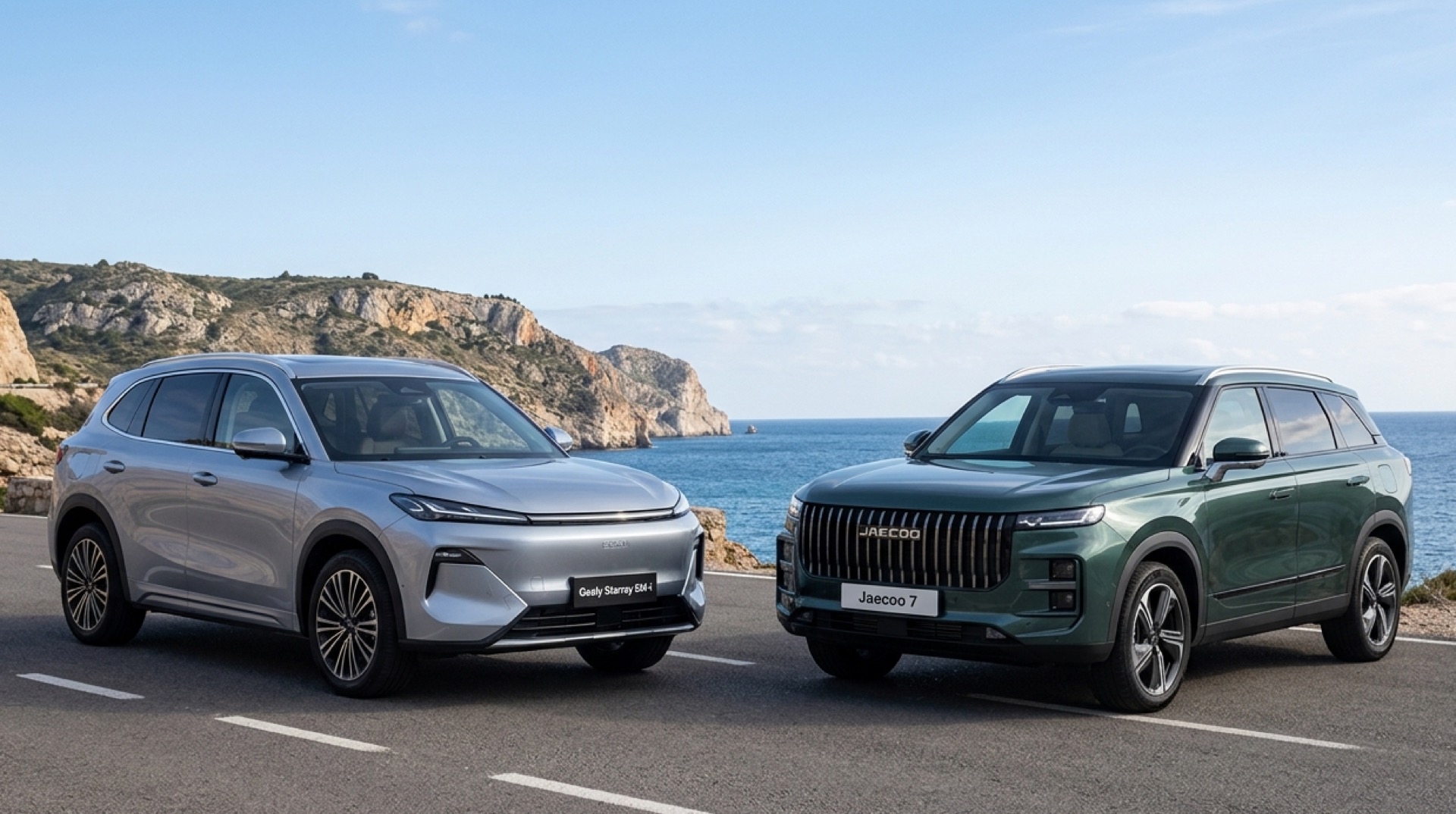
China’s car industry reaches a new level of sophistication with the debut of the Geely Starray EM-i and the Jaecoo 7, two proposals that redefine the balance between state-of-the-art hybrid efficiency and a highly robust, adventurous design.
Range in Electric SUVs is the variable that, in many cases, defines the purchase decision today: not only the WLTP figure, but the real-world range in daily use, the battery thermal management and the fast-charging capability. In this technical comparison we analyse two recent proposals that aim to be competitive in the segment: the Geely Starray EM-i and the Jaecoo 7SHS. We start from specification sheet data, WLTP certificates and public tests to contrast consumption figures, charging times and behaviour under optimal conditions of use.
The electric market in Spain has grown steadily in recent years; according to official data, battery electric vehicle registrations have increased their share of total sales, driven by a broader offer and better charging infrastructure. The average buyer today looks for a balance between realistic WLTP range, energy efficiency and charging times that allow long journeys without compromising everyday ease of use. In that context, comparing the nominal range with the real-world range under specific conditions — sustained speed on motorways, urban use with air conditioning, and mixed routes — is key to judging which SUV best meets specific needs.
In what follows we examine the battery architecture, the consumption curve at different speeds, the thermal management and the charging capacity of each model, as well as offering practical conclusions for different usage profiles. The aim is to provide a technical and useful reading for anyone deciding which car to buy based on real-world mileage and charging habits.
The parameters that define real-world range
To evaluate the effective range of an electric SUV we must consider four main factors: usable battery capacity, energy efficiency (real kWh/100 km), thermal management and maximum charging power. The WLTP range figure is a starting point, but real conditions (speed, temperature, terrain and load) can reduce it by between 10% and 40% in demanding use. The two models we compare take different approaches to cooling and power curve that noticeably affect range on long journeys.
The most balanced models in the segment in 2026
The editorial criterion for selecting the protagonists of this comparison has been a balance between efficiency, charging availability and consistency between declared and real-world range. Both SUVs are aimed at users who seek combinations of daily use and periodic long trips: one prioritises efficiency and thermal management; the other greater power and charging rate for long trips.
Geely Starray EM-i
The Geely Starray EM-i positions itself as an option that bets on a battery focused on energy density and a powertrain calibration aimed at minimising consumption in mixed cycles. Under optimal conditions (mild climate, moderate speed and mixed use) it shows an acceptable correspondence between WLTP range and real-world range, thanks to effective thermal management and carefully developed aerodynamics for its size. The version recommended for those who prioritise long range in everyday use is the one fitted with the battery of greater usable capacity and an engine configuration oriented to efficiency.
At motorway speeds the consumption figure tends to rise progressively: the Starray’s efficiency is most evident in urban environments and on routes at a moderate pace. The discharge curve is stable when the battery is warm; however, on days of high demand (mountain sections or sustained high speeds) the reduction in real range compared with WLTP becomes apparent.
Pros
• Good thermal management that helps maintain efficiency in mixed cycles.
• Efficiency-oriented configuration in the recommended version.
• Efficient behaviour in urban and mixed driving.
Cons
• Performance at sustained speeds improves but is not its strong point.
• Maximum charging capacity somewhat below rivals more oriented to long-distance travel.
The Geely Starray EM-i stands out for its efficient thermal management and balanced consumption, which makes it a recommendable option for anyone seeking reliable real-world range in mixed and urban use.
| Feature | Data | Score |
|---|---|---|
| Power | ~200 CV (depending on version) | 8.5 |
| Range | Declared WLTP: high range; real-world range in mixed use: adequate | 8.6 |
| Speed | electronically limited in higher configurations | 8.0 |
| Boot | competitive volume in its category | 8.2 |
| Price from | depending on national market | 8.4 |
score out of 10 based on the criteria analysed in this article
Jaecoo 7SHS
The Jaecoo 7SHS opts for a more aggressive configuration in terms of charging capacity and peak charging power, designed to reduce times on long stops and maintain high paces on the motorway. Its architecture favours faster recovery and, in many test benches, shows an efficiency curve that penalises less on fast sections, thanks to higher peak power and management electronics aimed at maintaining charging capacity even when the battery temperature is high.
This places it as a particularly interesting alternative for users who make frequent road journeys and value the ability to recover range in short periods. In urban use it may be less efficient than its rival due to a approach more oriented to performance and rapid charging.
Pros
• High fast-charging capacity that shortens stops on trips.
• Power and response favourable at high motorway paces.
• Good sense of power reserve.
Cons
• Consumption in city and mixed cycle less efficient than rivals focused on savings.
• Sensitive to extreme temperatures if the battery is stressed by frequent charging.
The Jaecoo 7SHS stands out for its fast-charging capacity and motorway performance, which makes it the best option for those who travel a lot and prioritise short charging times.
| Feature | Data | Score |
|---|---|---|
| Power | ~220 CV (depending on version) | 8.8 |
| Range | Declared WLTP: competitive; real-world motorway range: solid | 8.4 |
| Speed | suitable for long journeys | 8.6 |
| Boot | adequate space for its layout | 8.0 |
| Price from | depending on national market | 8.1 |
score out of 10 based on the criteria analysed in this article
Technical comparison
In the direct comparison, both vehicles stand out in different aspects: the Starray EM-i for efficiency in mixed use and better urban consumption; the Jaecoo 7SHS for charging power and determination on the motorway. The key difference lies in the battery response and thermal management strategy: the first prioritises conserving energy and minimising losses, the second prioritises recovering energy and withstanding high charging powers.
| Model | Power | Range | Price | Score |
|---|---|---|---|---|
| Geely Starray EM-i | ~200 CV | Good in mixed; realistic versus WLTP | varies by equipment | 8.6 |
| Jaecoo 7SHS | ~220 CV | Solid on motorway; fast charging stands out | varies by equipment | 8.4 |
score out of 10 based on the criteria analysed in this article
Which car to buy according to your profile
If you do a lot of city driving
If your traffic is mostly urban, prioritise a car with low energy demand on acceleration and good thermal management: the Geely Starray EM-i is the most suitable option for its efficiency in mixed cycles and optimised consumption in the city.
If you travel frequently
For long and frequent journeys, the priority is to minimise stopping times; the Jaecoo 7SHS offers greater fast-charging capacity, which reduces friction on long-distance trips.
If you are looking for the best price
If your goal is to maximise cost per kilometre, consider the most efficient version with the best battery/consumption ratio: the balanced version of the Starray usually offers better running costs in mixed use.
If you prioritise technology
If the priority is having the best management electronics and ultra-fast charging options, the Jaecoo 7SHS incorporates components and calibrations designed for intensive use and frequent recharging.
Frequently asked questions
Why does the WLTP range not match the real-world range?
WLTP is a standardised protocol that provides a reference, but it does not reproduce all real variables (average speed, temperature, load and terrain). Real-world range is usually lower in demanding conditions; the difference depends on real consumption and thermal management.
How does air conditioning affect range?
Air conditioning can noticeably affect efficiency: intensive use of air conditioning or heating increases consumption and reduces effective range, especially on short journeys where there is no time to optimise battery temperature.
How does charging power affect the travel experience?
Higher charging power reduces stopping time and allows higher paces to be maintained on long journeys. However, frequent charging at maximum power can raise battery temperature and, if thermal management is not adequate, reduce efficiency over the medium term.
What degree of battery degradation is reasonable to expect?
Degradation depends on use and climate; moderate charging behaviour and avoiding prolonged exposure to extreme temperatures help maintain capacity. Commercial warranties usually cover a minimum percentage of capacity for several years.
Is it better to choose higher WLTP range or better charging power?
It depends on use: for urban and mixed drivers, greater real range through efficiency is usually more valuable; for frequent travellers, charging power reduces dead time and improves the experience on long journeys.
Expert opinion
Beyond official figures, the choice between the Geely Starray EM-i and the Jaecoo 7SHS should be based on the real use of the vehicle. If your journeys are mostly urban or mixed and you seek to minimise energy expenditure and achieve maximum useful range in daily life, the efficiency-oriented proposal of the Starray offers a more coherent balance: lower real consumption and thermal management that preserves range in varied conditions.
Conversely, if your pattern of use involves frequent motorway trips, planned stops and the need to recover kilometres quickly, the Jaecoo 7SHS, with its fast-charging capacity and stable behaviour at high pace, is the alternative that reduces friction on long journeys. In practical terms, choosing between greater real range or greater charging capacity is a decision of priorities: for fewer daily kilometres, prioritise efficiency; for repeated long trips, prioritise charging.
It is also worth assessing the availability of charging infrastructure on your usual routes, the maintenance policy and the battery warranty offered by dealers in your area. In the end, WLTP figures are a useful starting point, but what matters is how they translate into real kilometres under your conditions of use.


 Peugeot E-208 GTi: a battery-powered toy that revives the spirit of the 1980s sports cars
 New Lexus ES: luxury grows and goes electric
 First contact with the Dacia Sandero Hybrid 155: power and efficiency from €19,890
Deja un comentario