Renault introduces Callie, its autonomous system capable of avoiding obstacles
 David Lopez @espacionblanco
8 November 2017
2 min.
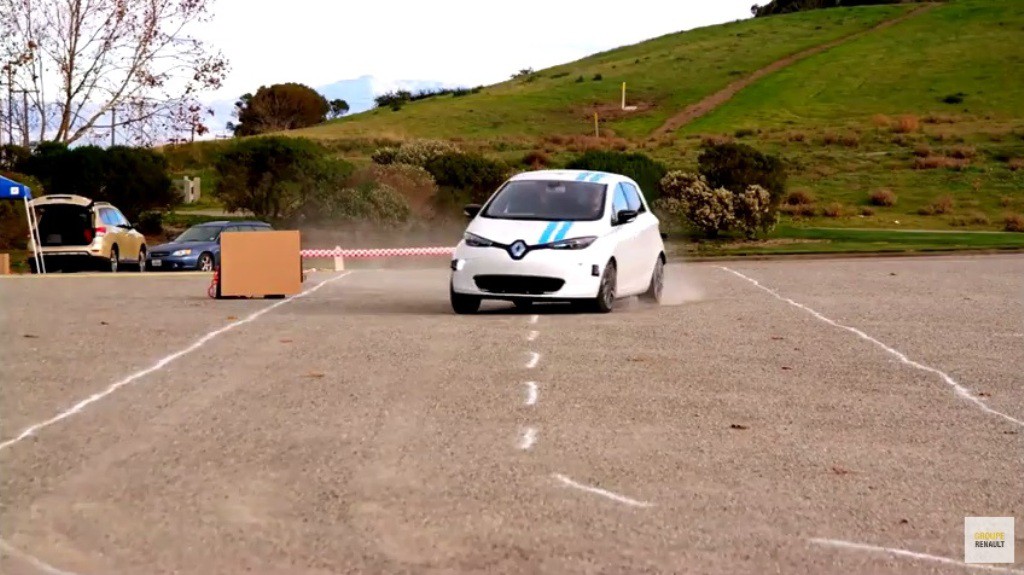
Building on a ZOE, Renault has developed the Callie autonomous driving system, capable of swerving around obstacles with the same effectiveness as a pilot
Autonomous driving will represent a major breakthrough in the vehicles of tomorrow, but first it needs a complex development process that allows it to interact perfectly with its surroundings. We have already seen how several brands are working on this area, enabling their vehicles to communicate with others as well as with the elements needed for traffic, such as traffic lights, especially at critical points like blind intersections that can be found in every city.
But although machines are presumed to be infallible, people are not, and misuse of them or a simple distracted pedestrian or animal can cause a serious accident in automated driving. Let’s take as an example a situation in which an animal is standing in the road, or simply appears and invades it, with the resulting scare and/or accident. What would an autonomous vehicle do in this case?
This is where the work carried out by Renault comes in, with the creation of Callie, an autonomous driving system they have developed at the Renault Open Innovation Lab located in Silicon Valley, and with which they promise to perform evasive manoeuvres with the same speed, reflexes and effectiveness as a professional pilot. In fact, professional pilots have been responsible for teaching Callie how to perform this complex manoeuvre, and the result seems to be nothing short of excellent.
As you will see in the video I’ve left below, Renault used its ZOE model as a guinea pig, a vehicle that, despite its characteristics, surprises with its ability and effectiveness in avoiding obstacles. Unfortunately, Renault provides no information clarifying the test conditions, but judging by the video they were carried out on dirt to make it even more difficult, although if you look at the speedometer it doesn’t exceed 29 MPH (just under 50 km/h), so they were not performed at an excessive speed.
Even so, this does not detract from its merit at all and, conjecture aside, the development of Callie by Renault represents one more step on the road towards achieving perfect autonomous driving. It also reflects the commitment of the Renault Group to autonomous driving, which will translate into the creation and development of more than 15 Renault models with different levels of driving automation by 2022, in addition to the benefits that will also be reported to the alliance that the Renault Group maintains with Nissan and Mitsubishi.
https://youtu.be/WIVTKhFcvT0


 The seven finalists for the 2027 European Car of the Year (COTY) are exclusively electric
 Peugeot E-208 GTi: a battery-powered toy that revives the spirit of the 1980s sports cars
 New Lexus ES: luxury grows and goes electric
Deja un comentario