Hybrid Cars Tests Rankings SUV
The 5 hybrid SUVs with the lowest real-world city consumption in 2026
 Iván Navarro
19 May 2026
5 min.
We analyse the five hybrid SUVs that consume the least in real urban use in Spain in 2026, with verified figures in l/100 km, the percentage of electric-mode driving and starting price.
The city remains the terrain where non-plug-in hybrid SUVs show their best version. No cables, no charging anxiety and systems capable of running in electric mode up to 70% of the time in dense traffic, HEVs have established themselves as the most rational choice for those who drive through Madrid, Barcelona or Valencia every day. In Highmotor we have cross-referenced real urban consumption data —not the WLTP homologated figures, but those recorded in dynamic road tests and by verified users— to build the definitive ranking of the hybrid SUVs with the lowest city consumption in 2026 sold in Spain.
Why urban consumption defines the modern hybrid SUV
A well-designed HEV turns the kinetic energy from braking into useful electricity. In urban cycles, where you brake every 200 metres, the system recovers virtually all the energy the combustion engine supplies during acceleration. The result is consumption figures hovering around 4 l/100 km in compact SUVs and dropping below 5 l/100 km even in family C-SUVs. Here raw power matters less than the intelligence of the management software and the sizing of the traction battery.
How we measured real urban consumption
We used as reference mixed urban routes of 25-30 km under real conditions (dense traffic, traffic lights, temperatures between 12 and 22 °C, air conditioning on) and cross-checked them against aggregated data from platforms such as Spritmonitor and the editorial team’s own tests. The percentage of time in electric mode was measured using the on-board computer over 45-minute cycles at rush hour.
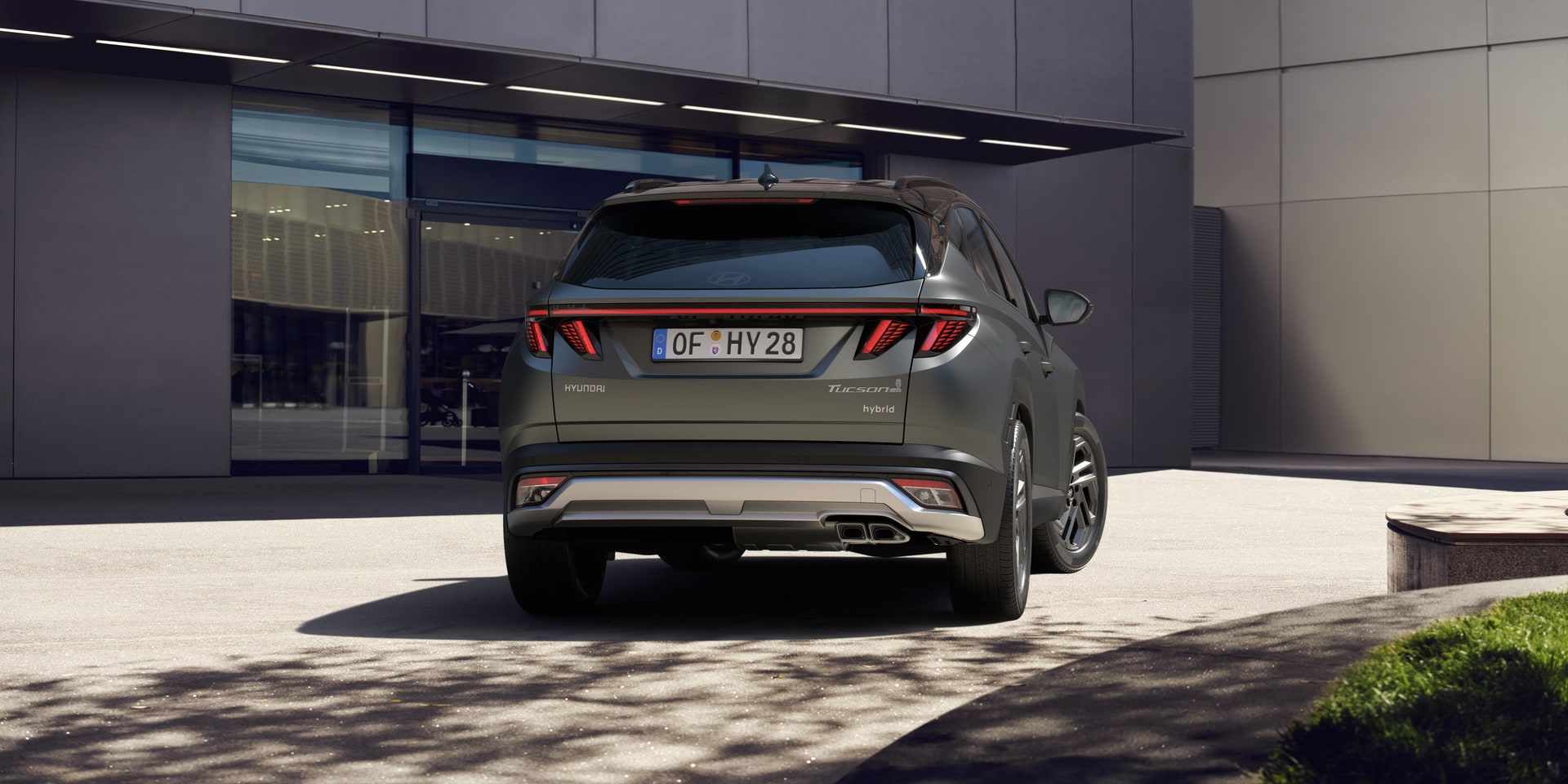
5. Hyundai Tucson HEV — from €32,900
The Hyundai Tucson HEV combines a 1.6 T-GDI with a 44.2 kW electric motor for a combined output of 215 CV. In the city it records a real consumption of 5.4 l/100 km, with 58% of the time in pure electric mode. Its six-speed automatic gearbox is less refined than a series-parallel system, but it makes up for this with a superior finish and notable interior space. ECO label from the DGT.
| Power kW | Power CV | Top speed | Range | City consumption | Label | Fuel |
|---|---|---|---|---|---|---|
| 158 kW | 215 CV | 193 km/h | ~900 km | 5.4 l/100 km | ECO | Hybrid |
4. Renault Symbioz E-Tech 145 — from €31,500
The Renault Symbioz debuts the fourth-generation E-Tech full hybrid system, with a clutchless multimode gearbox and always starting in electric mode. In urban use it records a real 4.9 l/100 km and a surprising 75% of the time with the combustion engine switched off, thanks to the 1.2 kWh battery and very aggressive electric torque management. It is probably the most electric-feeling hybrid SUV on the whole list.
| Power kW | Power CV | Top speed | Range | City consumption | Label | Fuel |
|---|---|---|---|---|---|---|
| 105 kW | 145 CV | 170 km/h | ~1,000 km | 4.9 l/100 km | ECO | Hybrid |
3. Honda HR-V e:HEV — from €30,400
The Honda HR-V fits the i-MMD system –Intelligent Multi-Mode Drive-, a series-parallel layout where the combustion engine almost always works as a generator. In the city the HR-V records 4.7 l/100 km and runs in electric mode 68% of the time. The driving sensation is that of an EV with a range extender, with instant response and absolute silence at low speeds.
| Power kW | Power CV | Top speed | Range | City consumption | Label | Fuel |
|---|---|---|---|---|---|---|
| 96 kW | 131 CV | 170 km/h | ~950 km | 4.7 l/100 km | ECO | Hybrid |
2. Lexus LBX — from €32,500
The Lexus LBX is the most efficient premium hybrid SUV on the Spanish market. It shares its architecture with the Yaris Cross but refines the series-parallel HEV system of the Toyota group with superior sound insulation and optimised thermal management. In the city it records a real 4.3 l/100 km and exceeds 70% of the time in electric mode. Its compact size (4.19 m) also makes it the king of urban parking.
| Power kW | Power CV | Top speed | Range | City consumption | Label | Fuel |
|---|---|---|---|---|---|---|
| 100 kW | 136 CV | 170 km/h | ~1,050 km | 4.3 l/100 km | ECO | Hybrid |
1. Toyota Yaris Cross 130 — from €25,900
The Toyota Yaris Cross with the new 130 CV fifth-generation hybrid powertrain crowns itself as the hybrid SUV with the lowest real city consumption in Spain in 2026. 4.1 l/100 km real, 72% of the time in electric mode and a price that makes it unbeatable in efficiency-to-cost ratio. The HSD (Hybrid Synergy Drive) system remains the industry benchmark after 27 years of evolution.
| Power kW | Power CV | Top speed | Range | City consumption | Label | Fuel |
|---|---|---|---|---|---|---|
| 96 kW | 130 CV | 170 km/h | ~1,100 km | 4.1 l/100 km | ECO | Hybrid |
Comparative summary table with score
| Position | |||||
|---|---|---|---|---|---|
| Toyota Yaris Cross 130 | 4.1 l/100 km | 130 | €25,900 | 9.5 | |
| Lexus LBX | 4.3 l/100 km | 136 | €32,500 | 9.1 | |
| Honda HR-V e:HEV | 4.7 l/100 km | 131 | €30,400 | 8.7 | |
| Renault Symbioz E-Tech | 4.9 l/100 km | 145 | €31,500 | 8.5 | |
| 5 | Hyundai Tucson HEV | 5.4 l/100 km | 215 | €32,900 | 8.0 |
Highmotor verdict
The dominance of Toyota and Lexus in urban efficiency remains overwhelming, but Honda and Renault have closed the gap enough to be competitive in any serious comparison. If use is 100% urban, the Yaris Cross is the rational choice; if you want a compact premium car, the LBX is unbeatable; and if the family demands space, the Tucson HEV justifies its extra tenths of consumption with its versatility.
Frequently asked questions
Which hybrid SUV consumes the least in the city in Spain in 2026?
The Toyota Yaris Cross 130 HEV, with 4.1 l/100 km real in urban cycles and 72% of the time in pure electric mode.
How much does a hybrid SUV save compared to a petrol one in the city?
Between 35 and 45% fuel savings in exclusively urban use, thanks to regeneration during braking and electric-mode operation at low speeds.
Do hybrid SUVs have an ECO label in Spain?
Yes, all HEVs homologated as non-plug-in hybrids carry the DGT ECO label, which allows them to drive without restrictions in the ZBEs of Madrid, Barcelona and other capitals.
Is an HEV or a PHEV better for urban use?
If you have no home charging point, an HEV is more efficient and cheaper. A PHEV only pays off if you charge it daily and make use of its real 50-80 km electric range.


 The seven finalists for the 2027 European Car of the Year (COTY) are exclusively electric
 Peugeot E-208 GTi: a battery-powered toy that revives the spirit of the 1980s sports cars
 New Lexus ES: luxury grows and goes electric
Deja un comentario