The 8 best-selling hybrid SUVs in Spain with the most efficient energy recovery technology
 Iván Navarro
24 July 2026
6 min.

We analyse the eight best-selling hybrid SUVs in Spain in 2026 and assess which energy recovery systems perform best in real-world use. An editorial ranking by Highmotor with a technical perspective and concrete data.
The hybrid SUV has become the default vehicle for the Spanish driver. ECO label without a plug, consumption figures that in the city come close to those of a city car, and a technical promise that in 2026 no longer hinges on raw power but on something more subtle: how much energy the car is capable of rescuing every time you lift your foot off the accelerator. That is the new frontier.
Before getting into the details, an editorial clarification. We have left BYD out of this analysis, although it is increasingly visible in the Spanish market with its hybrid offerings. In our view, other Asian brands —Toyota, Honda, Hyundai or Kia, and even the e-Power systems from Nissan— offer a mechanical setup and energy recovery management that are better aligned with what the European driver expects: progressive brake feel, clean transitions between modes and real efficiency that holds up outside the homologated cycle. This is not a dismissal of the Chinese manufacturer; it is a judgement call for this particular category.
That said, let us move on to the ranking.
What does energy recovery really measure in a hybrid SUV?
Regenerative braking is only the tip of the iceberg. A good hybrid system in 2026 combines three layers: regeneration when lifting off the accelerator (active coasting), regeneration through the brake pedal with an invisible blend with the hydraulic braking, and predictive management that anticipates descents, roundabouts and dense traffic by drawing on navigation data. The major Japanese manufacturers have spent two decades refining this choreography, and it shows.
1. Toyota RAV4 Hybrid — from €43,500
The benchmark. Year after year, the RAV4 remains the barometer of the segment. Its fourth generation of Hybrid Synergy Drive manages regeneration with a smoothness that others are still chasing: there is no jolt when you release the accelerator, and no step when friction braking kicks in to support the electric motor. On an urban route such as central Madrid and the M-30, the system keeps the battery in its optimal zone for hours without any driver intervention.
| Power kW | Power hp | Top speed | Range | Consumption | Label | Fuel |
|---|---|---|---|---|---|---|
| 135 kW | 183 hp | 180 km/h | ~900 km | 4.9 l/100 km | ECO | Hybrid |
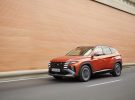
2. Hyundai Tucson Hybrid — from €34,750
The Tucson is the “design” hybrid of the category. Its 1.6 T-GDI HEV system, supported by a 44 kW electric motor, delivers somewhat more aggressive recovery than the Toyota —you notice it when lifting off on a secondary road—, which appeals to the more sporty driver but requires adaptation. On paper it is efficient; in practice it approaches 6.2 l/100 km in real mixed use.
| Power kW | Power hp | Top speed | Range | Consumption | Label | Fuel |
|---|---|---|---|---|---|---|
| 159 kW | 215 hp | 193 km/h | ~800 km | 6.2 l/100 km | ECO | Hybrid |
3. Kia Sportage Hybrid — from €33,900
It shares its platform and system with the Tucson, but Kia has calibrated the brake pedal with slightly different progressiveness. In my view, the Sportage’s regenerative-hydraulic blend feels more natural in the city. That said, on long descents the Toyota still wins thanks to its battery thermal management.
| Power kW | Power hp | Top speed | Range | Consumption | Label | Fuel |
|---|---|---|---|---|---|---|
| 169 kW | 230 hp | 193 km/h | ~800 km | 6.3 l/100 km | ECO | Hybrid |
4. Nissan Qashqai e-Power — from €37,500
Here the philosophy is different. The petrol engine never drives the wheels: it only generates electricity. The result is almost permanent energy recovery in the city and a pedal response that feels electric. On a Madrid–Cádiz run, however, consumption rises above that of the Toyota. It comes down to the usage profile.
| Power kW | Power hp | Top speed | Range | Consumption | Label | Fuel |
|---|---|---|---|---|---|---|
| 140 kW | 190 hp | 170 km/h | ~750 km | 5.3 l/100 km | ECO | Hybrid |
5. Honda CR-V e:HEV — from €42,400
The hidden gem. The e:HEV system from Honda is, technically speaking, the most elegant on the market: two electric motors and a management strategy that in the city works practically like a pure EV. Regeneration via steering-wheel paddles lets you modulate across four levels without touching the brake. A pleasure.
| Power kW | Power hp | Top speed | Range | Consumption | Label | Fuel |
|---|---|---|---|---|---|---|
| 135 kW | 184 hp | 187 km/h | ~850 km | 5.9 l/100 km | ECO | Hybrid |
6. Toyota C-HR — from €38,500
The second Toyota in the ranking because the segment demands it. The latest-generation C-HR fine-tunes energy distribution with a predictive algorithm that reads navigation data and pre-charges the battery before a known descent. A subtle detail that, on mountain roads, makes a real difference in consumption.
| Power kW | Power hp | Top speed | Range | Consumption | Label | Fuel |
|---|---|---|---|---|---|---|
| 144 kW | 197 hp | 180 km/h | ~950 km | 4.9 l/100 km | ECO | Hybrid |
7. Renault Symbioz E-Tech — from €33,200
Renault has matured its E-Tech into a serious rival. Multimode gearbox with dogboxes, always-electric start-off and a “B” mode regeneration that in the city lets you drive almost without using the brake. It is not the most refined, but its price-to-efficiency ratio is among the best in the ranking.
| Power kW | Power hp | Top speed | Range | Consumption | Label | Fuel |
|---|---|---|---|---|---|---|
| 107 kW | 145 hp | 170 km/h | ~900 km | 4.7 l/100 km | ECO | Hybrid |
8. Lexus NX 350h — from €52,900
The group’s premium offering. It shares its technical base with the RAV4 but takes predictive management to another level: the battery works within a wider thermal margin and regeneration feels even more transparent. Expensive, yes, but it has the best hybrid brake feel on the market today.
| Power kW | Power hp | Top speed | Range | Consumption | Label | Fuel |
|---|---|---|---|---|---|---|
| 179 kW | 243 hp | 200 km/h | ~950 km | 5.7 l/100 km | ECO | Hybrid |
Summary table and editorial score
| Model | Price from | Consumption | Power | Energy recovery | Score /10 |
|---|---|---|---|---|---|
| Toyota RAV4 Hybrid | €43,500 | 4.9 l | 183 hp | Excellent | 9.3 |
| Hyundai Tucson Hybrid | €34,750 | 6.2 l | 215 hp | Very good | 8.4 |
| Kia Sportage Hybrid | €33,900 | 6.3 l | 230 hp | Very good | 8.5 |
| Nissan Qashqai e-Power | €37,500 | 5.3 l | 190 hp | Outstanding in town | 8.7 |
| Honda CR-V e:HEV | €42,400 | 5.9 l | 184 hp | Outstanding | 9.0 |
| Toyota C-HR | €38,500 | 4.9 l | 197 hp | Excellent predictive | 9.1 |
| Renault Symbioz E-Tech | €33,200 | 4.7 l | 145 hp | Notable | 8.2 |
| Lexus NX 350h | €52,900 | 5.7 l | 243 hp | Premium benchmark | 9.4 |
Frequently asked questions
Which hybrid SUV has the best energy recovery in Spain in 2026?
The Lexus NX 350h leads in absolute refinement, but the Toyota RAV4 Hybrid offers the best value-for-money-and-efficiency ratio in the ranking, with mature regenerative management and real-world consumption below 6 l/100 km.
Do hybrid SUVs really not need a plug?
No. They recharge the battery through regenerative braking and the combustion engine itself. They are designed for drivers without easy access to a charging point.
What is the difference between Nissan’s e-Power system and a conventional hybrid?
In e-Power the petrol engine never drives the wheels: it only generates electricity. The wheels are always driven by the electric motor, which gives a response closer to that of a 100% electric car.
Is it worth paying more for an Lexus NX over a Toyota RAV4?
They share a technical base, but the NX offers acoustic refinement, superior brake feel and premium cabin quality. If your use is mainly urban, the RAV4 covers 90% of the experience for considerably less money.

 Peugeot E-208 GTi: a battery-powered toy that revives the spirit of the 1980s sports cars
 New Lexus ES: luxury grows and goes electric
 First contact with the Dacia Sandero Hybrid 155: power and efficiency from €19,890
Deja un comentario