The best ECO and city cars for 2026: which one should you choose?
 Iván Navarro
17 April 2026
8 min.
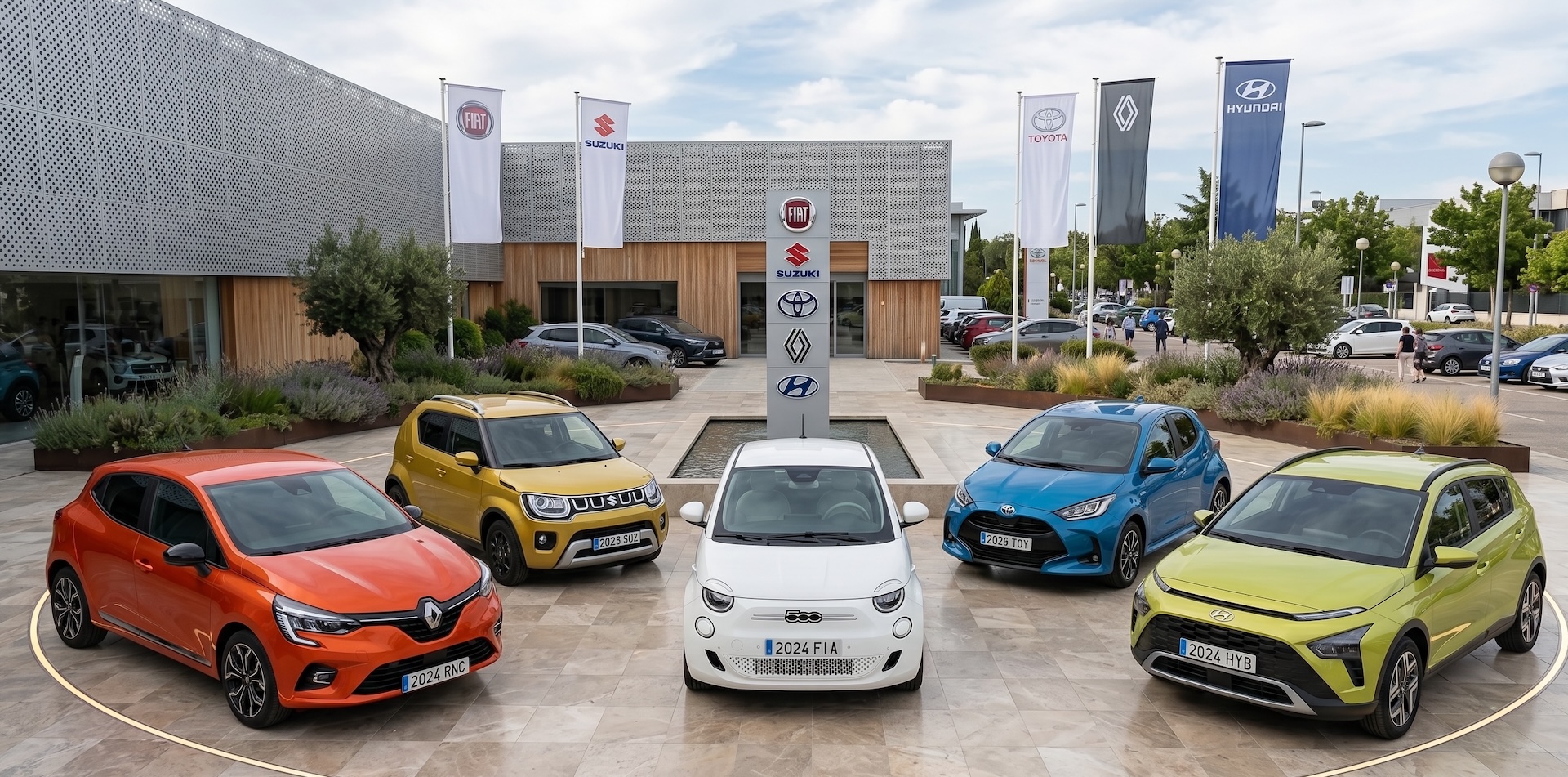
In this article we will explore five models that have managed to conquer the road, offering smart and versatile solutions for the challenges of everyday mobility.
In 2026 the urban market continues the trend towards ECO solutions: models that combine lightweight electrified powertrains with compact dimensions and low consumption for city driving. The offer ranges from mild‑hybrid micro cars to full hybrids, each with different usage approaches: lower daily running costs, easier parking or versatility for short trips. Here you will find a selection of relevant models in Spain, with their strengths, limitations and official starting prices, designed to help you compare options according to real use, budget and priorities of efficiency and urban functionality.
Who is this ranking for?
This ranking is based on market data, official specifications and published road tests. It is designed for anyone looking for an ECO-labelled car that performs well in the city and is cost-efficient.
If you drive many urban kilometres and want to save fuel, this list will help you compare alternatives; if you prioritise size and manoeuvrability for the city, you will find very compact options; if you seek a balance between comfort and efficiency for mixed journeys, there are also suitable models.
What details have we analysed?
We have considered market positioning, official technical data (power and WLTP consumption), dimensions and expected real-world use in urban environments, as well as the price-to-technical-proposition ratio and versatility for peri-urban journeys. Practical aspects such as ease of parking and estimated running costs have also been taken into account.
Ranking of the best ECO and city cars for 2026
Toyota Yaris Hybrid (from €21,900*)
Indicative price without applying public aid or the brand’s commercial discounts.
Why it’s here: The Yaris Hybrid combines a self-charging hybrid system with compact dimensions and low homologated consumption, positioning it as a benchmark in urban efficiency and everyday ease of use. It is a model with a wide presence in the market and a well-established service network.
Ideal for: Drivers who make many daily urban journeys and want to minimise consumption without depending on chargers.
Pros:
- Low average consumption in the city.
- Smooth driving adapted to urban traffic.
- Wide service network and reputation for reliability.
Cons:
- Limited boot space compared with larger supermini cars.
- Limited performance on fast roads.
Renault Clio E‑Tech (from €23,400*)
Indicative price without applying public aid or the brand’s commercial discounts.
Why it’s here: The Clio E‑Tech offers a hybrid powertrain that prioritises efficiency without giving up a more spacious interior and modern equipment. Its focus is on balancing city and nearby road driving, with a finish oriented towards comfort.
Ideal for: Users who need interior space and competent behaviour on occasional motorway trips.
Pros:
- Spacious interior and updated equipment.
- Hybrid system that reduces consumption in mixed use.
- Good ergonomics and comfort for occupants.
Cons:
- Slightly higher weight and technical complexity than micro cars.
- Entry price higher than some basic city cars.
Hyundai Bayon 48V Mild‑Hybrid (from €18,900*)
Indicative price without applying public aid or the brand’s commercial discounts.
Why it’s here: The Bayon combines a compact crossover body with a 48V mild‑hybrid system that reduces consumption and emissions in urban cycles. It offers greater load versatility and a raised driving position within its segment.
Ideal for: Drivers who want easy urban use with greater versatility on secondary roads.
Pros:
- Greater load space compared with small city cars.
- Improved efficiency thanks to the 48V system.
- Good equipment-to-price ratio in basic versions.
Cons:
- Does not offer pure electric driving.
- Average acceleration performance.
Fiat 500 Hybrid (from €15,900*)
Indicative price without applying public aid or the brand’s commercial discounts.
Why it’s here: The Fiat 500 Hybrid keeps the iconic styling and size of the 500 with a mild‑hybrid powertrain that reduces consumption and emissions in the city. It is a very compact and practical option for parking in central areas.
Ideal for: Those looking for a very small car for urban use and a low purchase cost.
Pros:
- Excellent size and manoeuvrability for the city.
- Competitive entry price.
- Design and ease of parking.
Cons:
- Limited interior space and boot.
- Less comfortable motorway behaviour due to its urban focus.
Suzuki Ignis Mild Hybrid (from €16,700*)
Indicative price without applying public aid or the brand’s commercial discounts.
Why it’s here: The Ignis offers an ultra-compact crossover format with a mild‑hybrid system that benefits urban use and allows you to combine low running costs with the ability to occasionally travel on faster roads.
Ideal for: Those who need a city car with a bit more height and everyday practicality.
Pros:
- Comfortable front seats and a raised driving position.
- Low consumption in the city.
- Very practical dimensions for garages and narrow streets.
Cons:
- Basic interior material quality in entry versions.
- Limited motorway range due to the small-displacement engine.
The prices shown in this ranking are indicative and do not apply public aid or the brand’s commercial discounts.
Technical comparison
| Model | Range | Power | Consumption | Top speed | Price (€*) |
|---|---|---|---|---|---|
| Toyota Yaris Hybrid | ND | 116 CV | 4.3 l/100 km (WLTP) | 175 km/h | 21,900 €* |
| Renault Clio E‑Tech | ND | 140 CV | 4.6 l/100 km (WLTP) | 180 km/h | 23,400 €* |
| Hyundai Bayon 48V | ND | 100 CV | 4.9 l/100 km (WLTP) | 180 km/h | 18,900 €* |
| Fiat 500 Hybrid | ND | 70 CV | 4.0 l/100 km (WLTP) | 164 km/h | 15,900 €* |
| Suzuki Ignis Mild Hybrid | ND | 83 CV | 4.4 l/100 km (WLTP) | 165 km/h | 16,700 €* |
These data are official and taken from the brands’ official websites.
Purchase aid in 2026: Plan Auto+ and tax benefits
The Plan Auto+ 2026 replaces previous programmes and establishes a new system of direct aid for purchasing electrified vehicles in Spain, with priority for pure electric cars and conditions for hybrids and mild‑hybrids. Regions may supplement the plan with their own programmes.
Main amounts of Plan Auto+ 2026
- Direct aid of up to €4,500 for electric passenger cars.
- Up to €5,000 for light vans in category N1.
- Retroactive effect from 1 January 2026.
- Approximate budget allocation of €400 million.
Who can benefit and priority criteria
Beneficiaries: individuals, self-employed workers and companies. The EEE criterion (Electric, Economic and European) is applied to prioritise pure electric vehicles over plug-in hybrids and mild‑hybrids. Passenger cars priced below €35,000 receive greater aid; between €35,000 and €45,000 the aid is reduced. There is an additional incentive if the final assembly or the batteries come from the European Union.
Additional requirements and tax advantages
The plan requires a mandatory minimum discount of €1,000 from the dealership. A 15% deduction on personal income tax is provided, up to a maximum of €3,000, and the tax validity of these measures is set until 31 December 2026.
Management and possible regional aid
Management is coordinated by the Ministry of Industry together with the Autonomous Communities. Additional regional programmes may exist, for example the Plan Cambia 360 in the Community of Madrid. At the time of writing, it is not officially confirmed whether these regional aids are compatible with Plan Auto+ 2026.
FAQ · The 5 questions everyone asks
What is the difference between an ECO-labelled car and a zero-emission one?
The ECO label identifies lightweight electrified vehicles (mild‑hybrid, self-charging hybrids, LPG or CNG) that reduce emissions; the 0 label corresponds to pure electric cars with WLTP range and zero local emissions.
Is a mild‑hybrid worth it for urban use?
In the city a mild‑hybrid reduces consumption and pull-away fuel use, which shows on fuel bills; profitability depends on the entry price and habitual use (more short trips favour savings).
Can I apply for Plan Auto+ for an ECO mild‑hybrid car?
Plan Auto+ prioritises electric cars, but it provides aid for other electrified vehicles under price conditions and EEE criteria; it is advisable to check price limits and mandatory discounts from the dealership.
What costs should I consider besides the purchase price?
You should consider real consumption, maintenance costs, insurance, local taxes and ease of resale; energy efficiency and the model’s demand influence the total cost of ownership.
How do size and power affect suitability for the city?
In the city, compact size and agility matter most; moderate power is sufficient and what is relevant is behaviour in dense traffic and the consumption linked to your daily routine.
Expert’s conclusion
This ranking summarises the most practical options for driving in the city with an ECO label in 2026: each model offers a balance between efficiency, size and cost. What it means for the buyer is choosing according to their routine: if your priority is to reduce daily spending, look for models with efficient hybrid systems; if you need space, consider larger superminis with electrified powertrains; if ease of parking matters most, the most compact option is usually the best.
To decide, look at two safe criteria: value for money and market demand. If you want to get the most for your money, first check the real entry price and what comes as standard. If the model is in high demand, it is normally also easier to sell later. And if you drive many kilometres, energy cost and efficiency matter more than the power figure.


 Peugeot E-208 GTi: a battery-powered toy that revives the spirit of the 1980s sports cars
 New Lexus ES: luxury grows and goes electric
 First contact with the Dacia Sandero Hybrid 155: power and efficiency from €19,890
Deja un comentario