The Cupra e-Racer strips down to show us all its mechanical components and how it works
 Javier López @jlopezbryan96
19 December 2018
3 min.
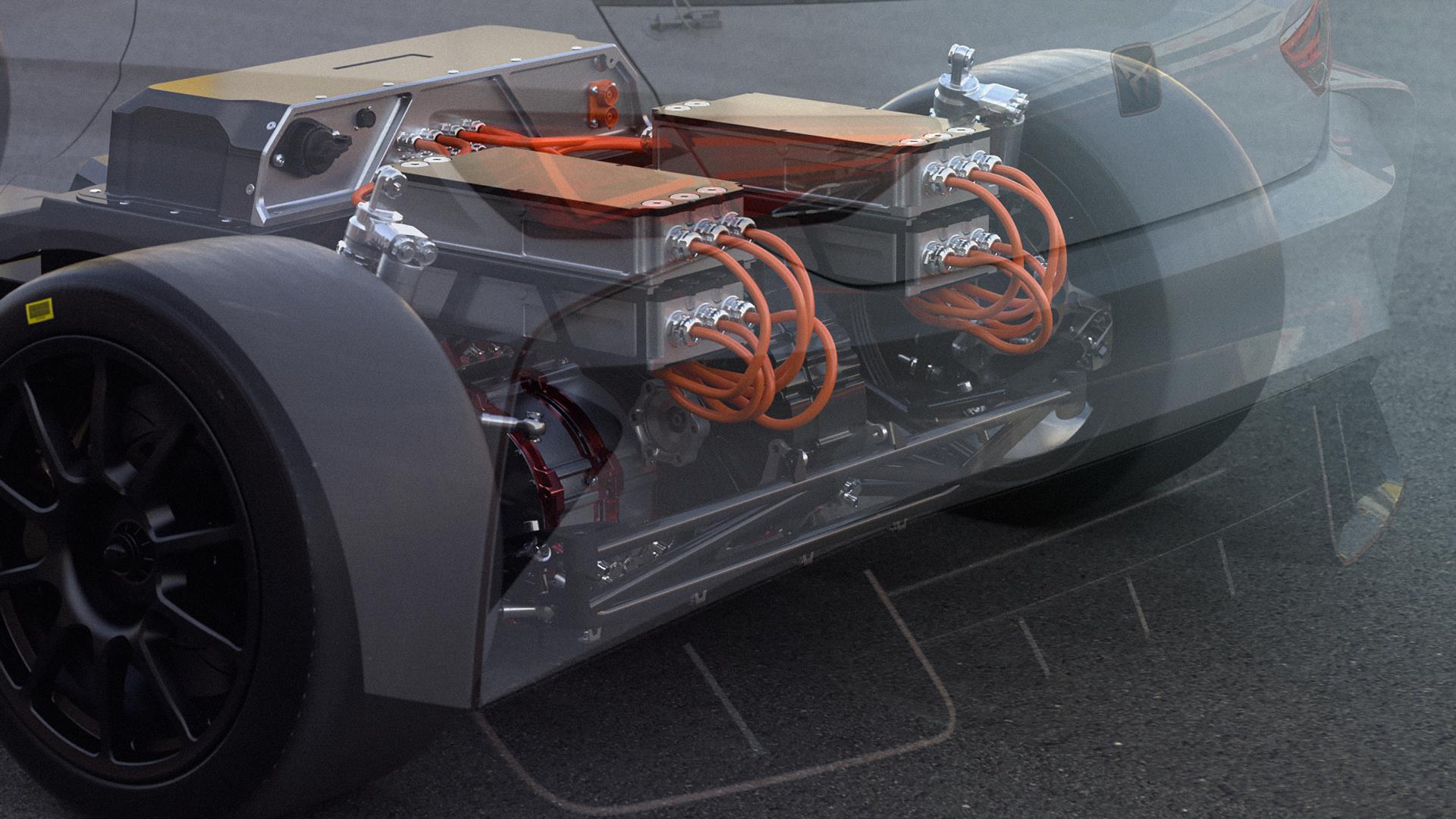
Cupra has stripped the e-Racer down to show us all its mechanical components, which come together to deliver absolute precision on the track.
As true lovers of motorsport, many of us have surely felt an immense curiosity about how the heart of our car works, a curiosity that has grown even stronger with the arrival of electric vehicles. Cupra, the new brand that is responsible for housing the sporting versions of SEAT models within its ranks, has wanted to satisfy our thirst for knowledge with the e-Racer, its electric racing model. To do so, the Spanish company has completely stripped down the e-Racer, with the aim of showing its inner anatomy and allowing us to appreciate each and every one of the components that bring this purely electric vehicle to life and ready to race.
Behind the aggressive look of the Cupra e-Racer we find a mechanical layout that in no way falls short of the aerodynamic package visible at first glance. This has been developed to deliver perfect balance on the asphalt, where sportiness and precision go hand in hand to cover the track in the shortest possible time.
At first we come across one of the essential components of the Cupra e-Racer: its battery. It weighs 450 kilos on the scale, a figure that accounts for a third of the car’s total weight. As Xavier Serra, head of engineering at Cupra, explains, they sought a position for the battery “as low as possible to achieve a centre of gravity closer to the ground and enhance the car’s dynamics.”
In turn, it is made up of 23 panels with a total of 6,072 cells, a power output equivalent to 9,000 mobile phones connected at the same time. To complement the battery we find four green motors positioned on the rear axle, which are capable of generating a total of 680 CV of power. Despite the immense power with which the e-Racer treats its drivers, Serra states that the Cupra e-Racer’s mechanical package is much simpler to manage than that of a combustion engine with similar performance.
On this premise, SEAT’s first electric offspring is capable of reaching 100 km/h in 3.2 seconds and a top speed of 270 km/h, a performance also made possible by having just a single gear. Another important asset of the e-Racer for maximum performance is that it does not lose energy but transforms it. This is possible thanks to an energy recovery system, which harnesses power under braking and deceleration.
https://youtu.be/35pmoA0R6wA
Last but not least, we come across an impressive temperature control system, made up of a cooling system built into the radiator capable of cooling all the mechanical components in just 20 minutes. In this way, Cupra wants to show not only its latest technology for the world of motorsport, but also various elements that will be key to the future road-going hybrid and electric vehicles that the Spanish company will develop.


 Peugeot E-208 GTi: a battery-powered toy that revives the spirit of the 1980s sports cars
 New Lexus ES: luxury grows and goes electric
 First contact with the Dacia Sandero Hybrid 155: power and efficiency from €19,890
Deja un comentario