The electric range of the Hyundai Tucson's plug-in hybrid rivals
 Iván Navarro
11 March 2026
8 min.
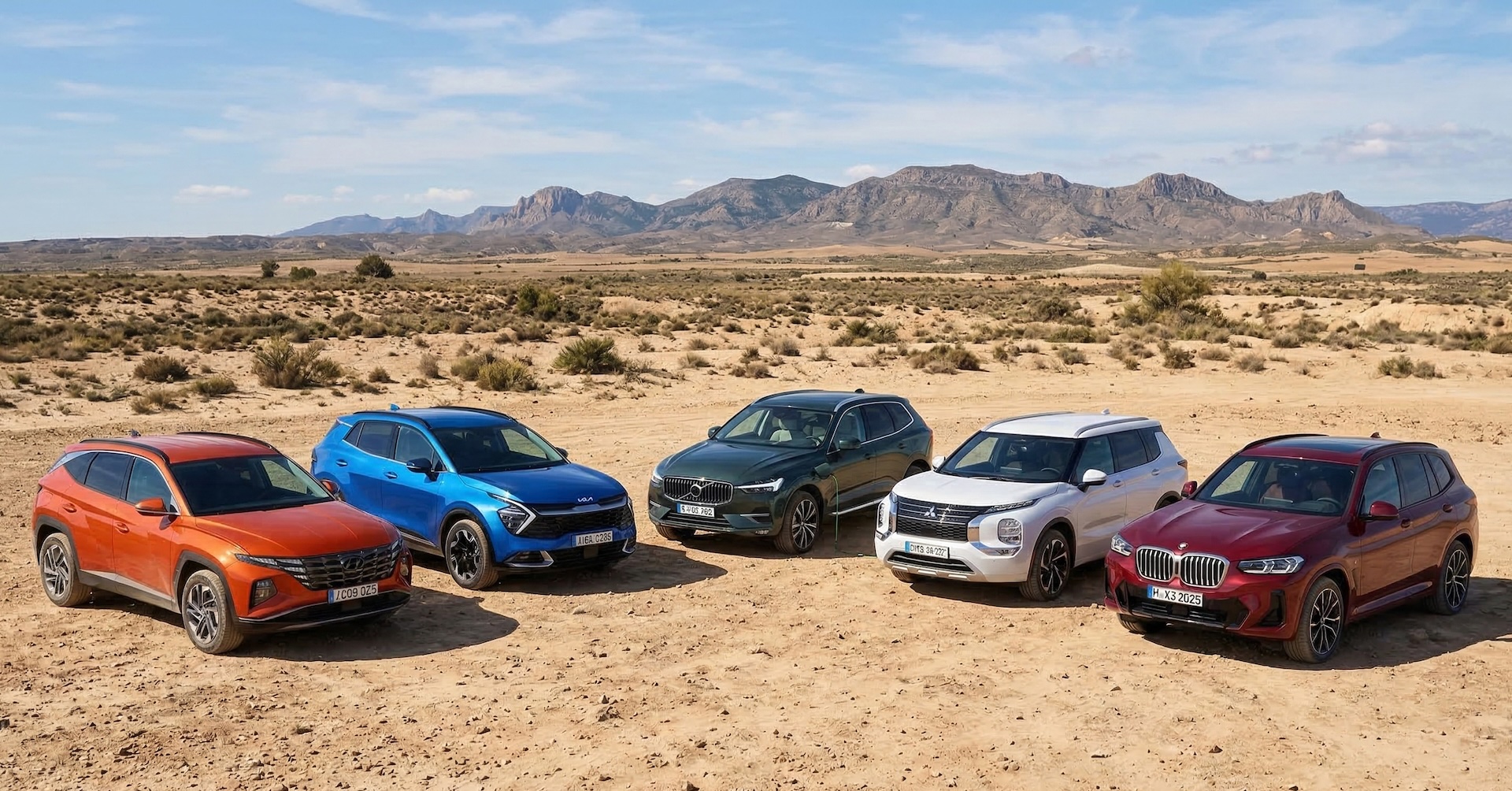
Electric range is one of the most important factors to consider when choosing a plug-in hybrid, as it will allow us to save more on our journeys within urban areas.
In 2026, the plug-in hybrid segment continues to offer practical alternatives for those looking to reduce consumption and emissions without giving up range on long journeys. The offer has matured: larger batteries, more efficient charging and technical versions that prioritise driving in electric mode. This review groups relevant models by their real electric capability, their market positioning and their everyday usefulness, and compares options for different uses and budgets.
Who is this ranking for?
This ranking is based on market data, official specifications and published tests. It is designed to guide you through a market where electric range varies greatly depending on the vehicle’s architecture and battery configuration.
If you do a lot of urban mileage and want to consume less day to day, this list helps you prioritise models with more electric range. If you are looking for a balance between travel and cost, or a family SUV with hybrid capability for long routes, here you will find comparisons that clarify differences in use and positioning.
What details have we analysed?
We have taken into account market positioning, homologated electric range (WLTP), combined power and official consumption figures, dimensions and expected real-world use, as well as the value-for-money relationship and technical approach to assess what each model offers in its segment.
Ranking of plug-in hybrids with the best range in 2026
Hyundai Tucson PHEV (from 39,100 €*)
Indicative price without applying public aid or the brand’s commercial discounts.
Why it’s here: It combines an optimised battery and thermal management that allow competitive electric journeys in its compact SUV category; a clear positioning in relation to equipment and price in the segment.
Ideal for: Drivers who alternate between city and short trips and who want a practical SUV with good electric range for everyday use.
Pros:
- Competitive electric range on the WLTP cycle for its size.
- Connectivity and equipment in line with its segment.
- Good value-for-money technical approach.
Cons:
- Towing capacity and range at full load lower than large SUVs.
- Slow domestic AC charging in basic configurations.
Kia Sportage PHEV (from 38,900 €*)
Indicative price without applying public aid or the brand’s commercial discounts.
Why it’s here: Plug-in version of a model with improved design and efficiency; it offers a balance between useful electric range and acquisition cost, along with equipment options aligned with the range.
Ideal for: Users looking for a versatile compact SUV with priority on efficiency and cost per kilometre.
Pros:
- Electric range sufficient for most urban journeys.
- Segment-level technological equipment.
- Accessible maintenance and service network in European markets.
Cons:
- Somewhat reduced boot space in some versions due to the battery.
- Pure performance dependent on the thermal-electric combination.
Volvo XC60 Recharge (from 67,000 €*)
Indicative price without applying public aid or the brand’s commercial discounts.
Why it’s here: Premium approach focused on efficiency and comfort; the PHEV configuration prioritises usable real electric range in the city and balanced dynamic behaviour.
Ideal for: Buyers looking for a mid-size SUV focused on comfort, safety and hybrid performance without giving up electric range.
Pros:
- Finish quality and active safety above average.
- Adequate electric range for urban use and short trips.
- Good integration of hybrid and assistance systems.
Cons:
- Entry price higher than compact SUVs.
- Higher maintenance and repair costs than mainstream models.
Mitsubishi Outlander PHEV (from 41,000 €*)
Indicative price without applying public aid or the brand’s commercial discounts.
Why it’s here: Historically a benchmark among PHEVs for its light off-road approach and towing capability; the 2026 version maintains a practical focus and electric range geared to family use.
Ideal for: Families or those who need more versatility and mixed-use options, with attention to light all-terrain behaviour.
Pros:
- Versatility and towing ability in its category.
- Design geared to family use and carrying equipment.
Cons:
- Platform less refined in dynamics compared with premium competitors.
- Cabin and interior finish with room for improvement compared with recent rivals.
BMW X3 xDrive30e (from 63,500 €*)
Indicative price without applying public aid or the brand’s commercial discounts.
Why it’s here: It combines engines and hybrid management focused on performance with electric range geared to urban journeys; it positions itself as an option for those who want performance without giving up efficient driving.
Ideal for: Drivers who want a premium SUV with sporty sensitivity and electric capability for daily use.
Pros:
- Dynamic response and tuning oriented to performance.
- Technological integration and material quality.
Cons:
- High entry price compared with mainstream alternatives.
- Moderate electric range compared with models specifically designed for efficiency.
The prices listed in this ranking are indicative and do not apply public aid or the brand’s commercial discounts.
Technical comparison
| Model | Range | Power | Consumption | Top speed | Price (€*) |
|---|---|---|---|---|---|
| Hyundai Tucson PHEV | 48–61 km WLTP | ~265 CV | 1.2–1.6 l/100 km (WLTP combined) | 180–200 km/h | 39,100 |
| Kia Sportage PHEV | 50–65 km WLTP | ~265 CV | 1.1–1.6 l/100 km (WLTP combined) | 180–200 km/h | 38,900 |
| Volvo XC60 Recharge | 40–55 km WLTP | ~350 CV | 1.5–2.0 l/100 km (WLTP combined) | 200–230 km/h | 67,000 |
| Mitsubishi Outlander PHEV | 40–55 km WLTP | ~230 CV | 1.4–1.8 l/100 km (WLTP combined) | 170–190 km/h | 41,000 |
| BMW X3 xDrive30e | 45–55 km WLTP | ~300 CV | 1.3–1.8 l/100 km (WLTP combined) | 200–230 km/h | 63,500 |
These data are official and taken from the brands’ official websites.
Purchase aid in 2026: Plan Auto+ and tax benefits
The 2026 Plan Auto+ replaces the previous MOVES programmes and establishes a new system of direct aid for the purchase of electrified vehicles in Spain, with updated conditions and requirements.
Main amounts of the 2026 Plan Auto+
– Direct aid of up to 4,500 € for electric passenger cars.
– Up to 5,000 € for light vans in category N1.
– Retroactive effect from 1 January 2026.
– Approximate budget allocation of 400 million euros.
Who can benefit and priority criteria
Beneficiaries are individuals, self-employed workers and companies; the application of the EEE criterion (Electric, Economic and European) prioritises BEV vehicles over PHEVs. Vehicles priced below 35,000 € receive higher aid; between 35,000 € and 45,000 € the aid is reduced. There is an additional incentive if the final assembly or the batteries are of EU origin.
Additional requirements and tax advantages
The Plan establishes a mandatory minimum discount of 1,000 € from the dealership, a 15% deduction on personal income tax (IRPF) up to a maximum of 3,000 €, and tax validity until 31 December 2026.
Management and possible regional aid
Management is coordinated by the Ministry of Industry together with the Autonomous Communities; additional regional programmes may exist. Example: Plan Cambia 360 in the Community of Madrid. At the time of writing, it is not officially confirmed whether these regional aids are compatible with the 2026 Plan Auto+.
FAQ · The 5 questions everyone asks
What electric range should I expect from a PHEV today?
The WLTP electric range of a PHEV is usually between 40 and 65 km depending on the model and battery. For daily urban use it covers most journeys; on the road the range is reduced by speed and temperature.
Is a PHEV worth it compared with a BEV for long-distance travel?
A PHEV offers greater flexibility by combining a combustion engine and an electric motor, avoiding limitations in charging infrastructure. However, for sustained long journeys a BEV with good range and a fast-charging network may be more efficient in cost per kilometre.
How does the battery affect boot capacity?
In many PHEVs the battery slightly reduces the loading volume compared with the combustion version; the impact varies by platform and should be checked in the official technical sheet if space is decisive for your plans.
What additional maintenance does a PHEV require?
Maintenance combines the usual combustion-engine servicing with checks on the electric part: battery management, power electronics and possible checks of the charging unit. It is generally not substantially more complex than a combustion car with regular maintenance.
Should public aid be considered when comparing prices?
Yes. Aid reduces the cost of entry and can change the value-for-money relationship between models, especially when the price difference between electrified and combustion versions is small.
Expert conclusion
This ranking shows that in 2026 plug-in hybrids already offer electric ranges useful for everyday life, but the differences between models stem from different technical approaches: some prioritise efficiency and accessible price, others comfort and performance. For the buyer, the choice is not only a matter of electric kilometres, but of how that use fits into their routine.
If you want to make your money go further, first look at the real entry price and what comes as standard. If you prefer to play it safe, consider models with strong market traction and a service network; if your use is mainly urban, prioritise WLTP electric range and real loss in daily use. And if you do a lot of mileage, energy cost and efficiency matter more than the power figure. If you won’t charge often, don’t buy from the catalogue: buy for your routine.


 Peugeot E-208 GTi: a battery-powered toy that revives the spirit of the 1980s sports cars
 New Lexus ES: luxury grows and goes electric
 First contact with the Dacia Sandero Hybrid 155: power and efficiency from €19,890
Deja un comentario