Toyota C-HR vs Hyundai Kona Hybrid: urban hybrid SUV showdown in 2026
 Iván Navarro
16 May 2026
5 min.
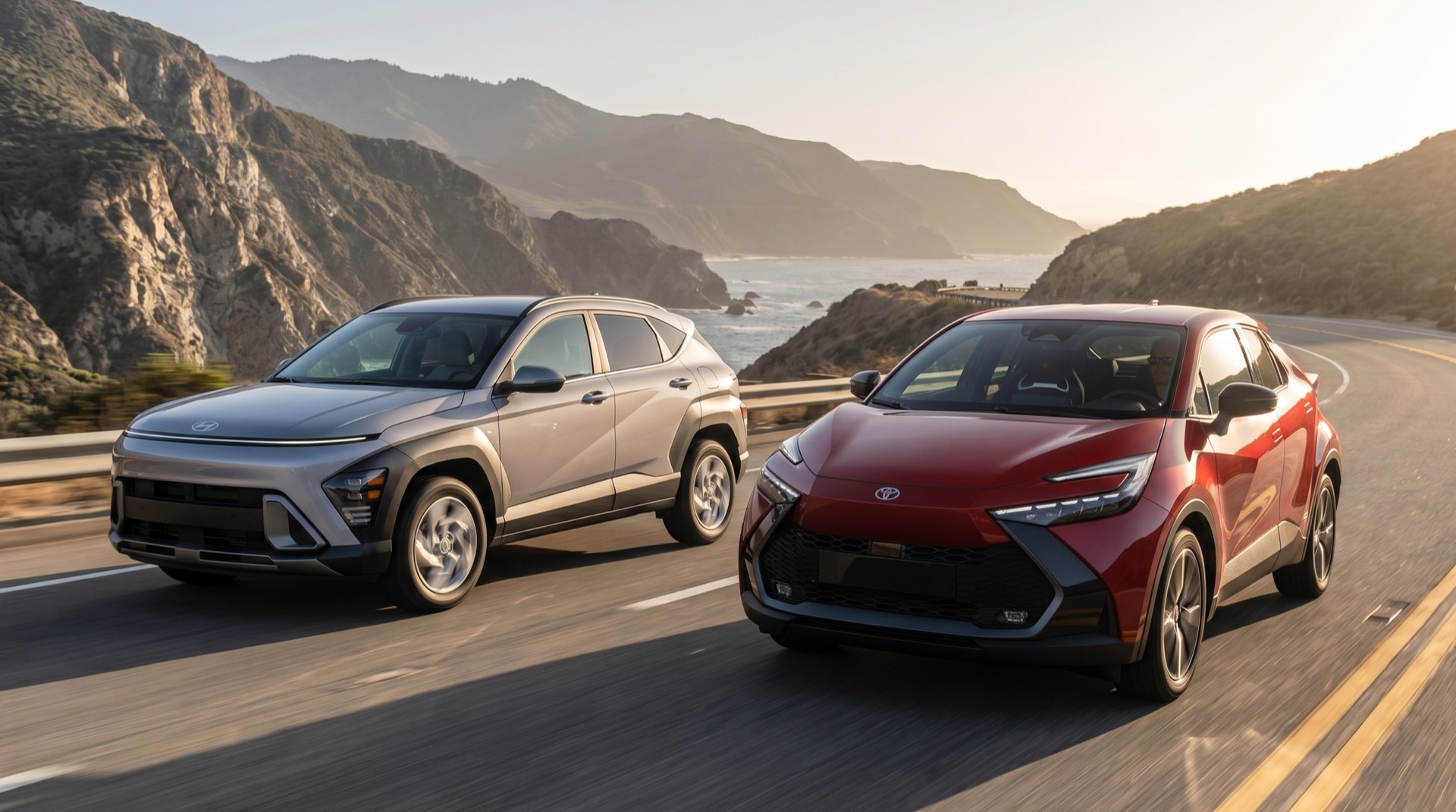
We compare the 2026 Toyota C-HR Hybrid against the 2026 Hyundai Kona Hybrid: WLTP consumption, price in Spain, equipment and warranty in the urban hybrid SUV segment.
The urban hybrid SUV segment is enjoying its golden moment in Spain. With traffic restrictions tightening in the big cities and the ECO label as everyday access pass, two models attract much of the attention of the rational buyer: the Toyota C-HR, an undisputed benchmark of self-charging hybridisation, and the Hyundai Kona Hybrid, a rival that bets on technology, disruptive design and a warranty that is hard to match. This 2026 urban hybrid SUV comparison pits them face to face.
Context: why urban hybrid SUVs matter in 2026
The Spanish buyer of compact SUVs no longer looks for diesel nor settles for a pure petrol engine. They want an ECO label, consumption below five litres and a size that is manageable in car parks. In that territory, conventional hybridisation — no plugs, no bulky batteries — has become the most pragmatic solution. And there, the Toyota C-HR vs Hyundai Kona Hybrid duel sums up almost everything the market can offer today.
Toyota C-HR Hybrid from 32,500 €
The 2026 Toyota C-HR Hybrid keeps betting on a sculptural, almost conceptual design, which remains the most daring in its category. The second generation refines the silhouette, improves aerodynamics and fine-tunes its fifth-generation hybrid system. The entry 1.8-litre variant delivers 140 CV combined, while the 2.0 rises to 197 CV with surprisingly agile response for a conventional hybrid.
Its great asset remains consumption: in real urban driving it is common to go below 4.5 l/100 km, thanks to electronic management that prioritises electric mode in pull-aways and traffic jams. The perceived quality of the interior has taken a notable leap, with soft-touch materials, a dual 12.3" screen and a multimedia system finally up to the task.
| Potencia kW | Potencia CV | Velocidad máx. | Autonomía | Consumo | Etiqueta | Combustible |
|---|---|---|---|---|---|---|
| 103 kW | 140 CV | 170 km/h | ~950 km | 4,7 l/100 km | ECO | Híbrido |
C-HR design and interior space
The C-HR sacrifices some practicality in favour of style: the boot stays at 388 litres and the rear seats, with the very high waistline, convey a certain feeling of enclosure. In return, it offers a low, sporty driving position, closer to a coupé than to a conventional SUV.
Consumption and hybrid efficiency
Here Toyota plays at home. The Hybrid Synergy Drive system has been perfected over three decades and it shows: imperceptible transitions between combustion and electric motors, very well calibrated regenerative braking and exemplary behaviour in town. It is, quite simply, the benchmark.
Hyundai Kona Hybrid from 28,900 €
The 2026 Hyundai Kona Hybrid takes a different strategy: to look like a bigger car for less money. Its futuristic design, with the continuous LED strip and angular wheel arches, catches the eye as much as the C-HR but from a different aesthetic school. Under the bonnet it fits a 1.6 GDI paired with an electric motor, with 141 CV combined and, pay attention, a six-speed dual-clutch gearbox — not a CVT — which translates into a more conventional response to the pedal.
Where the Kona hits hard is interior space: 466 litres of boot, notable rear room and ergonomics designed for family use. It adds curved 12.3" screens, wireless charging, a head-up display on higher trims and the unbeatable 5-year warranty with no mileage limit.
| Potencia kW | Potencia CV | Velocidad máx. | Autonomía | Consumo | Etiqueta | Combustible |
|---|---|---|---|---|---|---|
| 104 kW | 141 CV | 165 km/h | ~900 km | 5,0 l/100 km | ECO | Híbrido |
Kona technology and equipment
Hyundai has understood that the young buyer values the screen as much as the mechanics. The 2026 Kona Hybrid offers as standard wireless integration with Android Auto and Apple CarPlay, level 2 driver assistants and a 360º camera system available on mid-range trims.
Warranty and after-sales
Five years against Toyota’s three (extendable with servicing at the official network up to ten years on the battery). A weighty argument for anyone planning to keep the car beyond the fourth year.
Direct comparison: consumption, price and boot
Comparing the consumption of the Toyota C-HR and the Hyundai Kona, the Japanese car wins by a few tenths; on price, the Korean starts cheaper; on boot space, the Kona clearly prevails.
| Modelo | CV | Consumo WLTP | Maletero | Garantía | Precio desde | Puntuación |
|---|---|---|---|---|---|---|
| Toyota C-HR Hybrid | 140 | 4,7 l | 388 l | 3 años | 32.500 € | 8,7/10 |
| Hyundai Kona Hybrid | 141 | 5,0 l | 466 l | 5 años | 28.900 € | 8,5/10 |
Which is the best urban hybrid SUV?
If the absolute priority is consumption and proven reliability, the Toyota C-HR remains the segment’s benchmark. If what you are looking for is more space, more equipment per euro and a reassuring warranty, the Hyundai Kona Hybrid stands as the most rational purchase. There is no loser: there are two philosophies.
Frequently asked questions
Which consumes less, the Toyota C-HR or the Hyundai Kona Hybrid?
The Toyota C-HR is homologated at 4.7 l/100 km versus the Kona’s 5.0 l, a difference that widens in urban use thanks to its more refined hybrid system.
Which has the better warranty?
The Hyundai Kona Hybrid offers 5 years with no mileage limit, versus the Toyota C-HR’s 3 years (extendable via the official network).
Which is cheaper in Spain?
The Hyundai Kona Hybrid starts at 28,900 €, about 3,600 € below the Toyota C-HR.
Which has more boot space?
The Kona offers 466 litres versus the C-HR’s 388, clearly more practical for family use.


 Kia offers an electric range of 10 models, 50 versions and 400 possible combinations
 The seven finalists for the 2027 European Car of the Year (COTY) are exclusively electric
 Peugeot E-208 GTi: a battery-powered toy that revives the spirit of the 1980s sports cars
Deja un comentario