Corolla Cross Honda HR-V Toyota Hybrid Cars Comparisons Tests SUV
Honda HR-V e:HEV vs Toyota Corolla Cross Hybrid: which hybrid SUV dominates the city?
 Iván Navarro
16 May 2026
5 min.
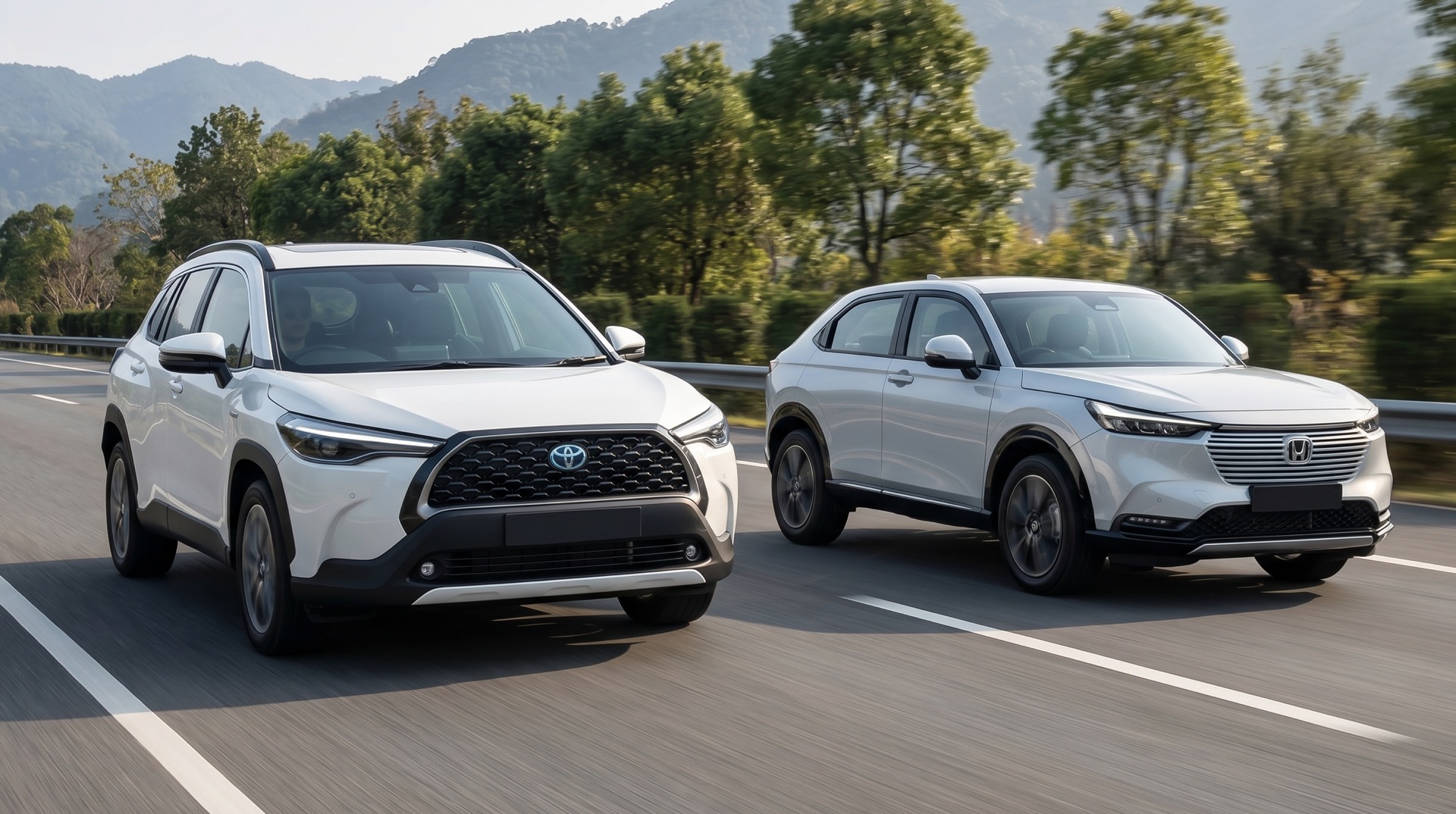
A technical comparison between the Honda HR-V e:HEV and the Toyota Corolla Cross Hybrid to find out which urban hybrid SUV offers the best fuel consumption, technology and price in Spain.
The compact hybrid SUV segment is enjoying its golden age in Spain. Two undisputed contenders are vying for the urban driver’s favour: the Honda HR-V e:HEV and the Toyota Corolla Cross Hybrid. Both carry the ECO label, both promise supermini-level consumption and both represent two very different philosophies of electrification. One is based on a series-parallel system with an electric focus; the other inherits two decades of planetary gear refinement developed in Aichi. Let’s see which one fits best into daily life in Madrid, Barcelona or Valencia.
The B-SUV hybrid showdown in Spain
The Spanish market has established the hybrid B-SUV segment as the rational choice for anyone who wants ground clearance, the DGT ECO label and modest consumption without needing a plug. Honda and Toyota have spent decades refining their own hybrid architectures and, although they share the same goals, their technical paths diverge.
Honda HR-V e:HEV (from €30,900)
The HR-V e:HEV uses the well-known e:HEV system with two electric motors and a 1.5 i-MMD petrol engine that works almost always as a generator. In town, the HR-V runs practically in pure electric mode: the combustion engine only starts to recharge the battery or, occasionally, to connect directly to the wheels on the motorway. The result is a smooth, quiet response with a pedal feel closer to an electric car than a conventional hybrid.
Its coupé-SUV design (4.34 m) sacrifices some boot space (319 litres) in exchange for a sleeker look, but the rear Magic Seats remain a unique asset in the segment. Superior interior finish, refined driving and real-world city consumption of around 4.5-5.0 l/100 km.
| Power kW | Power hp | Top speed | Range | Consumption | Label | Fuel |
|---|---|---|---|---|---|---|
| 96 kW | 131 CV | 170 km/h | ~850 km | 5.4 l/100 km | ECO | Hybrid |
Toyota Corolla Cross Hybrid (from €32,500)
The Corolla Cross uses the fourth-generation Hybrid Synergy Drive system with a planetary gear set, paired with the 2.0 Atkinson-cycle engine in its 197 CV version (a 1.8 with 140 CV is also available). The Toyota philosophy relies on mechanically integrating the combustion engine through epicyclic gears, which translates into maximum efficiency in mixed use and a more linear sense of acceleration.
At 4.46 m long, the Corolla Cross is noticeably more spacious: 425 litres of boot space, better rear accommodation and a clearly more family-oriented layout. Its real-world urban consumption falls between 4.2 and 4.8 l/100 km, with the 2.0 version surprising by keeping figures low despite its higher power.
| Power kW | Power hp | Top speed | Range | Consumption | Label | Fuel |
|---|---|---|---|---|---|---|
| 145 kW | 197 CV | 180 km/h | ~900 km | 5.0 l/100 km | ECO | Hybrid |
Hybrid technology: series e:HEV vs planetary Toyota
Here lies the heart of the debate. The e:HEV in Honda is essentially a series hybrid with a direct bypass: in town you will never notice the petrol engine working to drive the wheels. The HSD in Toyota splits torque between electric and combustion via a planetary splitter, offering greater versatility outside urban environments. In dense traffic, the Honda system feels more electric; in mixed use, Toyota is unbeatable on efficiency.
Real-world city consumption: the decisive factor
In pure traffic jams and constant stop-start driving, the HR-V e:HEV shines thanks to its ability to run on electric power over long stretches. The Corolla Cross, however, is more efficient when city driving is combined with faster roads. The practical difference is just 0.3-0.5 l/100 km in favour of the Toyota in mixed use; a technical tie in 100% urban use.
Space, boot and life on board
The Corolla Cross wins on cubic capacity and rear seats; the HR-V responds with its Magic Seats and a more refined interior design. If you regularly carry family and luggage, Toyota. If you prioritise urban manoeuvrability and perceived quality, Honda.
ECO label and urban taxation
Both carry the DGT ECO label, which guarantees access to Madrid’s Low Emission Zone, Barcelona’s ZBE and parking discounts in most Spanish cities. Complete parity on this point.
Summary table and rating
| Model | Price from | Power | City consumption | Boot | Label | Rating |
|---|---|---|---|---|---|---|
| Honda HR-V e:HEV | €30,900 | 131 CV | 4.5-5.0 l | 319 l | ECO | 8.5/10 |
| Toyota Corolla Cross Hybrid | €32,500 | 140-197 CV | 4.2-4.8 l | 425 l | ECO | 8.8/10 |
Verdict: which one dominates the city?
If your life is spent between traffic lights and narrow car parks, the Honda HR-V e:HEV offers the experience closest to an electric car, with better manoeuvrability and a more premium interior. If you need a more versatile car that also excels in town, the Toyota Corolla Cross Hybrid is the more rational choice: more space, more power and slightly better real-world consumption.
Frequently asked questions
Which hybrid SUV uses less fuel in town, the Honda HR-V e:HEV or the Toyota Corolla Cross Hybrid?
In pure urban traffic they are very closely matched (4.2-5.0 l/100 km). The HR-V e:HEV feels more electric, while the Corolla Cross edges ahead in mixed city-outskirts use.
Do both have the DGT ECO label?
Yes. Both models, being approved self-charging hybrids, carry the ECO label and can enter the Low Emission Zones of Spain’s main cities.
Which offers more interior space?
The Toyota Corolla Cross Hybrid, with 425 litres of boot space versus the HR-V’s 319, plus better rear accommodation thanks to its 12 cm of extra length.
Which hybrid technology is better for the city?
The Honda e:HEV system works as a series hybrid in urban driving, almost always running on electric power. It is the option closest to an electric car without needing a plug.
Technical specifications of the cars in this article


 Kia offers an electric range of 10 models, 50 versions and 400 possible combinations
 The seven finalists for the 2027 European Car of the Year (COTY) are exclusively electric
 Peugeot E-208 GTi: a battery-powered toy that revives the spirit of the 1980s sports cars
Deja un comentario