Hybrid Cars Comparisons Family Tests
Toyota RAV4 vs Honda CR-V: which family hybrid SUV offers better comfort and equipment for less than 45,000 euros
 Iván Navarro
1 August 2026
6 min.
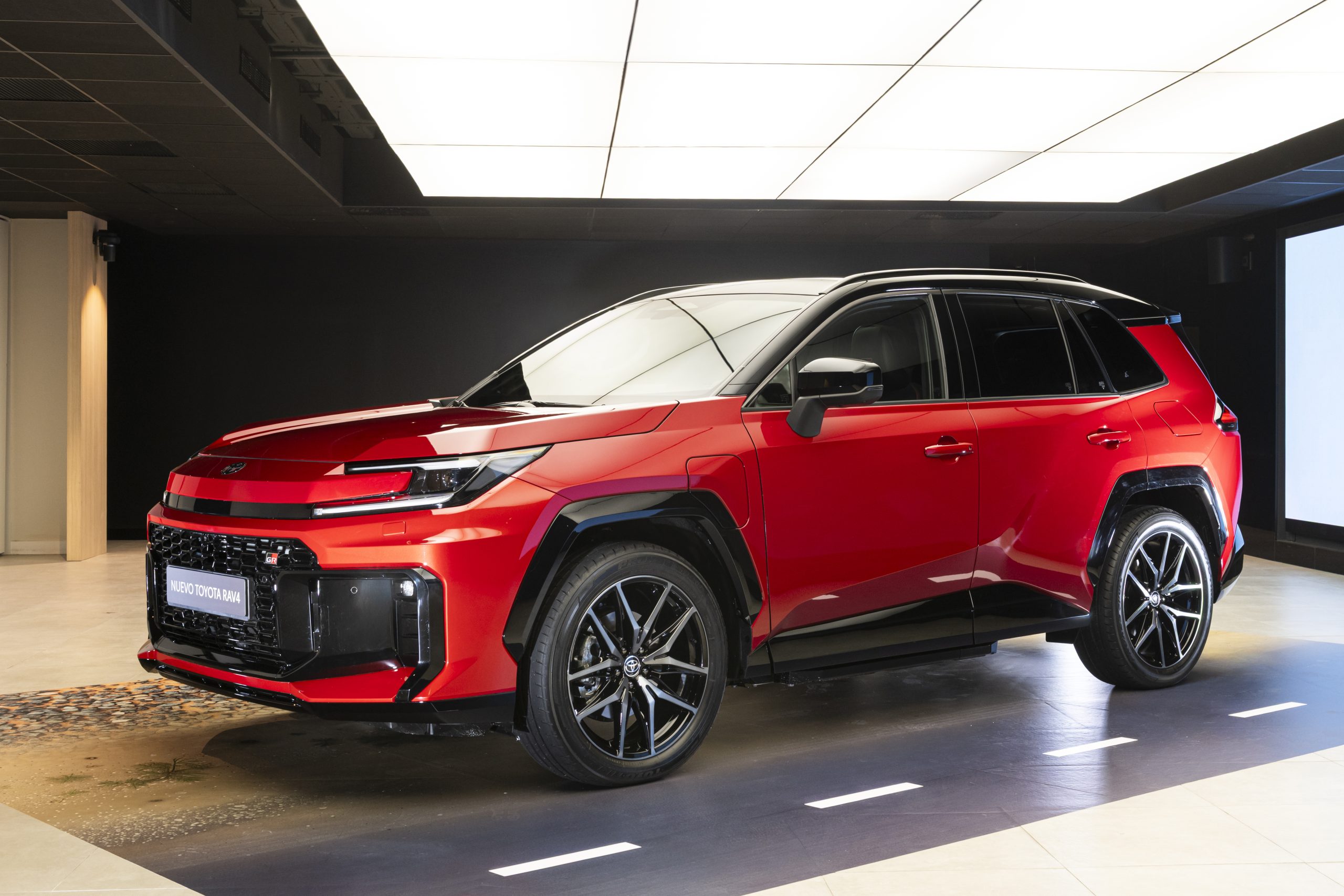
We compare the Toyota RAV4 Plug-in Hybrid Advance and the Honda CR-V Hybrid i-MMD Elegance to decide which family hybrid SUV is worth more. Comfort, equipment, real-world efficiency and price, analysed without filters.
The premium family hybrid SUV segment has become a minefield of decisions. Two names still dominate the registration charts and the dinner-table conversations: Toyota RAV4 and Honda CR-V. Both target the same buyer — a family, medium-to-high mileage, a desire to cut consumption without giving up the SUV — and yet they solve the problem in very different ways.
Why do we compare the Toyota RAV4 and the Honda CR-V?
They are the two family hybrid SUVs with the strongest pedigree on the market. Toyota has spent almost three decades refining its hybrid; Honda, with its i-MMD system, has built an alternative that in our view is today the most refined in the segment. Buying either is not a technical gamble, it is a mature decision.
The context: premium family hybrid SUV in Spain
The typical buyer drives between 15,000 and 25,000 km a year, regularly enters low-emission zones (ZBE) and wants a favourable environmental label. Here the Plug-in RAV4 has a clear advantage: a CERO label. The CR-V Hybrid, being a conventional hybrid, stays at ECO. A nuance that weighs more in the ZBEs of Madrid or Barcelona than it looks on paper.
Toyota RAV4 Plug-in Hybrid from ≈50,500 €
The plug-in RAV4 is the most ambitious version in the range. It combines a 2.5 naturally aspirated engine with two electric motors and a 22.7 kWh battery that covers the daily journey — home, office, school — without starting the petrol engine. In electric mode it behaves like a genuine electric car, not like those PHEVs that pretend to be one for barely 30 km.
Plug-in hybrid engine, electric range and real-world consumption
On paper it homologates 1.5 l/100 km and more than 100 km of electric range. In real life, with a full battery and mixed suburban use, covering 100 electric km is perfectly possible. If you neglect recharging, consumption approaches 6–6.5 l/100 km on the road. It is a hybrid, yes, but it punishes the careless.
Advance equipment, comfort and on-board technology
The Advance trim comes well equipped: heated and ventilated seats, leather upholstery, a nine-speaker JBL system, HUD, panoramic roof and the full Toyota T-Mate suite. The 10.5″ central screen has improved considerably over previous generations, although the interface still isn’t the fastest in its class.
| Power kW | Power CV | Top speed | Range | Consumption | Label | Fuel |
|---|---|---|---|---|---|---|
| ≈200 kW | ≈270 CV | ≈180 km/h | over 100 electric km | ≈1.5 l/100 km | CERO | PHEV |
Honda CR-V Hybrid i-MMD Elegance from ≈51,500 €
The CR-V takes a different philosophy. No plug: a pure full hybrid, with the Honda i-MMD system that in practice behaves more like an extended-range electric than a classic hybrid. In the city the petrol engine barely intervenes, and when it does it goes unnoticed.
i-MMD system, efficiency and road behaviour
It quotes around 6 l/100 km and on real journeys — an afternoon from Madrid to Segovia along the A-6 — it’s easy to get close. The electric-to-petrol transition is smoother than in the Toyota, without the “elastic surge” the RAV4’s e-CVT still carries. For drivers who demand refinement, the CR-V wins this round.
Elegance equipment, interior space and perceived quality
The Elegance trim includes heated leather seats, a hands-free power tailgate, the full Honda Sensing suite, a 9″ screen, wireless phone charging and tri-zone climate control. The rear seats are — and this one is measurable — roomier than the RAV4’s, with almost two fingers more knee room. The boot stays at 587 litres versus the plug-in Japanese model’s 446, penalised by the battery.
| Power kW | Power CV | Top speed | Range | Consumption | Label | Fuel |
|---|---|---|---|---|---|---|
| ≈140 kW | ≈180 CV | ≈190 km/h | Data not available | ≈6 l/100 km | ECO | Hybrid |
Direct comparison: ride comfort and acoustic insulation
On the motorway, a technical tie with nuances. The CR-V insulates road noise better; the RAV4 filters potholes better thanks to a slightly softer suspension. In the city, the Honda is simply more pleasant: absolute silence most of the time.
Technology and ADAS equipment: what each offers
Toyota Safety Sense and Honda Sensing are very evenly matched today in performance. Adaptive cruise, lane keeping and autonomous braking work well on both. The Honda adds slightly more accurate sign recognition; the Toyota has a more complete HUD. A technical tie with a slight edge to the Japanese model for the HUD.
Space, boot and practicality for families
Here the CR-V prevails. More space in the back, a larger boot, better solutions for child seats with Isofix. If the criterion is purely family, there is little debate.
Real-world efficiency: city, motorway and long-distance consumption
With a disciplined charging routine and short trips, the RAV4 can go weeks without refuelling. Without charging, the CR-V is more efficient on the motorway. It depends on use; there is no universal winner.
Price, trims and value for money
Both hover around 50,000–52,000 €. The RAV4 justifies the premium with its CERO label and 140 electric km; the CR-V, with refinement and space. If you are interested in how this segment is being reshuffled, the family hybrid SUV buying guide explores the criteria that weigh most today.
Summary table: scores by category
| Model | Comfort | Equipment | Efficiency | Space | Technology | Price/value | Total |
|---|---|---|---|---|---|---|---|
| Toyota RAV4 PHEV | 8 | 9 | 9 | 7 | 8 | 8 | 8.2 |
| Honda CR-V Hybrid | 9 | 8 | 8 | 9 | 8 | 7 | 8.2 |
Verdict: which family hybrid SUV to buy for less than 45,000 euros
Tie on points, winner depending on profile. If you have a garage with a charging point and make short urban journeys, the Plug-in RAV4 will save you money and give you a CERO label. If you want ride comfort, real space and don’t want to think about charging, the CR-V is the most rational choice. To get below 45,000 € in real terms, in both cases you will need to negotiate and forgo the top trim. In this comparison of compact PHEVs under 40,000 € we set out alternatives if the budget is tight.
Frequently asked questions
Which family hybrid SUV is more efficient, the RAV4 or the CR-V?
It depends on use. With daily charging, the RAV4 Plug-in wins on short trips thanks to its ≈140 electric km. On the motorway and long journeys without charging, the CR-V Hybrid is more consistent at around 6 l/100 km.
Do both models have a CERO label?
No. The Toyota RAV4 Plug-in Hybrid has a CERO label as a PHEV. The Honda CR-V Hybrid, being a conventional hybrid without a plug, displays an ECO label.
Which offers more interior space and boot capacity?
The Honda CR-V, with more rear-seat space and a larger boot. The RAV4 loses some capacity due to the battery’s placement.
Can they be bought for less than 45,000 euros?
The Advance and Elegance trims analysed here exceed an indicative RRP of 50,000 €. Dropping to intermediate trims, and with dealer discounts or MOVES grants where applicable, it is feasible to get close to or below that figure.


 Kia offers an electric range of 10 models, 50 versions and 400 possible combinations
 The seven finalists for the 2027 European Car of the Year (COTY) are exclusively electric
 Peugeot E-208 GTi: a battery-powered toy that revives the spirit of the 1980s sports cars
Deja un comentario