Volkswagen Golf vs Peugeot 308: a technological duel between two benchmarks of the C segment
 Iván Navarro
20 May 2026
5 min.
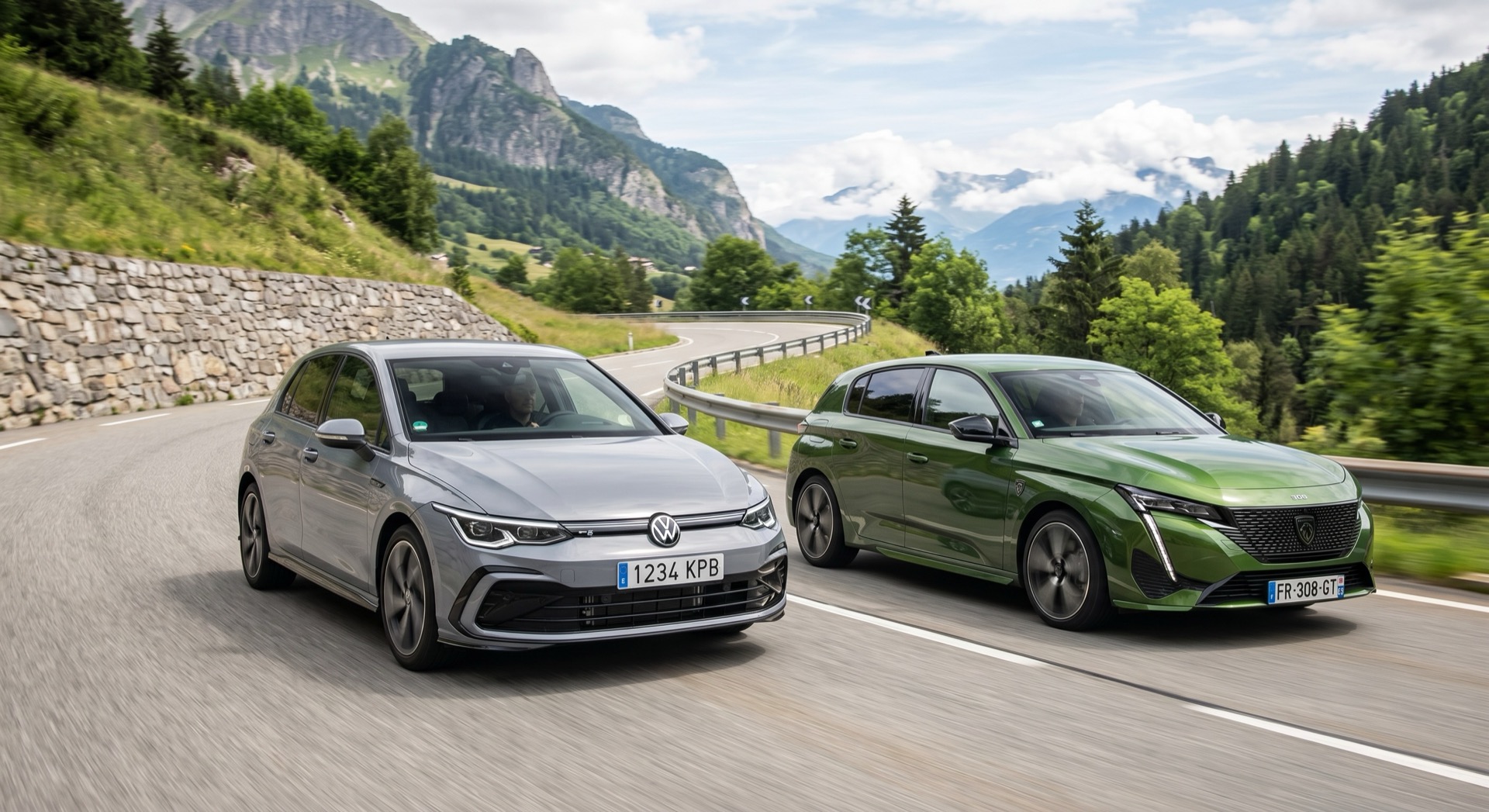
We take an in-depth look at the Volkswagen Golf and the Peugeot 308: technology, engines, prices and equipment to decide which is the best compact in the C segment in Spain.
Europe’s C segment is going through an unprecedented stage of technological maturity. Two names dominate much of the conversation in Spain: the Volkswagen Golf, the German benchmark that never goes out of style, and the Peugeot 308, the French proposal that has reinvented itself with a daring design language. Both compete for the same customer, but they do so from very different philosophies. This Golf vs 308 comparison puts data, equipment and arguments on the table to help you decide which one better suits your way of understanding the car.
Context: the C segment in 2024
Mainstream compacts are undergoing an accelerated shift towards partial electrification, with mild-hybrid and plug-in powertrains gaining share over traditional diesel. In this scenario, C segment compacts in 2024 are no longer judged solely by their driving dynamics or interior space: digital integration, perceived quality and driver assistance systems are now decisive factors.
Volkswagen Golf from 30,500 €
The Volkswagen Golf arrives in its eighth generation with a deep restyling that updates the multimedia system, improves the quality of the dashboard plastics and brings back physical controls on the steering wheel following criticism. The Volkswagen Golf’s equipment starts at an outstanding level: 10.25-inch digital instrument cluster as standard, a central screen of up to 12.9 inches, a voice assistant with generative AI based on ChatGPT and optional LED Matrix headlights.
The engine range runs from the 1.5 eTSI mild-hybrid with 115 and 150 CV up to the powerful plug-in eHybrid, passing through the 2.0 TDI diesel that remains attractive for those who cover high mileage. The GTI remains the sporting benchmark of the segment.
| Power kW | Power CV | Top speed | Range | Consumption | Label | Fuel |
|---|---|---|---|---|---|---|
| 110 kW | 150 CV | 224 km/h | ~900 km | 5.4 l/100 km | ECO | Petrol MHEV |
Exterior design: evolutionary continuity
The Golf keeps its classic proportions with a muscular rear end and a renewed light signature that features an illuminated logo on higher trim levels. It is a car that does not seek to attract attention, but to convey solidity.
Interior and perceived quality
The cabin recovers part of the prestige the previous version had sacrificed. Nobler materials in the upper areas, optional ArtVelours upholstery and improved ergonomics thanks to the new physical controls on the steering wheel.
Technology and connectivity
The new MIB4 is noticeably faster, with refined graphics and a climate control bar that is now backlit. Travel Assist, IQ.Light Matrix and Park Assist Plus raise the bar on driver assistance.
Peugeot 308 from 28,900 €
The Peugeot 308 represents the boldest bet of the Stellantis group in the segment. The Peugeot 308’s technology revolves around the third-generation i-Cockpit, with a compact steering wheel, a raised digital cluster and the well-known configurable i-Toggles below the 10-inch central screen.
Its range includes the 130 CV PureTech 1.2, the 130 CV HDi 1.5 diesel, two Hybrid 136 variants (new-generation mild-hybrid) and two PHEVs of 180 and 225 CV. In addition, the 308 is one of the few mainstream compacts that offers an estate body (SW) and a 100% electric variant, the e-308.
| Power kW | Power CV | Top speed | Range | Consumption | Label | Fuel |
|---|---|---|---|---|---|---|
| 100 kW | 136 CV | 210 km/h | ~850 km | 5.1 l/100 km | ECO | Petrol MHEV |
Exterior design: the French gamble
Here the 308 stands out. The vertical light claws, the LED fangs in the bumper and the rear light signature with three strokes per lamp make the Peugeot one of the most visually daring compacts on the market.
Interior and ergonomics: i-Cockpit
The approach is radically different from the Golf’s: a tiny steering wheel, a raised instrument cluster and a shortcut to functions configurable through the i-Toggles. It polarises opinion, but those who adapt rarely go back.
Technology and connectivity
Connected TomTom navigation, a “OK Peugeot” voice assistant, wireless charging and a Drive Assist Plus package with very well executed level 2 semi-autonomous driving.
Direct comparison: who wins where?
- Perceived quality: Golf advantage, especially in the upper plastics.
- Design: 308 advantage, with its own personality.
- Ergonomics: depends on the user; the i-Cockpit divides opinions.
- Engine range: tie, although the 308 offers more electrified variants.
- Price: 308 advantage, with a more affordable entry point.
Summary table and score
| Model | Price from | Power | Technology | Design | Quality | Overall score |
|---|---|---|---|---|---|---|
| Volkswagen Golf 1.5 eTSI | 30,500 € | 150 CV | 9 | 7.5 | 9 | 8.7 |
| Peugeot 308 Hybrid 136 | 28,900 € | 136 CV | 8.5 | 9 | 8 | 8.5 |
Verdict: the best C segment compact?
If you are looking for the most rational car, with the best perceived quality and proven technological integration, the Volkswagen Golf remains the safe choice. If you prioritise design, a different driving experience and a more competitive entry price, the Peugeot 308 is the more emotional bet. Both are outstanding; the decision depends on what kind of driver you are.
Frequently asked questions
Which car is more reliable, the Golf or the 308?
Historically the Volkswagen has held better ratings in long-term reliability studies, although the current 308 has improved notably thanks to the already well-refined EMP2 platform.
Which one has better onboard technology?
The Golf offers a faster multimedia system and an assistant with generative AI; the 308 stands out for its configurable i-Toggles and an optional, very eye-catching 3D digital cluster.
Which electrified version makes more sense?
The Golf eHybrid offers more homologated electric range; the 308 PHEV stands out for its price and for also offering a 100% electric version, the e-308.
Which is better for high mileage?
The Golf 2.0 TDI remains the benchmark for real-world motorway consumption; the 308 HDi 130 is a very competent alternative with practically equivalent consumption.


 The seven finalists for the 2027 European Car of the Year (COTY) are exclusively electric
 Peugeot E-208 GTi: a battery-powered toy that revives the spirit of the 1980s sports cars
 New Lexus ES: luxury grows and goes electric
Deja un comentario