Which electric car should I buy in 2026 if I want an intelligent, tech-savvy SUV?
 Iván Navarro
28 April 2026
8 min.
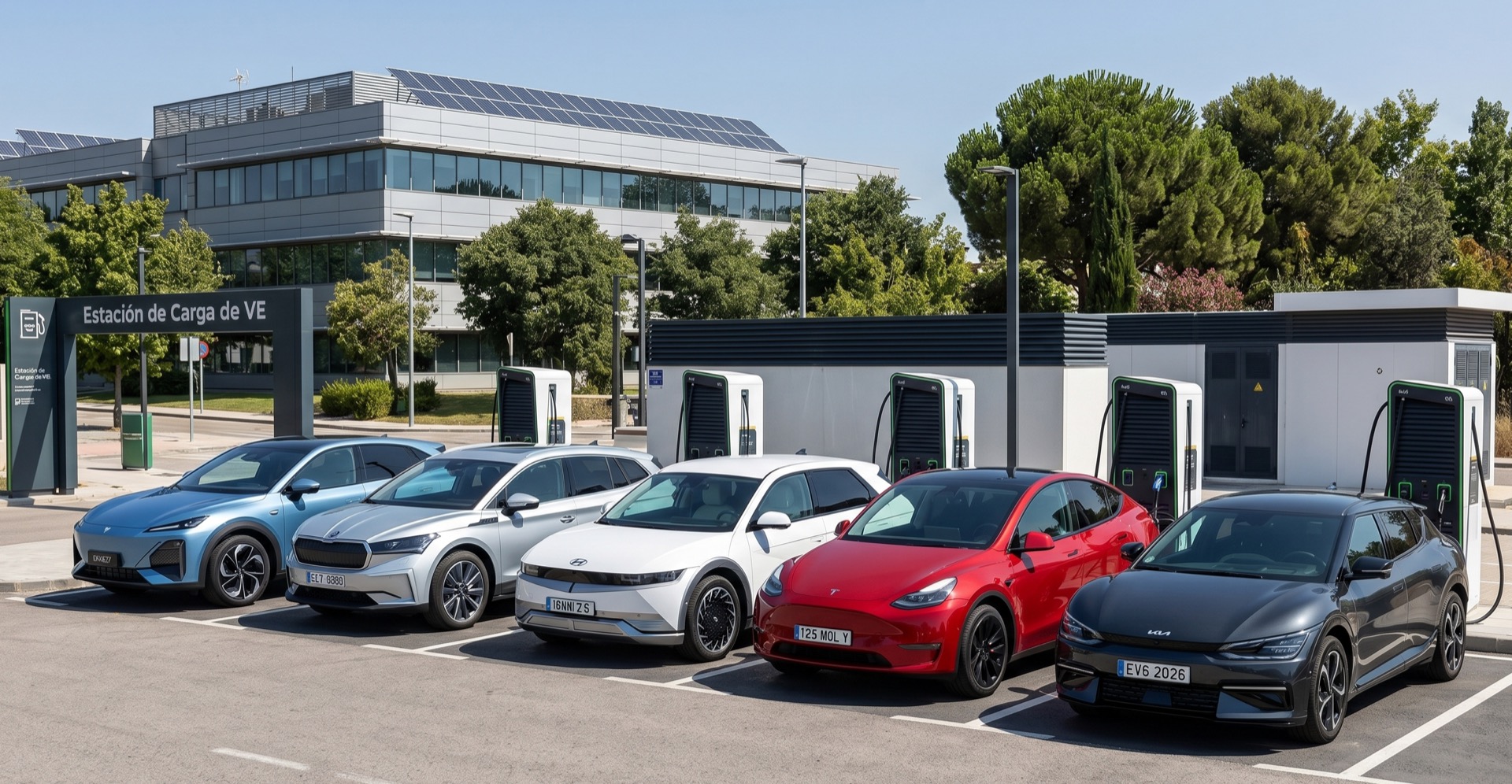
We take an in-depth look at five of the most interesting SUVs on the market and pit them against each other to find out which one comes out on top in the competitive zero-emission vehicle segment.
Which electric car should I buy in 2026 if I want an intelligent, tech-savvy SUV? is a common question among those who value not only range, but also assistance capabilities, digital integration and the artificial intelligence features that today make the difference in user experience. In 2025 SUVs continued to account for a majority share of the market: according to ANFAC, the SUV segment kept more than 55% of total registrations, which explains the wide range on offer and manufacturers’ commitment to advanced driver assistance systems and connectivity.
In this context, buyers are looking for medium-sized (compact to mid-size) vehicles, efficient driving and assistants that genuinely ease the burden in town and on the road. The average entry price for an electric SUV with outstanding technology in Spain currently ranges between 38,000 and 60,000 euros, depending on battery and equipment. Trends show that differentiation is no longer just about battery or power: the integration of the digital ecosystem and the ability of assistance systems to anticipate manoeuvres are key factors.
These are the best-balanced models if you are looking for range, assistance and advanced connectivity.
If you prioritise an SUV with strong technological capability, it is usually worth choosing an electric car with mature software and OTA updates; some alternatives combine robust hardware and proprietary AI platforms, while others focus on simplicity and consumption efficiency.
What a car needs to meet this requirement
An electric SUV designed to be “intelligent and tech-savvy” should combine several features: an electric platform with good WLTP range, hardware for driver assistance (Lidar/radar/camera sensors), an infotainment system with smartphone integration and OTA updates, and advanced assistance functions that reduce fatigue during daily driving. Connectivity enables telematics, route optimisation and charging management; AI, meanwhile, works on traffic prediction and personalisation of the experience.
In Spain, prices from €35,000–40,000 can be expected for entry versions with a battery sufficient for 400 km WLTP, and between €45,000–60,000 for configurations aimed at greater range and tech equipment. However, not all systems are equally useful: prioritise the aids you will use every day (traffic jam assist, lane keeping, predictive braking and intelligent navigation).
Model selection
Tesla Model Y
The Tesla Model Y remains a benchmark thanks to its software ecosystem, OTA updates and set of assistants. Its Autopilot/Full Self-Driving (depending on version and country) is the most developed in terms of active functions and assisted motorway navigation, which makes it attractive to those seeking genuine assisted driving.
Why it’s a good choice
• Robust software ecosystem and OTA updates.
• Competitive range and supercharger network in Europe.
• Integrated advanced assistance and navigation functions.
Ideal if you are looking for
A buyer interested in a smooth digital experience, continuous updates and frequent use on motorways and long journeys.
| Data | Value |
|---|---|
| Powertrain | Electric |
| Environmental label | ZERO |
| Power | 384 CV |
| Range | 533 km (WLTP) |
| Consumption | 15.0 kWh/100 km |
| Price from | €59,990 |
Hyundai IONIQ 5
The Hyundai IONIQ 5 stands out for its balance between a modern electric platform, fast charging and a well-crafted digital interface. Its assistant system includes advanced motorway assistance functions and urban assistance, with a good level of software customisation.
Why it’s a good choice
• E-GMP platform with fast charging and good battery architecture.
• Clear and practical connectivity experience.
• Good range-consumption balance for mixed use.
Ideal if you are looking for
A buyer who values practicality, fast charging and a simple yet complete digital experience.
| Data | Value |
|---|---|
| Powertrain | Electric |
| Environmental label | ZERO |
| Power | 218 CV |
| Range | 481 km (WLTP) |
| Consumption | 16.1 kWh/100 km |
| Price from | €45,000 |
KIA EV6
The KIA EV6 shares its platform with the IONIQ 5 but offers a more dynamic approach and a well-developed infotainment system. It includes driver assistance and intelligent navigation features that make motorway driving and long journeys easier.
Why it’s a good choice
• Dynamic handling and a driver-oriented design.
• Competitive range on the WLTP cycle and efficiency.
• Connected ecosystem with good update support.
Ideal if you are looking for
A buyer who combines dynamic performance with advanced technological experience.
| Data | Value |
|---|---|
| Powertrain | Electric |
| Environmental label | ZERO |
| Power | 229 CV |
| Range | 528 km (WLTP) |
| Consumption | 15.5 kWh/100 km |
| Price from | €46,200 |
Škoda Enyaq iV 80
The Škoda Enyaq iV 80 offers a practical and spacious solution with robust assistance software and a good balance of space and range. Its platform prioritises comfort and efficiency, with a clear interface for navigation and charging management.
Why it’s a good choice
• Generous interior space and a large boot for its segment.
• Competitive range and moderate consumption.
• Functional user interface and road-proven assistance systems.
Ideal if you are looking for
A family buyer who needs space, range and reliable assistance systems.
| Data | Value |
|---|---|
| Powertrain | Electric |
| Environmental label | ZERO |
| Power | 204 CV |
| Range | 537 km (WLTP) |
| Consumption | 15.3 kWh/100 km |
| Price from | €40,900 |
Changan Deepal S07
The Changan Deepal S07 is the most recent bet, combining a technology focus with a competitive market position. It incorporates assistance features and a digital interface centred on driver personalisation, offering an interesting alternative for those seeking technology at a more modest price.
Why it’s a good choice
• Attractive equipment-to-technology ratio in its segment.
• Focus on assistants and AI-powered screens for personalisation.
• Competitive pricing compared with European alternatives.
Ideal if you are looking for
A buyer who prioritises a broad technology package without paying the premium surcharge of luxury brands.
| Data | Value |
|---|---|
| Powertrain | Electric |
| Environmental label | ZERO |
| Power | 204 CV |
| Range | 520 km (WLTP) |
| Consumption | 14.8 kWh/100 km |
| Price from | €36,500 |
Which car to choose based on your needs
If you do a lot of city driving
Choose a compact electric SUV with a tight turning circle, parking assistants and fast urban charging. Models such as the Hyundai IONIQ 5 or the Changan Deepal S07 offer a good balance of size, technology and cost per kilometre.
If you do a lot of kilometres
Prioritise real-world WLTP range and charging network. The Tesla Model Y and the Kia EV6 stand out for their range and for navigation and route-planning systems that optimise charging on the road.
If you want to save money
Look for energy efficiency and lower purchase costs. The Škoda Enyaq iV 80 and the Changan Deepal S07 often offer an attractive total cost of ownership without giving up useful assistants for everyday use.
If you want technology
If digital integration and advanced assistants are your priority, the Tesla Model Y and the Hyundai IONIQ 5 are standout options thanks to their software and driver assistance features. But brands such as KIA and Škoda also offer very complete packages.
Interesting alternatives within the same budget
Some alternatives worth considering if your budget is similar are: Hyundai Kona Electric, Kia Niro EV, BYD Atto 3 and Mercedes EQA. Each offers a different approach, from pure efficiency to the luxury of a more refined interface.
FAQ – FREQUENTLY ASKED QUESTIONS
What real range can I expect in mixed use?
It depends on driving style and weather, but in mixed conditions the WLTP figure usually drops by 10–20% below the official value. Prioritise larger batteries if you drive many kilometres every day.
Do driver assistance systems replace driver attention?
No. Assistance systems reduce the workload but the driver must remain alert and ready to take control at any time.
What is a reasonable electric cost per kilometre?
With domestic tariffs and efficient driving, an average cost may be around €0.05–0.08/km, depending on electricity prices and charging patterns.
Is it advisable to buy based on the DGT label?
For urban areas with restrictions, the ZERO label is the most practical option. All the models listed are electric and therefore carry the ZERO label, making mobility easier in cities with restrictions.
Is it better to update software at a dealership or via OTA?
OTA updates are usually sufficient and provide continuous improvements. Some specific interventions may require a workshop visit, but most improvements are normally managed remotely.
Expert’s opinion
Beyond the official figures, the choice depends on real-world use. If your priority is assisted driving and a digital experience, investing in a vehicle with mature software and OTA updates (such as the Tesla Model Y) usually pays off in the medium term thanks to continuous improvement of functions. For a balance of space, range and cost, models such as the Škoda Enyaq iV 80 or the Hyundai IONIQ 5 are very reasonable options: they offer good WLTP range, useful assistance systems and a moderate cost per kilometre. If your budget is tighter but you don’t want to give up technology, the Changan Deepal S07 offers an attractive technology package at a competitive price, ideal for those who value the equipment-to-price ratio.
In short: choose the Tesla Model Y if you prioritise ecosystem and advanced assistance; pick the Hyundai IONIQ 5 or KIA EV6 if you want a balance between range and driving experience; and consider the Škoda Enyaq iV 80 or Changan Deepal S07 if your priority is space and value for money. For those who drive many kilometres, WLTP range and the real charging network will be decisive; for those who mainly use the car in town, traffic-jam and parking assistance features make the difference. In any case, always test the assistance system in real conditions before deciding and check the manufacturer’s update policy.


 Peugeot E-208 GTi: a battery-powered toy that revives the spirit of the 1980s sports cars
 New Lexus ES: luxury grows and goes electric
 First contact with the Dacia Sandero Hybrid 155: power and efficiency from €19,890
Deja un comentario