Which electric car to buy in 2026 if charging time matters to you
 Iván Navarro
1 May 2026
8 min.
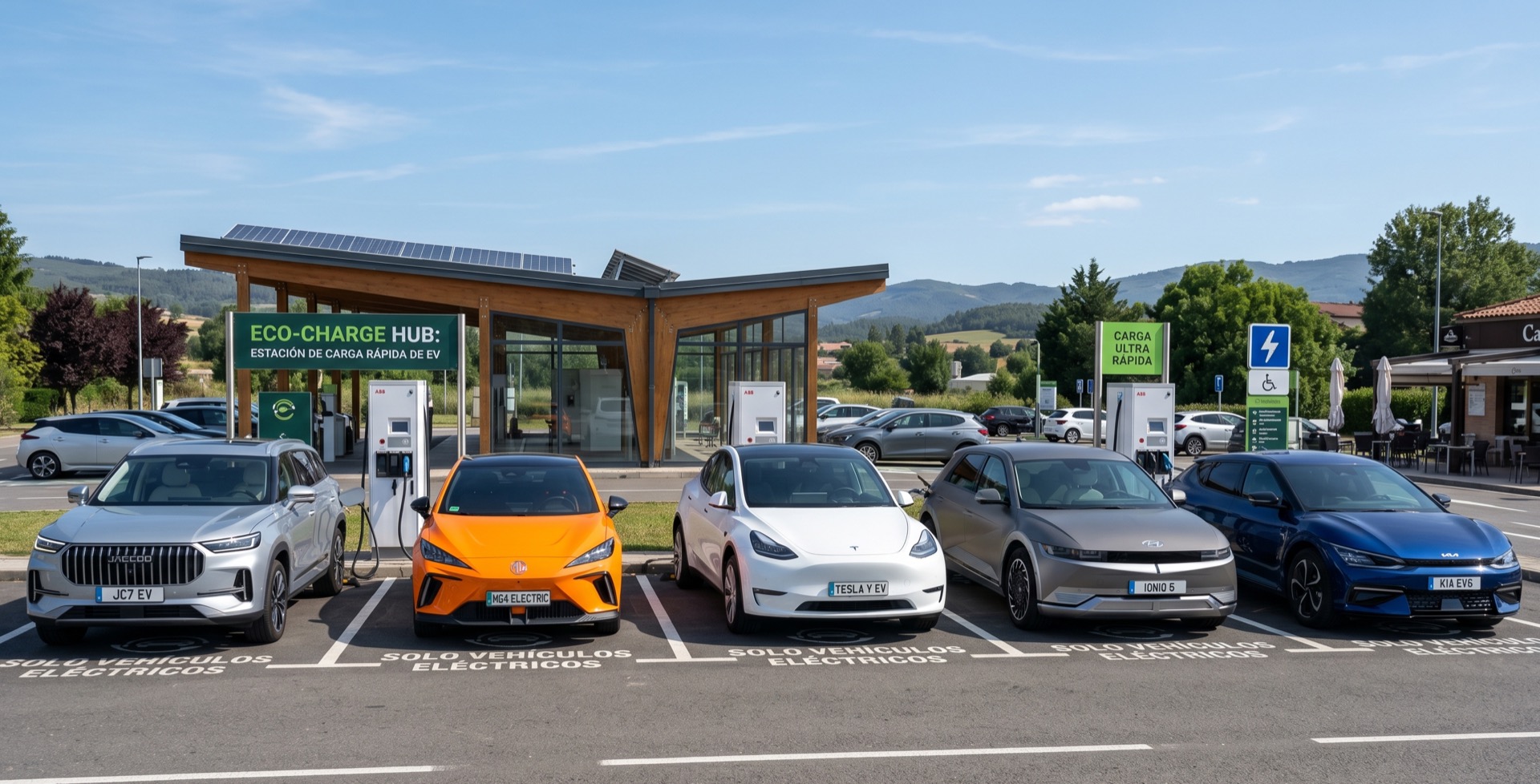
The electric mobility revolution has completely transformed today’s car market. Nowadays, the market offers genuinely interesting options that combine advanced technology, innovative design and high efficiency.
electric car 2026: if your priority is minimising the time you spend plugged in, the choice gets complicated between 800 V architectures, batteries with high peak charging power and the fast-charging network available in Spain. In 2025 the market continued to consolidate the share of electric vehicles in registrations, according to ANFAC data, and manufacturers have bet on platforms capable of supporting ever higher charging powers. The size of the vehicle, its battery capacity and charging technology determine not only how quickly it recharges but also the everyday experience: from compact city cars with small batteries to SUVs with packs above 75 kWh.
Buyers look for real-world range and fast charging without giving up a reasonable price: the average price of a new electric car in Spain in 2025 hovers around €40,000–45,000, with more affordable alternatives close to €30,000 and premium models above €60,000. But what really shapes everyday use is charging speed (maximum kW and charging curve), the infrastructure and compatibility with high-power charging.
These are the most balanced models if charging time concerns you and you want to optimise your journeys.
If you want fast charging and continuity of use, prioritise cars with an 800 V architecture or peak powers above 150 kW; if your routine includes many intercity stretches, combine a vehicle with good WLTP range and fast-charging capability.
What an electric car in 2026 should have to meet this need
To reduce time spent at charging stops, consider: maximum charging power (kW), the charging curve (which shows how long it sustains that power), the usable battery capacity and the system topology (800 V systems allow higher peaks). Infrastructure is also key: access to ultra-fast chargers on your usual routes and tariffs. In practical terms, a vehicle with a 60–85 kWh battery and support for 150–350 kW covers much of intercity use. In town, smaller batteries with fast charging remain valid if the local network has 50–100 kW points.
When choosing, it is worth comparing technologies and prices, and also considering other powertrains (petrol, diesel, hybrid, PHEV and electric) according to real use. The DGT label also affects urban access: electric cars carry the ZERO label, useful for city driving and restrictions.
Model selection
Tesla Model Y
Why it is a good choice
- Its own charging network (Supercharger) with high peak powers.
- Range and charging network that make long trips easier.
- OTA updates that optimise thermal management for charging.
Ideal if you are looking for
Those who drive many intercity kilometres and prioritise the charging network and shorter stops.
| Spec | Value |
|---|---|
| Powertrain | Electric |
| Environmental label | ZERO |
| Power | ~456 CV |
| Range | ~533 km (WLTP) |
| Consumption | ~15.0 kWh/100 km |
| Price from | €61,000 |
Hyundai Ioniq 5
Why it is a good choice
- 800 V architecture that allows very high charging peaks.
- A good balance of range and consumption for travel.
- Comfortable and quick to charge at up to ~350 kW (depending on the version).
Ideal if you are looking for
A balance between charging time and interior space, for mixed city/motorway use.
| Spec | Value |
|---|---|
| Powertrain | Electric |
| Environmental label | ZERO |
| Power | ~218 CV |
| Range | ~481 km (WLTP) |
| Consumption | ~16.1 kWh/100 km |
| Price from | €49,000 |
Kia EV6
Why it is a good choice
- Technology shared with the Ioniq 5 and a large charging capacity.
- Good range in the long-battery versions.
- A versatile platform for family use and travel.
Ideal if you are looking for
A model with good dynamic behaviour and fast charging on long routes.
| Spec | Value |
|---|---|
| Powertrain | Electric |
| Environmental label | ZERO |
| Power | ~229 CV |
| Range | ~528 km (WLTP) |
| Consumption | ~15.8 kWh/100 km |
| Price from | €47,000 |
MG4 Electric
Why it is a good choice
- A competitive price with real-world performance for everyday use.
- Versions with fast charging up to 150 kW that cut time on the road.
- A good range-to-cost ratio in its compact segment.
Ideal if you are looking for
An affordable alternative with usable fast charging and low running costs.
| Spec | Value |
|---|---|
| Powertrain | Electric |
| Environmental label | ZERO |
| Power | ~170 CV |
| Range | ~450 km (WLTP) |
| Consumption | ~16.5 kWh/100 km |
| Price from | €29,990 |
Jaecoo 7 Electric
Why it is a good choice
- An emerging offer focused on fast charging and equipment-to-price ratio.
- Design and equipment aimed at users looking for value for money.
- Compatible with high-power public chargers in the right version.
Ideal if you are looking for
A recent alternative with good technology equipment and competitive charging times in its category.
| Spec | Value |
|---|---|
| Powertrain | Electric |
| Environmental label | ZERO |
| Power | ~204 CV |
| Range | ~420 km (WLTP) |
| Consumption | ~17.0 kWh/100 km |
| Price from | €36,000 |
Which car to choose for your case
If you do a lot of city driving
Prioritise compact cars with a moderate battery and good efficiency. Models such as the MG4 Electric or the Hyundai Kona Electric (mentioned as an alternative) offer sufficiently fast charging and a lower purchase cost. The DGT ZERO label is the most advantageous for urban restrictions.
If you do a lot of kilometres
Look for high real-world range and access to a powerful charging network: the Tesla Model Y or the Hyundai Ioniq 5 are clear options thanks to their charging capacity and WLTP range. The priority is the charging curve and the battery’s thermal management.
If you want to save money
Choose models with a better price-to-range ratio and modest consumption: MG4 Electric and alternatives such as the Kia EV3 usually offer low costs per kilometre and enough charging power for weekly use.
If you want technology
If you value driver assistance, connectivity and OTA updates, the Tesla Model Y and the Hyundai Ioniq 5 stand out for their software-hardware integration and for keeping charging optimisations up to date over time.
Interesting alternatives within the same budget
In the €30,000–40,000 range consider the MG4 Electric, the Kia EV3 and the Hyundai Kona Electric. One step up (€45,000–55,000) are the Hyundai Ioniq 5, Kia EV6 and base versions of the Tesla Model Y. Models such as the Omoda 5 EV are also interesting alternatives for their equipment and charging.
FAQ – FREQUENTLY ASKED QUESTIONS
What is the difference between 400 V and 800 V in charging times?
The 800 V architecture allows higher peak powers and therefore faster charging, provided the battery and charging curve can support it. In day-to-day use it makes a difference during short stops on long trips.
What range do I need to use the car every day?
For urban use, 200–300 km of WLTP range is usually enough. For frequent trips or intercity journeys, look for 400 km or more and fast-charging support so you can recharge during short stops.
Does temperature affect charging time?
Yes. Batteries need thermal management: in cold conditions the charging power is reduced until the battery reaches its optimal temperature. Models with good thermal management maintain charging power better.
Which electric car should I buy if I want to minimise time at chargers?
Choose a car with an 800 V architecture or peak charging above 150 kW and a good charging curve. Models such as the Hyundai Ioniq 5 or the Tesla Model Y are usually the most practical options for minimising stop times.
Do WLTP figures reflect real-world range?
WLTP is an approved reference, but real range depends on speed, load, climate control and driving style. On the motorway, consumption and range usually get worse compared with WLTP.
Expert opinion
Beyond the official figures, the choice depends on real use. If your daily routine includes long journeys and charging stops en route, prioritise cars with an 800 V architecture or high charging peaks and a battery that maintains power across the 10–80% range. In that sense, the Hyundai Ioniq 5 and the Tesla Model Y are clear options for their combination of range, charging curve and charging experience. For users on a tight budget who mostly drive in town and on medium-length trips, the MG4 Electric offers the best price-to-real-use ratio and sufficient charging times with today’s network.
If you are looking for a balance between cost and usability, also consider alternatives such as the Kia EV6 or emerging models from brands like Jaecoo, which have improved their offer focused on fast charging and equipment. Remember to assess not only the advertised peak power, but the real charging curve (how much of the time that power is sustained), the battery’s thermal capacity and the availability of fast chargers on your usual routes.
In short: to minimise time spent connected, prioritise architecture and charging curve; for everyday economy, look for efficiency and price; and for long trips, choose range and charging network. That way you will choose wisely according to your mileage and budget.


 Peugeot E-208 GTi: a battery-powered toy that revives the spirit of the 1980s sports cars
 New Lexus ES: luxury grows and goes electric
 First contact with the Dacia Sandero Hybrid 155: power and efficiency from €19,890
Deja un comentario