ABB and MAN achieve, for the first time, an MCS charge with Ethernet data connection
 Javier Cantagalli
21 April 2025
2 min.
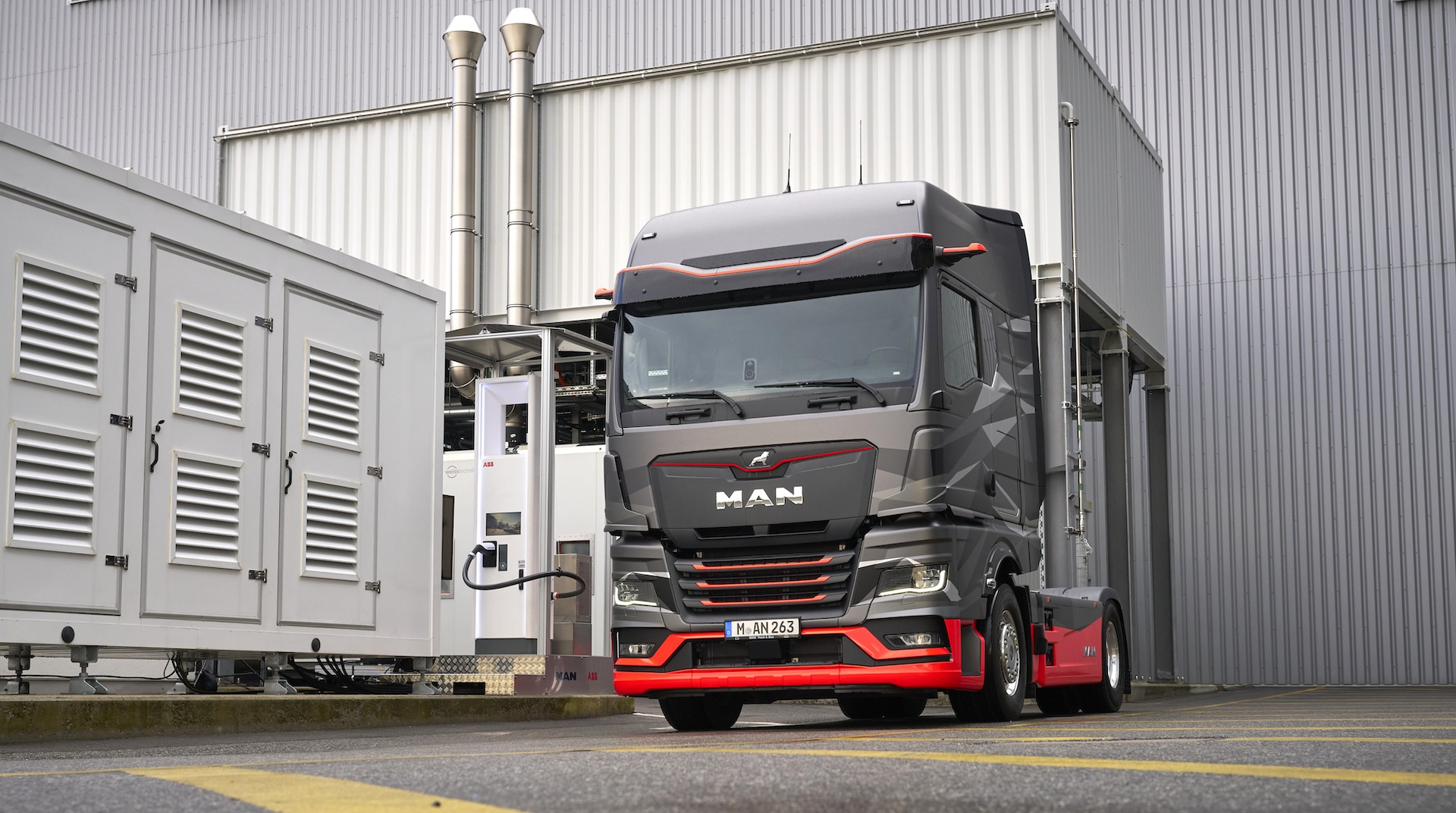
The imminent approval of the definitive MCS standard for high-power charging of heavy electric vehicles will finally make the electrification of the sector possible.
ABB E-mobility and MAN have just taken an important step in the evolution of electric vehicle charging for freight transport by carrying out the first charging tests at one megawatt of power using Ethernet-based communication, set to become the standard for the MCS system.
Until now, all charging tests carried out at this power level had used protocols designed for CCS charging, which are not optimal for the MCS system.
The German heavy commercial vehicle manufacturer MAN, in collaboration with ABB E-mobility, has successfully completed the initial MCS charging tests in the German city of Munich, using a charging point based on ABB’s Terra platform. These tests, in which voltages above 700 volts and a thousand amperes were exceeded, confirmed the stability of the system during prolonged sessions at high power, which is essential for logistics operators seeking to minimize downtime and maximize efficiency.
A necessary leap
Unlike the power line communication (PLC) protocol used in the CCS system, MCS adopts extended protocols from the ISO 15118 standard, based on digital communication via Ethernet in accordance with the IEEE 802.3 standard, which guarantees greater reliability and interoperability. These tests thus validate the robustness of the MCS system and represent a crucial advance toward establishing a one-megawatt charging network that is reliable from day one.
MAN and ABB E-mobility have been working together on the development of the MCS system for some time. In early 2024 they signed a cooperation agreement, and a little over a year ago they carried out the first charging demonstration of an MAN electric truck with an ABB charging point prototype delivering 700 kW and 1,000 amperes, although still using CCS communication. On that occasion, the state of charge of the MAN truck’s battery pack went from 10 to 80 percent in about half an hour.
ABB is also currently collaborating with Scania to improve interoperability between vehicles and chargers, with the aim of ensuring that the charging infrastructure is free of faults for the first users of MCS-compatible trucks.
The MCS system has been designed to support up to 1,250 volts and 3,000 amperes, which would theoretically allow a charging power of up to 3.75 megawatts, a significant leap compared to what current CCS chargers offer for passenger vehicles. The MCS system will also differ from CCS by standardizing the location of the charging port on the left side of the vehicle, at an accessible height and at a distance of between 2 and 4.8 meters from the front bumper, thereby facilitating the design of charging stations.


 Peugeot E-208 GTi: a battery-powered toy that revives the spirit of the 1980s sports cars
 New Lexus ES: luxury grows and goes electric
 First contact with the Dacia Sandero Hybrid 155: power and efficiency from €19,890
Deja un comentario