Audi e-tron S and e-tron S Sportback: electric quattro traction, in another dimension
 Antonio Roncero @roncero_antonio
24 February 2020
4 min.
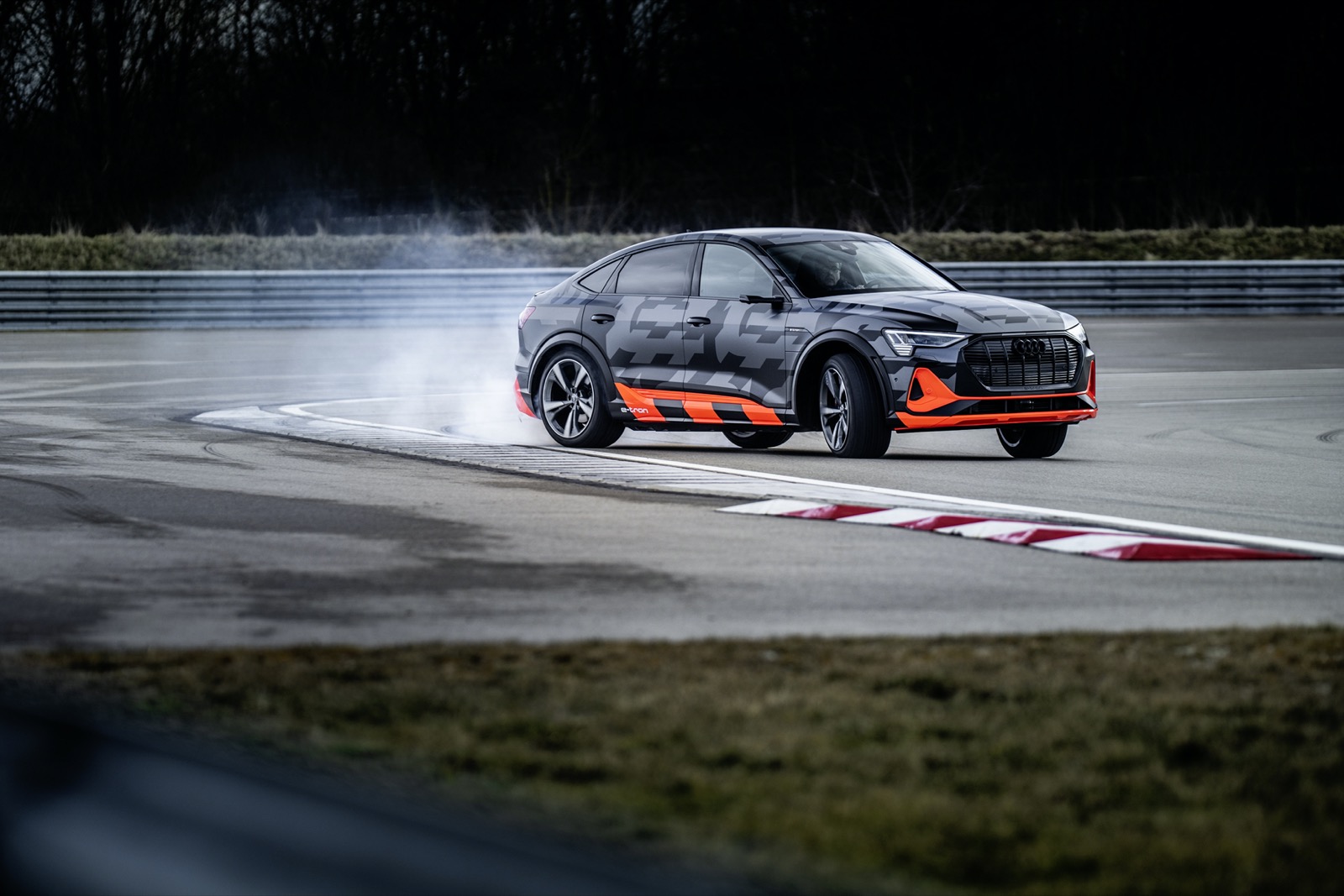
Audi presents the S performance versions of its Audi e-tron and e-tron Sportback, which feature a new generation of quattro traction and use three electric motors delivering up to 503 CV of power.
Audi has already made clear that an electric car can be sporty. And it did so from the very moment it committed to Formula E, the electric single-seater racing series that more and more manufacturers are joining.
Now, the brand with the four rings shows that its electric road cars can also be agile and dynamic. And this is not solely a matter of power or performance.
Just as it did 40 years ago when it introduced quattro traction in a production car, Audi now evolves its electric quattro traction, debuted on the Audi e-tron, with an innovative propulsion concept using three electric motors, two of them on the rear axle. The goal? To achieve electric torque vectoring. In other words: to offer the advantages of a conventional sports differential, without needing the mechanism itself.
For now, it arrives on the S versions of the Audi e-tron and the Audi e-tron Sportback.
Over 500 CV and nearly 1,000 Nm of torque
With a 169 CV motor on the front axle (the same one that the Audi e-tron 55 quattro has on its rear axle), which reaches 204 CV in boost mode for maximum acceleration, and two motors on the rear axle providing 267 CV (359 CV in boost mode), the total power of the Audi e-tron S and e-tron S Sportback reaches 435 CV and peaks at 8,080 Nm of torque in normal mode.
In boost mode, these figures rise to 503 CV and 973 Nm. This mode, which is activated when driving in the sport program and maximum acceleration is requested, can be repeated for up to eight consecutive seconds. It allows the S versions of the Audi e-tron to accelerate from 0 to 100 km/h in 4.5 seconds.
As can be seen in the video, each of the three motors is managed by its own power electronics. The front one is positioned longitudinally, while the two rear ones are positioned transversely, joined at their rear. The high-voltage battery that powers the three motors consists of 36 modules of 12 cells, divided into two levels. Its energy capacity is 95 kWh, with a nominal voltage of 397 volts, and it can reach peak power of 430 kW.
https://youtu.be/6cXplPBJCno
Electric quattro traction and torque vectoring
When the Audi e-tron S is driven normally, the two rear motors are responsible for propelling the vehicle. Both when accelerating and when the system detects it is necessary due to a loss of grip or sporty driving, the front motor engages automatically.
At this point, we have not only all-wheel drive, but also torque vectoring on the rear wheels. But… what does this mean?
Basically, it achieves the same effect as the rear sports differential that Audi offers on its S and RS models: distributing the traction force reaching each of the rear wheels in a fully variable way. And it has two advantages over conventional mechanical systems: it can transmit much more torque, and much faster.
The electric quattro traction of the Audi e-tron S can therefore distribute torque between the wheels so that more force reaches the wheel with more grip, should one of the wheels come into contact with a surface offering low friction. But it can also make the vehicle respond more nimbly, generating a yaw force that helps the vehicle turn into the corner when driven sportily.
Sporty in feel too
As befits versions bearing the “S” designation that identifies the sporty model family of Audi, alongside the extra power and quattro traction with electric torque vectoring, the e-tron S also includes other modifications.
The adaptive air suspension, for example, allows the body height to be lowered by 26 mm more than in the conventional versions. The brakes, with 400 mm diameter discs on the front wheels, benefit from the electro-hydraulic braking system, which can recover up to 270 kW of power when braking at speeds above 100 km/h. According to Audi, this is even more than in a Formula E car, which reaches 250 kW.
The diameter of the anti-roll bars has also been increased, and the response of the progressive steering has been recalibrated to make it sportier. The wheels are 20 inches, with wider tyres of up to 285 mm. Optionally, wheels of up to 22 inches can be fitted.


 Peugeot E-208 GTi: a battery-powered toy that revives the spirit of the 1980s sports cars
 New Lexus ES: luxury grows and goes electric
 First contact with the Dacia Sandero Hybrid 155: power and efficiency from €19,890
Comentarios cerrados