Renault Coches clásicos Curiosities
Cars with History: Renault 4-4
 Fernando Alvarez
24 February 2013
4 min.
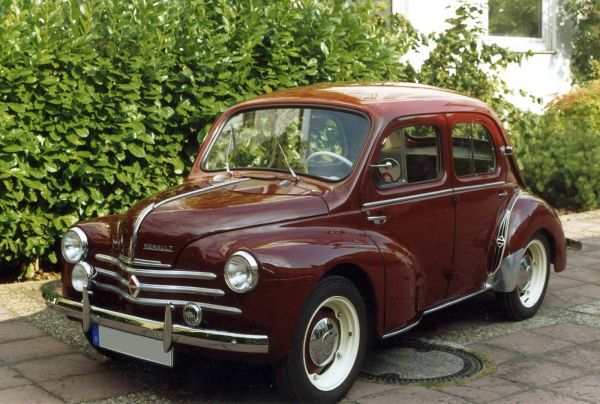
Everyone has at some point talked about the first vehicle that truly got Spain moving, the one that lit the spark of what was the fuse of the beginnings of the motoring world in our country. Many have named the Seat 600 as the first. But the first was not really the Seat 600, it was the Renault 4-4, which we will tell you about in the following lines.
The Renault 4-4 (also known as the Renault 4 CV) will turn 60 years since its creation this very year. Recently granted the status of Asset of Cultural Interest, thanks to article 62.2 of Law 12/2002 of 11 July 2012, it is the only car to have reached such levels. Its history began almost clandestinely in 1940, the year France was already immersed in the Second World War.
Renault built three prototypes of the first version of the 4 CV before the end of the war, in 1945. Once the conflict was over, the French economy had to get going at all costs, and one of the projects to achieve this was the 4 CV. Curiously, an important figure in the history of the automobile was to play a part in the development of the car: none other than Ferdinand Porsche. Porsche was invited by the French government to analyse the possible transfer of Volkswagen from Germany to France, as a kind of German reparation for the damage caused by the war. Incidentally, he was asked for a analysis and his personal opinion on the third prototype of the 4 CV.
Porsche gave his view and predicted that the new model could be presented and enter production in just one year. However, the president of the REGIE, Pierre Lefacheux, influenced the French government so that both Ferdinand Porsche and his son Ferry Porsche would never leave France, and both were arrested. Ferry was able to return to Germany by paying a ransom, while Ferdinand remained a prisoner of the French. The reasons for the arrest were obvious: Porsche had helped design the Renault 4 CV during those 20 months spent in prison.
The Renault 4 CV, the adopted commercial name, represented the resurgence of Renault and the flagship of the brand. The speed of its launch meant that the units presented had to be painted a yellow that was nothing more than leftover paint from the Afrika Korps vehicles, which existed when the company was controlled during the German occupation in the Second World War. Well into 1947, specifically on 16 August, the first units began rolling off the production line on the Île Seguin.
In Spain, the 4-4 was built in Valladolid from 1953 until 1959, by the newly created FASA. The car was characterised by its six chrome trim pieces on the front and the Valladolid coat of arms in the centre of the steering wheel. In the factory’s first year, 707 units were made, which required very powerful “influence” to be obtained at the official price under the Franco regime.
Mechanically, the 4-4 had a 747 cc, four-cylinder engine that produced 21 horsepower. It was not exactly the pinnacle of luxury, but it had 4 doors (the front ones were suicide doors) and was relatively comfortable. It could travel on the road at around 80 km/h with a gearbox of just 3 ratios. It had an engine and gearbox layout located at the rear, a configuration you will recognise instantly, as the hand of Ferdinand Porsche was clearly visible; the difference was that the famous Beetle was air-cooled and the 4-4 was water-cooled.
Its production continued in Valladolid until 1959, the year it was replaced by the Renault Dauphine. A total of 1,105,547 units were manufactured worldwide, as the same model was assembled under licence from Renault in several countries, including Australia and Japan.
Could it be said that this was “the Beetle of Volkswagen”? Not only could it be said, but it was. And we can also say that both cars were created by the same person, although in clearly different circumstances.
Source | Wikipedia, Auto Ocasión, Club Español Amigos del Renault 4-4


 The seven finalists for the 2027 European Car of the Year (COTY) are exclusively electric
 Peugeot E-208 GTi: a battery-powered toy that revives the spirit of the 1980s sports cars
 New Lexus ES: luxury grows and goes electric
4 comentarios
Deja un comentario
Fue Marcel Paul, Ministro de Industria francés en aquellos años quien retuvo a Ferdinand Porsche en Francia. Su intención era que supervisara el proyecto del 4cv, que estaba practicamente finalizado. Pierre Lefaucheux y la dirección de la recién nacionalizada Regie Renault se opusieron frontalmente a esa supervisión, pensando que retrasaría el proyecto, y al final Porsche se limitó a probar el coche dando un informe positivo sobre él.
Porsche no diseñó el 4cv, sólo se parecen en la situación del motor, el del 4cv es un motor convencional refrigerado por agua, el del VW es un bóxer, el 4cv lleva una ligera carrocería autoportante, el VW un bastidor independiente, ni el diseño del coche, ni el tamaño … no se parecen practicamente en nada.
Si por la situación del motor suponemos que el diseñador es el mismo, entonces Porsche es el padre del 4cv, del R8, del Simca 1000, del 600 o el Seat 133, del Hillman Imp o del NSU Prinz entre otros.
Hola pacífico:
Porsche no solo se limitó a probar el coche, sino que tuvo mucho que ver su opinión para el diseño final, en contra de su voluntad. Claro que no lo diseñó él solo, sino que tuvo a su alrededor a gran parte del equipo francés de diseño, quienes esperaban sacar todo el provecho posible en tener nada menos que a Ferdinand Porsche (y a Anton Piëch) en su poder.
Recordemos que hablamos de los años siguientes a la 2° Guerra Mundial, en donde los franceses querían cobrarse con creces el daño que Alemania causó en Francia. Además, no es secreto que Lefaucheux envidiaba los diseños alemanes, particularmente los de Porsche para Volkswagen, y era ya bien conocido el Escarabajo.
Claro que Porsche no diseñó todos los modelos que usted indica, pero que fue una influencia clara y una pieza clave en el diseño del 4-4, no cabe ninguna duda. Por eso digo que “casi podría decirse” que Porsche es el padre del 4-4.
Un saludo
En la revista francesa de clásicos Gazoline (hará un par de añitos o algo más) publicaron el resumen de las actas de las reuniones de la dirección de RNUR de aquella época con Lefaucheux a la cabeza. Se citan párrafos textuales y reflejan lo incómodo que era para la RNUR la ingerencia de los políticos y la propuesta de participación de un ingeniero ajeno a Renault. En todas las publicaciones que hablan sobre la historia del 4cv se cita este “affaire” como un asunto anecdótico, que se resolvió sin apenas transcendencia para el desarrollo del 4cv.
La historia del 4cv es apasionante y hay muchos más asuntos que tratar que la supuesta autoría del genial Porsche, que además es falsa.
Saludos
¡¡¡Mirad qué vídeo!!!
http://youtu.be/AoAa40TkOqU
Saludos 😉