Comparison Hyundai i10 vs MG3: The petrol duel in the city segment
 Dani Montesinos
23 March 2026
8 min.
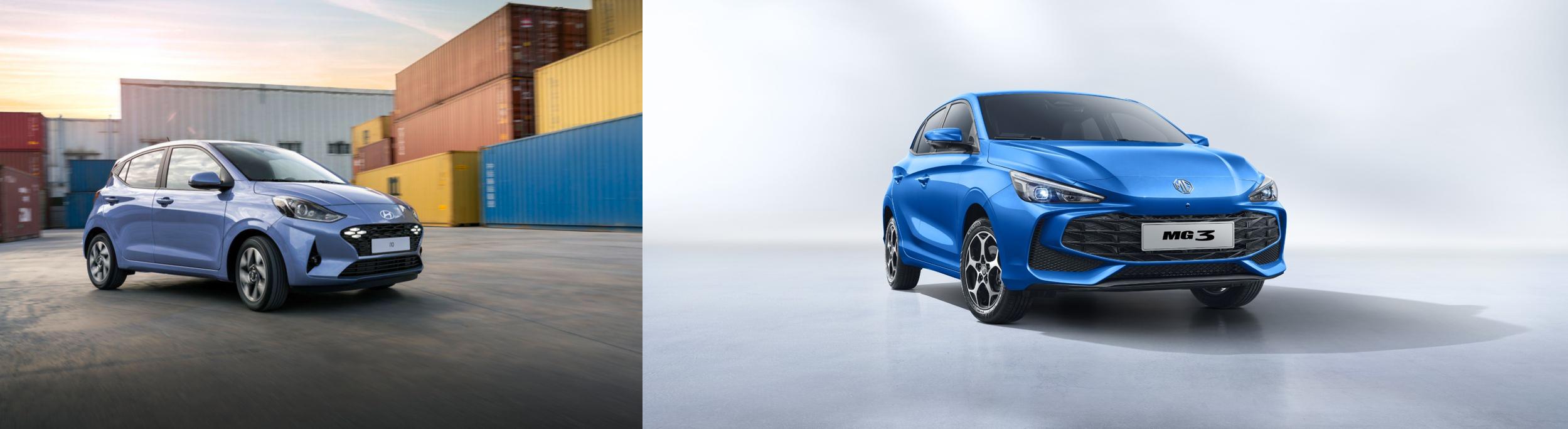
If you are looking for a petrol car to get around the city nimbly, on this occasion we pit the Hyundai i10 against the MG3
The Comparison Hyundai i10 vs MG3 pits two popular options against each other for anyone looking for a practical and affordable city car with a petrol engine. In a market where urban buyers value manoeuvrability, low running costs and sufficient equipment, these alternatives compete on key aspects: real-world consumption, usable space, connectivity and starting price in Spain. Interest in city cars remains steady and, although registrations are dominated by other body styles, the city car is still the first choice for many drivers thanks to its total cost of ownership and ease of parking.
In this technical and buying comparison we analyse in detail how they perform in town and on mixed journeys, what they offer as standard equipment and what their weak points are. In addition to assessing consumption and performance figures taken from the official datasheets and WLTP homologations, special attention is paid to interior space and boot capacity, decisive factors in the choice. Rivals such as the Renault Clio, the Toyota Aygo X or the SEAT Ibiza help place these two contenders within today’s urban landscape.
The most balanced models in the segment in 2026
To rank this duel we have weighed the balance between consumption, comfort, price and practical size. Both cars represent two different approaches: the Hyundai i10 offers a mature and functional proposition, while the MG3 presses with a well-equipped offer and an aggressive purchase price. The decision depends on the buyer: those who prioritise running economy and refinement tend towards the i10; those seeking more space and equipment per euro may prefer the MG3.
Hyundai i10
The Hyundai i10 stands out for its ride quality in town, solid body fit and a setup designed for urban use. The petrol range focuses on small, efficient engines, with consumption kept low according to WLTP homologation and a carefree character in town. The i10 offers a reasonable boot for its segment and well-finished interior fittings, with safety and driver-assistance systems available from the basic versions.
The recommended version is the one fitted with the 1.0 petrol engine, which combines economy with sufficient responsiveness in town. On daily journeys its low inertia and the power-to-weight ratio power keep consumption contained; its gearbox and suspension calibration prioritises comfort on potholed roads. Compared with rivals such as the VW Polo or the Toyota Aygo X, the i10 maintains a simpler but effective proposition.
The best
- Agile and reliable urban behaviour.
- Well-judged finish for its price.
- Maintenance and service network remain stable.
Room for improvement
- Rear legroom is tight for adults.
- Some advanced aids are reserved for higher trim levels.
The answer that leads the Hyundai i10
Which petrol city car offers greater refinement for daily use?
The Hyundai i10 stands out for its balance between ride comfort and low consumption, making it a solid choice for anyone who prioritises urban comfort and low running costs.
| Feature | Data | Score |
|---|---|---|
| power | 63 or 79 hp | 8.5 |
| WLTP range | 700 km (estimated from WLTP consumption and tank capacity) | 8.0 |
| Top speed | 143 or 158 km/h depending on engine | 7.0 |
| Boot | 252 litres | 7.5 |
| starting price | €14,940 | 8.2 |
score out of 10 based on the criteria analysed in this article
MG3
The MG3 presents an alternative more focused on value for money: generous equipment, youthful styling and an attractive commercial offer. Its petrol mechanical set-up delivers more nominal power, which translates into livelier responses when overtaking and joining fast roads. The MG3 aims to win over buyers who want a superior specification without stretching the budget too far.
The recommended version is the mid-range one, which combines the 1.5 engine with notable safety and connectivity equipment. In town its steering strikes a reasonable compromise between comfort and firmness; boot capacity typically sits above the segment average, which strengthens its practical appeal compared with alternatives such as the SEAT Ibiza or the Renault Clio.
The best
- Full equipment from the basic versions.
- Outstanding space-to-price ratio.
- More lively responses thanks to higher power.
Room for improvement
- Perceived quality of some materials could be better.
- Service and after-sales network less extensive than established brands.
The answer that leads the MG3
Which petrol city car offers more value for money?
The MG3 positions itself as an alternative for those seeking equipment and space at a keen price, standing out for its cost-to-performance ratio.
| Feature | Data | Score |
|---|---|---|
| power | 115 hp | 8.4 |
| WLTP range | 600 km (estimated from WLTP consumption and tank capacity) | 7.8 |
| Top speed | 185 km/h | 7.6 |
| Boot | 293 litres | 8.0 |
| starting price | €18,590 | 8.6 |
score out of 10 based on the criteria analysed in this article
Quick technical comparison of the Top 2
In the direct comparison clear differences emerge: the i10 prioritises refinement, ease of driving and a superior sense of build quality; the MG3 competes with more power and a more generous boot, as well as more standard equipment. On entry price the MG3 is usually more aggressive, while the Hyundai retains residual value and a wider service network. For the urban buyer who values manoeuvrability and comfort, the i10 is the most balanced option; for those seeking space and equipment at the lowest possible cost, the MG3 has the advantage.
| Model | Power | Range | Price | Score |
|---|---|---|---|---|
| Hyundai i10 | 63 or 79 hp | 700 km | €14,940 | 8.4 |
| MG3 | 115 hp | 600 km | €18,590 | 8.6 |
score out of 10 based on the criteria analysed in this article
Which car to buy according to your profile
If you do a lot of city driving
Choose the Hyundai i10 for its manoeuvrability, tight turning circle and balanced behaviour at low speed; it offers daily comfort and low consumption that reduce running costs.
If you travel frequently
The MG3 offers more power and a generous boot, making it easier to travel with luggage and overtake more safely on the road; however, the i10 is more comfortable on long journeys thanks to its filtering.
If you are looking for the best price
The MG3 usually has a more aggressive commercial offer in starting price, with more equipment for the same budget; check the warranty and service network before deciding.
If you prioritise technology
Choose the i10 if you value more intuitive interfaces and careful finishes; the MG3 competes with screens and connectivity, but with a different approach to materials.
Frequently asked questions
Which uses less in urban driving?
In town, the Hyundai i10 tends to record more modest real-world consumption thanks to its smaller-capacity engine and a setup geared to city traffic.
Which has the bigger boot?
The MG3 offers a larger boot in its proposition, making it more practical if you need space for luggage or regular shopping.
Which car holds its resale value better?
Historically, brands with a greater presence and network, such as Hyundai, tend to retain residual value better; however, the MG3’s entry price offsets this in the cost-benefit equation.
Which is more comfortable for two adults in the back?
The i10 has limited rear legroom; for two adults on a regular basis the MG3 offers more space and relative comfort.
Which is easier to park in the city?
Both are very suitable for urban environments, but the Hyundai i10 stands out for its turning circle and visibility, which make manoeuvres in tight spaces easier.
Expert opinion
Beyond figures and equipment, the choice between the Hyundai i10 and the MG3 depends on real use and the buyer’s priorities. If driving is mainly urban and you value a docile car with low consumption and a perception of superior quality, the i10 is a logical choice. Its behaviour in town and its refined setup make it comfortable day to day and consistent with moderate budgets. Conversely, if the main criterion is maximising space and equipment for the lowest possible price, the MG3 presents an attractive alternative: more power and a larger boot are compelling arguments for small families or users who regularly carry loads. It is also worth considering the service network and after-sales coverage: brands with greater presence can be an advantage in the long run in terms of maintenance costs and resale. In short, for those who prioritise efficiency and refinement in urban environments, the i10 is the recommended option; for those seeking price-to-equipment ratio and greater load capacity, the MG3 deserves attention. Models such as the Renault Clio, the SEAT Ibiza or the Toyota Aygo X may be interesting alternatives if you are looking for a balance between comfort, technology and practicality.
But not everyone offers the same balance. Assessing your daily use, annual mileage and space needs will lead you to the right decision.

 Peugeot E-208 GTi: a battery-powered toy that revives the spirit of the 1980s sports cars
 New Lexus ES: luxury grows and goes electric
 First contact with the Dacia Sandero Hybrid 155: power and efficiency from €19,890
Deja un comentario