Did you know that the aerodynamic drag coefficient of a truck is better than that of a Formula 1 car?
 Antonio Roncero @roncero_antonio
3 January 2021
7 min.
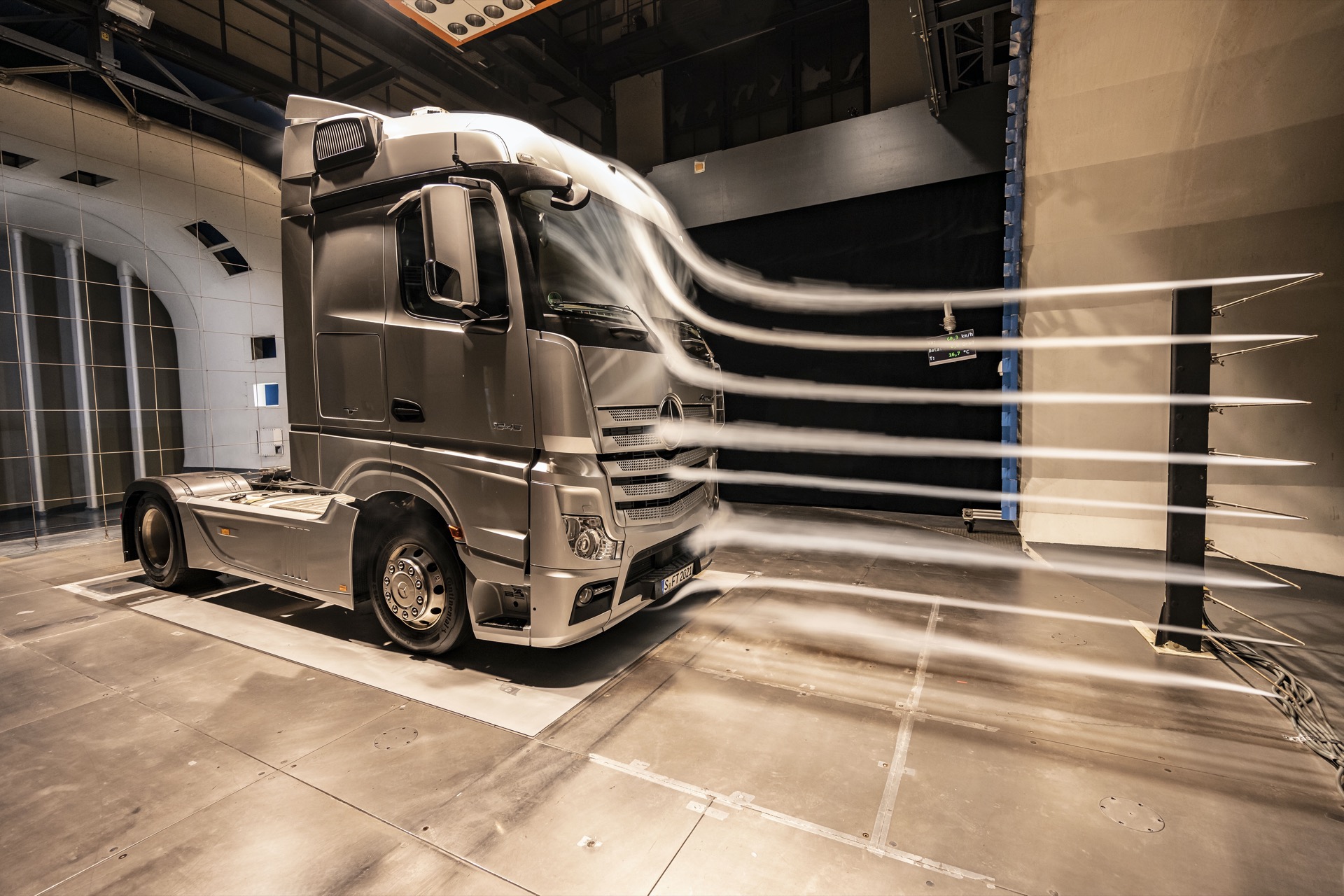
As strange as it may seem, the aerodynamic drag coefficient of a Formula 1 car is much worse than that of a truck, or that of the car you usually drive. Here is the technical explanation.
Well, yes, the title of this article is correct: the aerodynamic drag coefficient of a truck is better than that of a Formula 1. And so is that of the car you drive every day. Something that may sound surprising to those who are not familiar with the basic principles of aerodynamics. But there is an explanation for it. And even if you don’t believe it, it’s easier than it seems.
A truck has a more favourable drag coefficient than a Formula 1 car, but an F1 car has lower aerodynamic resistance
To understand this, the first thing is to know some key concepts and not confuse aerodynamic resistance with the drag coefficient. To give you an idea: the drag coefficient of a truck is between 0.6 and 0.7, although there are exceptions such as the truck from Tesla, for which a surprising Cx of 0.36 was announced; while that of a Formula 1 car is around 1, and in a standard road car it is normally around 0.30. And the lower this drag coefficient is, the better in terms of achieving lower aerodynamic resistance.
But other factors also influence aerodynamic resistance. And here is the key: a truck has a more favourable drag coefficient than a Formula 1 car, but an F1 car has lower aerodynamic resistance. Let’s look at this in more detail.
Aerodynamic resistance
Aerodynamic resistance is the force opposing the movement of a given object (in this case a car, a truck… or a Formula 1 car) as it moves through the air. This resistance is calculated with a formula, which you don’t need to memorise. You only need to know that it is the product of factors such as air density, the frontal area of the object, its drag coefficient, and the square of the speed at which the object moves relative to the air.
Since we are comparing objects, air density and speed don’t matter in this case. Keep in mind that the final aerodynamic resistance of an object is determined, among other factors, by the drag coefficient and the frontal area that the object presents to the wind. And it does so in a directly proportional way to both.
Drag coefficient
The drag coefficient, also called aerodynamic resistance coefficient, is a dimensionless number (that is, it has no units of measurement) associated with a particular surface, which quantifies the resistance of an object to moving through a fluid medium (in this case the medium is air), compared to that of a body capable of completely stopping the airflow when it hits it.
A wall perpendicular to the airflow would have a drag coefficient Cx=1. A flat plate perpendicular to the airflow would exceed that figure, with a Cx above 1.2, due to the effect produced behind the plate as the air passes. That is why the design of the rear part is so important in vehicle aerodynamics, and the Cx can change from one car to another simply by varying this area.
As we have already pointed out, the lower the Cx, the better for aerodynamic resistance. Other examples of the drag coefficient of geometric bodies would be, for instance, 0.47 for a sphere, 0.50 for a cone or 1.05 for a cube. Let us recall what we noted at the beginning: in the case of a conventional production car, the drag coefficient Cx is between 0.25 and 0.30; for a truck it is around 0.7; and for a Formula 1 car, with uncovered wheels and variable wings, it can range… from 0.7-0.8 when competing on circuits such as Monza, up to about 1.2 in Monaco!
We now focus solely on the coefficient in the direction of the X axis, along which the vehicle moves; but there are also lateral (Cy) and vertical (Cz) drag coefficients. This is not directly relevant here, but it is worth knowing that in an F1 car the Cx is sacrificed to achieve a high Cz (which provides downforce) by playing with the wing configuration. Hence, on “fast” circuits, where low downforce is desired, an F1 car has a better drag coefficient than on slow circuits, where aerodynamic resistance matters less but it is desirable for the car to “stick” to the ground, favouring cornering.
The frontal area
The frontal area is the easiest term to understand in this equation: it is the size of the air front the object must move in order to advance. In other words: the area it occupies when seen from the front. In a vehicle, this involves the dimensions of the bodywork, but also the wing mirrors, the tyres…
The frontal area of a car can be around 2 square metres. That of a Formula 1 single-seater is around 1.4 square metres. And that of a modern truck is around 8-9 square metres. It is clear that the most efficient shape for achieving a large interior space (the box shape, in the case of a truck) is the least efficient in terms of aerodynamic resistance, because it has the largest frontal area.
To improve aerodynamics, trucks use, for example, roof deflectors. These deflectors do not change the frontal area, but they do change the drag coefficient. On a road car such as the Audi e-tron, replacing conventional wing mirrors with virtual mirrors improves both things: less frontal area and a better Cx.
Another important matter when talking about aerodynamics is the design of the rear of the vehicle, almost as important as the front, because the air must be encouraged to flow over the bodywork at the front and “exit” at the back quickly and smoothly, without generating turbulence or layers at different speeds that harm aerodynamics. Although we will not dwell on this point.
The truck, the Formula 1 car and the mathematics
With these three concepts it is much easier to understand the equation that solves the statement of this article. Because, on its own, the Cx of an object does not tell us much unless it is associated with the frontal section.
For the same drag coefficient, an object with a larger frontal area will present greater aerodynamic resistance. And that is why an SUV consumes more than a saloon car with the same power, because the Cx may even be equivalent, but the SUV has a larger frontal area.
We have already seen that a Formula 1 car does indeed have a less favourable drag coefficient than a truck. However, its aerodynamic resistance is lower, because that resistance is directly proportional to the product of the drag coefficient (Cx) and the frontal area (S). If we call this product SCx, that of a Formula 1 car can be around 1.4-1.5, while for a truck the SCx is roughly 4 times higher than that of a Formula 1 car. Although its drag coefficient is more favourable, the aerodynamic resistance is worse.
Another interesting point would be to introduce the speed factor. As you may recall, we said that aerodynamic resistance is proportional to air density, to SCx and to the square of the speed. You can use the calculator to see the difference in aerodynamic resistance that a truck has to overcome when travelling at its maximum speed, around 100 km/h, and the one a Formula 1 car must overcome travelling at three times that speed.
I would also like to point out that there is a relationship between aerodynamic resistance, speed and power, which is worth knowing. Specifically, the power needed to overcome a given aerodynamic resistance is proportional not to the speed, but to its cube. For this reason a car with fairly “average” aerodynamics can reach the 200 km/h barrier with just 150 CV, whereas doubling the top speed without changing the aerodynamics requires increasing the power by more than 6 times. But that is another story, one that will fill a new article.


 Peugeot E-208 GTi: a battery-powered toy that revives the spirit of the 1980s sports cars
 New Lexus ES: luxury grows and goes electric
 First contact with the Dacia Sandero Hybrid 155: power and efficiency from €19,890
Deja un comentario