Don't wait for them to become mandatory: get rid of your warning triangles now and take advantage of the benefits of V16 beacons
 Antonio Roncero @roncero_antonio
28 December 2023
5 min.
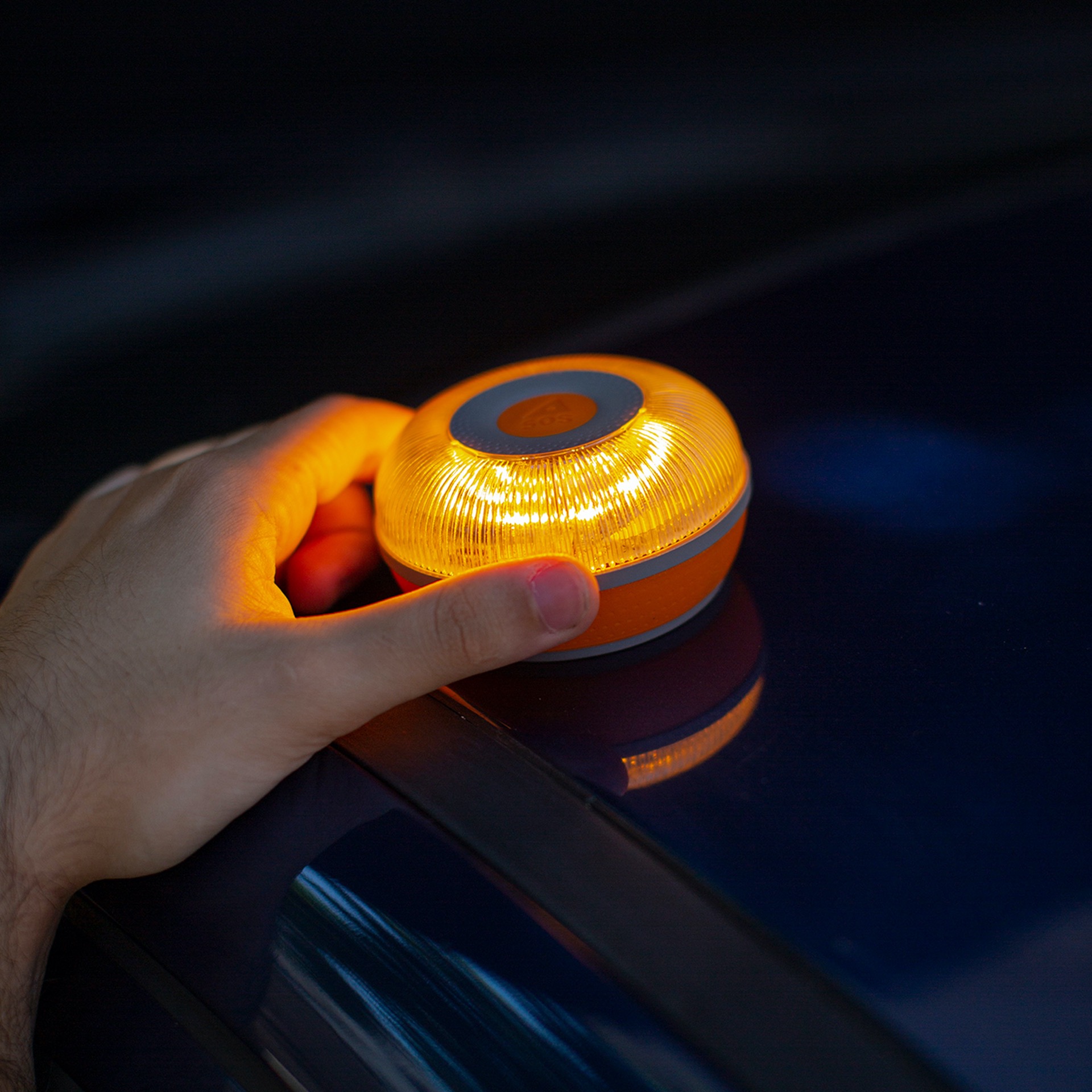
Although they won’t be mandatory until January 1, 2026, you can already say goodbye to warning triangles and replace them with a V-16 beacon, which takes up much less space and, above all, is much safer when you need to signal an emergency.
The warning triangles that we all must carry in our cars are on borrowed time: from January 1, 2026, it will be mandatory to use V-16 beacons as the new method of signaling in the event of an accident or breakdown on the road. And if you still haven’t bought one of these beacons, which have been able to replace triangles since July 2021, then you don’t know their advantages.
To tell you about them in detail, I have tested the FlashLED SOS V16 beacon. And I’ll tell you right away that, from the very first moment, even before taking it out of the box, the moment I saw its size I was clear that I wasn’t going to wait one more day to get rid of the two boxes of warning triangles that have been taking up space and rattling around in my car’s boot for years. If this isn’t reason enough for you to say goodbye to triangles, keep reading.
And remember: it’s not a question of choosing between triangles or V16 beacons, because at the latest, in 2026 V16 beacons will be mandatory. So it’s better to start enjoying their benefits now, which are not few.
1.- Minimal space and easy placement
The FlashLED SOS V16 beacon looks like a “yo-yo.” With a diameter of just under 10 cm and a height of barely 4.5 cm, it has the appearance of a sturdy, well-built device. It takes up very little space, so it fits perfectly in the vehicle’s glovebox, which already offers an additional advantage: if you need to use it, you can place it without leaving your car. Simply stick your hand out the window and place it on the roof; the base has magnets that will keep it attached to the bodywork. Therefore, the risk of being run over is reduced compared with placing triangles, which require walking 50 meters away from the vehicle to set them up.
To activate the beacon, you just press the SOS button on its top, and it will start emitting flashes of orange light that are visible from more than 1 kilometer away and in 360 degrees, far more than reflective triangles, especially in low-light conditions or bad weather. The manufacturer claims a IP54 protection rating, which indicates total protection against dust and moisture. I have tested it in rainy conditions, and it proved completely watertight. I was also surprised by the power of the light it emits and how visible it is even in heavy fog.
To operate, it uses a 9-volt battery (type 6LR61), and I think it’s a very good idea that you can check its status simply by holding down the activation button for a few seconds, which lights up LEDs indicating whether the battery has charge, whether it has reached 50% of its capacity, or whether it needs replacing. In theory, one battery provides 6 hours of uninterrupted LED operation.
2.- Real-time connection with DGT 3.0 and anonymous geolocation
The FlashLED SOS V16 beacon offers connectivity without needing a mobile phone. To do this, it integrates a SIM card that provides IoT connection to the Telefónica Tech service at no cost to the user. By law, when this type of connected beacon becomes mandatory from 2026, it must offer at least 12 years of free connection service; FlashLED SOS guarantees free data service until 2038.
This feature greatly improves safety, as it allows real-time geolocation of the vehicle and connection to the DGT 3.0 platform. It’s important to be clear here that the geolocation is completely anonymous, so it never compromises your privacy. When you activate the V16 beacon, in addition to alerting other road users through its light flashes, it transmits the location to the DGT (Spanish Traffic Authority), indicating that there is a stopped vehicle, which improves response time in an emergency.
This also allows the DGT, once the information has been validated with traffic management systems, to share an alert with the rest of the road users. These alerts can reach drivers through navigation apps that are increasingly common, such as Google Maps or Waze. Or also through the free SOS Alert app, included with the FlashLED SOS beacon.
3.- Free SOS Alert app with additional features
Purchasing the FlashLED SOS V16 beacon also includes the free SOS Alert app, available for iOS and Android devices. Downloading or using it is not required for the beacon to work and report incidents, and no configuration is needed at all, but it can be useful because it adds extra features.
Once downloaded to your phone, you just need to link the app to the beacon using the QR code or the IMEI number shown on the base, and you can receive confirmation that a notice has been sent to the DGT 3.0 when the beacon is activated due to an emergency, or send SMS alerts to contacts -up to five- that you set up in the app itself, who will also receive an alert message with the beacon’s position.
The app also lets you manage several beacons if you have more than one vehicle, as well as access additional vehicle information -make, model and VIN number, among other details- simply by entering the license plate, and you can add up to 3 vehicles. This app is free and has no associated cost.
The usual price of the FlashLED SOS V16 beacon is 59.90 euros, although there are occasional offers with discounts, such as the Christmas 2023 campaign, which offered a pack with a shock-resistant protective case for 49.90 euros.
FlashLED SOS V16 Beacon – Image Gallery


 Kia offers an electric range of 10 models, 50 versions and 400 possible combinations
 The seven finalists for the 2027 European Car of the Year (COTY) are exclusively electric
 Peugeot E-208 GTi: a battery-powered toy that revives the spirit of the 1980s sports cars
Deja un comentario