How to Choose a 7-Seat Family SUV in 2026: Practicality, Useful Boot Space and the Right Engine
 Eduardo Molina
6 August 2026
7 min.
A practical guide to choosing a 7-seat SUV in Spain in 2026, with objective criteria for interior space, usable boot capacity and engine choice according to annual mileage. A verifiable shortlist covering mainstream and premium models.
Choosing a 7-seat family SUV in 2026 is nothing like doing so five years ago. The range has grown, electrification has reshuffled prices and engines, and the DGT environmental label has become a purchasing criterion nearly as important as boot space. The question is no longer just “will the kids fit in the back?”, but “how much actually fits when all seven seats are occupied?” and “which powertrain makes sense for how I use the car?”.
Let’s sort it out.
What defines a good 7-seat family SUV in 2026
A serious 7-seat SUV in 2026 meets three conditions at once: a third row that is genuinely usable (not just homologated), a functional boot with all seven seats in use, and a powertrain that matches the family’s annual mileage. All three pillars must hold up or the car is no good. On paper almost all of them promise; in practice, half fall apart as soon as an adult sits in the very back.
Real interior space in all three rows
The third row is the filter. Below 4.70 m of overall length, it is hard to achieve a rear bench for adults with decent legroom. The good examples are around or above 4.75 m and offer a sliding second row — that detail is what separates “two children up to ten years old” from “two adults on a short trip”.
Usable boot space by configuration
Here it is worth looking at three figures, not one: litres with seven seats, with five and with two. With the third row in use, a good large family SUV offers between 180 and 300 usable litres. With five seats, between 600 and 800. With two, figures exceeding 1,900. If you are only shown the large figure, be suspicious.
Engine choice: diesel, HEV, PHEV or electric
The rule that works in 2026 is simple. Under 15,000 km/year with home charging: PHEV or electric. Between 15,000 and 25,000 km/year with mixed use: self-charging hybrid. Over 25,000 km/year with lots of motorway driving and occasional towing: diesel still makes sense, although the range of options is narrowing.
DGT label and ZBE: what to check before signing
If you live or work in Madrid, Barcelona or any city with a ZBE (low-emission zone), the label matters. A PHEV with a CERO label has free access; an HEV with an ECO label faces occasional restrictions that will become more frequent. A Euro 6d diesel with an ECO label covers almost everything today, but it is worth reviewing local developments before committing to five years of ownership.
Mainstream models: the practical reference
Skoda Kodiaq (from €42,500)
The Kodiaq is probably the most rational 7-seat family SUV on the market. Well-resolved space, a third row usable on short trips, and a boot that in the five-seat configuration approaches 800 litres. The 1.5 TSI mHEV version handles mixed use without fuss; the 2.0 TDI remains the reference for anyone doing 30,000 km/year.
| Power kW | Power CV | Top speed | Range | Consumption | Label | Fuel |
|---|---|---|---|---|---|---|
| 110 | 150 | 207 km/h | ~900 km | 6.4 l/100 | ECO | Petrol MHEV |
Kia Sorento (from €47,900)
The Sorento plays a different card: available as HEV and PHEV, with an interior finish above the segment average and a seven-year warranty that weighs in the purchase equation. The PHEV version carries a CERO label and offers around 55 km of electric range, enough for the typical daily commute.
| Power kW | Power CV | Top speed | Range | Consumption | Label | Fuel |
|---|---|---|---|---|---|---|
| 195 | 265 | 193 km/h | ~900 km / 57 km EV | 1.6 l/100 | CERO | PHEV |
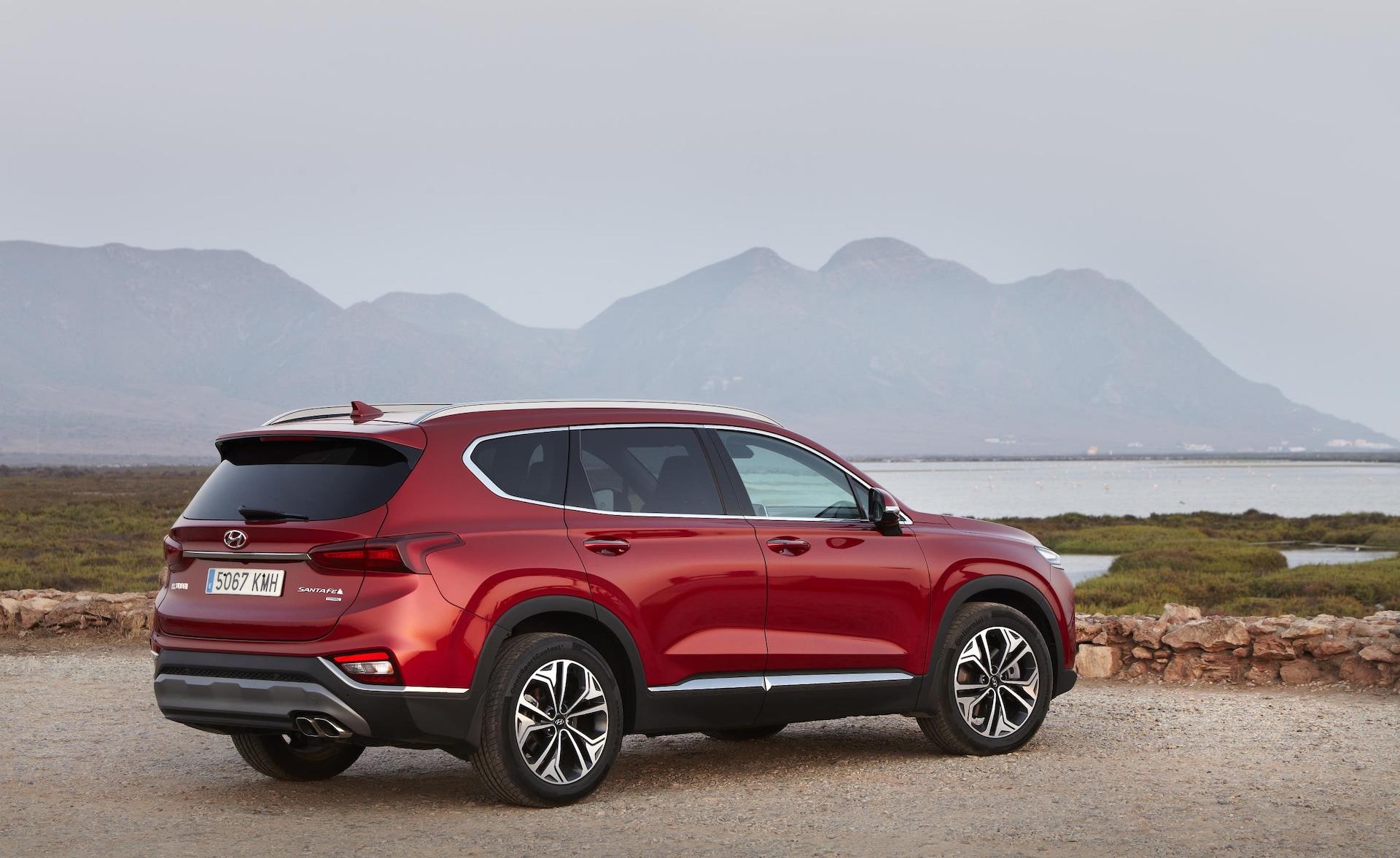
Hyundai Santa Fe (from €48,500)
Redesigned with a very distinctive language, the Santa Fe leans on near-MPV interior space and a third row among the best in the segment. HEV and PHEV available. In our view, the interior feels a step above where the brand was two generations ago.
| Power kW | Power CV | Top speed | Range | Consumption | Label | Fuel |
|---|---|---|---|---|---|---|
| 158 | 215 | 190 km/h | ~950 km | 6.3 l/100 | ECO | Hybrid |
Peugeot 5008 (from €42,000)
Renewed on the STLA Medium platform, the 5008 is now also sold as an electric model. Interior with a redesigned i-Cockpit and a third row slightly tighter than Korean competitors — but for two children it does the job. As an alternative to the more rational approaches we already reviewed in our guide to family hybrid SUVs 2026, it offers a more stylish approach.
| Power kW | Power CV | Top speed | Range | Consumption | Label | Fuel |
|---|---|---|---|---|---|---|
| 100 | 136 | 200 km/h | ~850 km | 5.8 l/100 | ECO | Petrol MHEV |
SEAT Tarraco (from €40,500)
The Tarraco shares its platform with the Kodiaq but with a slightly sportier steering feel. PHEV available, with a CERO label and declared consumption below 2 l/100 km in the combined cycle. The sensible choice for anyone who does not want to pay the premium-brand surcharge.
| Power kW | Power CV | Top speed | Range | Consumption | Label | Fuel |
|---|---|---|---|---|---|---|
| 150 | 204 | 205 km/h | ~750 km / 50 km EV | 1.7 l/100 | CERO | PHEV |
Mazda CX-80 (from €52,000)
The CX-80 is Mazda’s bet on an almost premium approach at a contained price. Rear-wheel drive, an available inline six-cylinder engine and a driving feel different from its rivals. To my taste, the most engaging to drive in the mainstream group.
| Power kW | Power CV | Top speed | Range | Consumption | Label | Fuel |
|---|---|---|---|---|---|---|
| 241 | 327 | 195 km/h | ~800 km / 61 km EV | 1.6 l/100 | CERO | PHEV |
Premium: when the budget allows
Volvo XC90 (from €78,500)
The XC90 remains the brand’s reference point. Its 2024 renewal has modernised the digital side without giving up what makes it good: space, safety and a second row comfortable to the point of tedium. In PHEV form, it carries a CERO label and comes close to 70 km of electric range.
| Power kW | Power CV | Top speed | Range | Consumption | Label | Fuel |
|---|---|---|---|---|---|---|
| 335 | 455 | 180 km/h | ~700 km / 70 km EV | 1.3 l/100 | CERO | PHEV |
BMW X7 (from €116,000)
A different league and a different price. The X7 is the largest SUV from BMW with seven genuine seats and six-cylinder petrol or diesel engines. This is the flagship of the segment from Munich. High-saloon rear-seat comfort and an electrically operated third row.
| Power kW | Power CV | Top speed | Range | Consumption | Label | Fuel |
|---|---|---|---|---|---|---|
| 280 | 381 | 245 km/h | ~1,000 km | 7.4 l/100 | ECO | Diesel MHEV |
7-seat SUV comparison: summary table and rating
| Model | From (€) | 7-seat boot | Label | Interior space | Engine | Value | Score |
|---|---|---|---|---|---|---|---|
| Skoda Kodiaq | 42,500 | 289 l | ECO | 9 | 8 | 9 | 8.7 |
| Kia Sorento | 47,900 | 187 l | CERO (PHEV) | 8 | 9 | 9 | 8.7 |
| Hyundai Santa Fe | 48,500 | 239 l | ECO | 9 | 8 | 8 | 8.5 |
| Peugeot 5008 | 42,000 | 259 l | ECO | 7 | 7 | 8 | 7.5 |
| SEAT Tarraco | 40,500 | 230 l | CERO (PHEV) | 8 | 8 | 9 | 8.3 |
| Mazda CX-80 | 52,000 | 258 l | CERO (PHEV) | 8 | 9 | 7 | 8.1 |
| Volvo XC90 | 78,500 | 302 l | CERO (PHEV) | 9 | 9 | 7 | 8.4 |
| BMW X7 | 116,000 | 326 l | ECO | 10 | 9 | 8.3 |
FAQ
Which 7-seat SUV should I buy in Spain in 2026 if I drive 20,000 km/year?
For that mileage with mixed use, an HEV such as the Hyundai Santa Fe or the Kia Sorento HEV is the most balanced option. If you have home charging and many trips under 50 km, the PHEV of the SEAT Tarraco or the Sorento PHEV itself pays off thanks to the CERO label.
How much boot space does a 7-seat family SUV need with all seven seats in use?
A reasonable minimum is 200 usable litres with the third row deployed. Below that, barely two cabin-size suitcases fit. The Skoda Kodiaq and the Volvo XC90 are among those that offer the best figure in that configuration.
Does a diesel still make sense in a large family SUV?
Yes, for profiles above 25,000 km/year with predominantly motorway driving and occasional towing. The BMW X7 diesel or the Skoda Kodiaq TDI maintain real-world consumption of 6–7 l/100 km, figures a HEV rarely matches on sustained motorway driving.
Is the premium surcharge for an XC90 or an X7 worth paying?
It depends on two factors: rear-seat mileage and residual value. If you regularly carry adults in the back, premium comfort is noticeable on every long journey. If use is more urban and family-oriented, a Kodiaq or Sorento covers 90% of cases at half the price.


 Peugeot E-208 GTi: a battery-powered toy that revives the spirit of the 1980s sports cars
 New Lexus ES: luxury grows and goes electric
 First contact with the Dacia Sandero Hybrid 155: power and efficiency from €19,890
Deja un comentario