Dacia Jogger KIA Kodiaq RAV4 Renault Skoda Sportage Symbioz Toyota Electric Cars Comparisons Family Buying Guides SUV
How to Choose a Family SUV for Under €45,000 in 2026: Engine, Seats and Real Running Costs
 Iván Navarro
31 August 2026
7 min.
A practical guide to choosing a family SUV for under €45,000 in 2026 in Spain: HEV, PHEV and BEV powertrains, usable seats and real running costs. Eight candidates assessed with judgement, plus a comparison table with scores.
Buying a family SUV for under €45,000 in 2026 is, at the same time, easier and more complicated than three years ago. Easier because the hybrid offer has become far more widespread. More complicated because you have to filter out a lot of noise to find what really makes sense. This guide focuses on the Spanish market, on models you can configure at a dealership today, and on the real cost of running them.
One clarification before we get into the analysis: we have deliberately left out the BYD range. The electric and electrified segment has become far more competitive than it was two seasons ago and, in our view, the value-for-money advantage that the Chinese brand showed against European and Asian rivals has narrowed noticeably with the arrival of Skoda, Renault or Hyundai, with very well-tuned offers at this price point. This is not a criticism of the manufacturer; it is an editorial decision to narrow the comparison to what we currently consider most advisable.
What defines a good family SUV in 2026
A family SUV today is not judged on boot space alone. The environmental label (ECO or Zero, to enter low-emission zones without hassle), real consumption on mixed journeys and total cost over three or four years all count. The best family SUV 2026 is not necessarily the largest or the most powerful, but the one that fits your use: 15,000 km a year in town and on motorways calls for an HEV; 25,000 km with fast charging at home and long trips, a PHEV or even a BEV; a large family, seven seats that are genuinely usable.
HEV, PHEV or BEV: which powertrain makes sense under the €45,000 threshold
In my view, the hybrid remains the most rational choice at this budget if you have no charging point at home. The PHEV shines if you make short daily trips and can charge it every night; if not, you are carrying around 300 kg of battery for nothing. Pure BEVs under €40,000 with genuine family space are still a minority; the ones available force you to compromise on range or size. Our list is built on this logic.
Toyota RAV4 hybrid — from €43,500
The Toyota RAV4 is the benchmark for the family hybrid SUV on its own merits. Its fourth-generation HEV system delivers real-world consumption of 5.5–6 l/100 km, and reliability is what it is: high. The interior is sober and the driving feel is somewhat removed from the enthusiast’s, but it wins you over through what it doesn’t get wrong. In this list, it plays the role of the safe bet.
| Power kW | Power CV | Top speed | Range | Consumption | Label | Fuel |
|---|---|---|---|---|---|---|
| 136 | 185 | 180 km/h | ~1,100 km | 4.9 l/100 km | ECO | Hybrid HEV |
Kia Sportage HEV — from €34,900
The Kia Sportage delivers a bolder design, seven years of warranty and a capable HEV. Perceived quality has taken a leap over the previous generation, although the boot (587 l) falls short of the RAV4. In the direct duel with the Japanese model, we have already analysed who comes out ahead depending on the type of use.
| Power kW | Power CV | Top speed | Range | Consumption | Label | Fuel |
|---|---|---|---|---|---|---|
| 176 | 239 | 196 km/h | ~900 km | 5.5 l/100 km | ECO | Hybrid HEV |
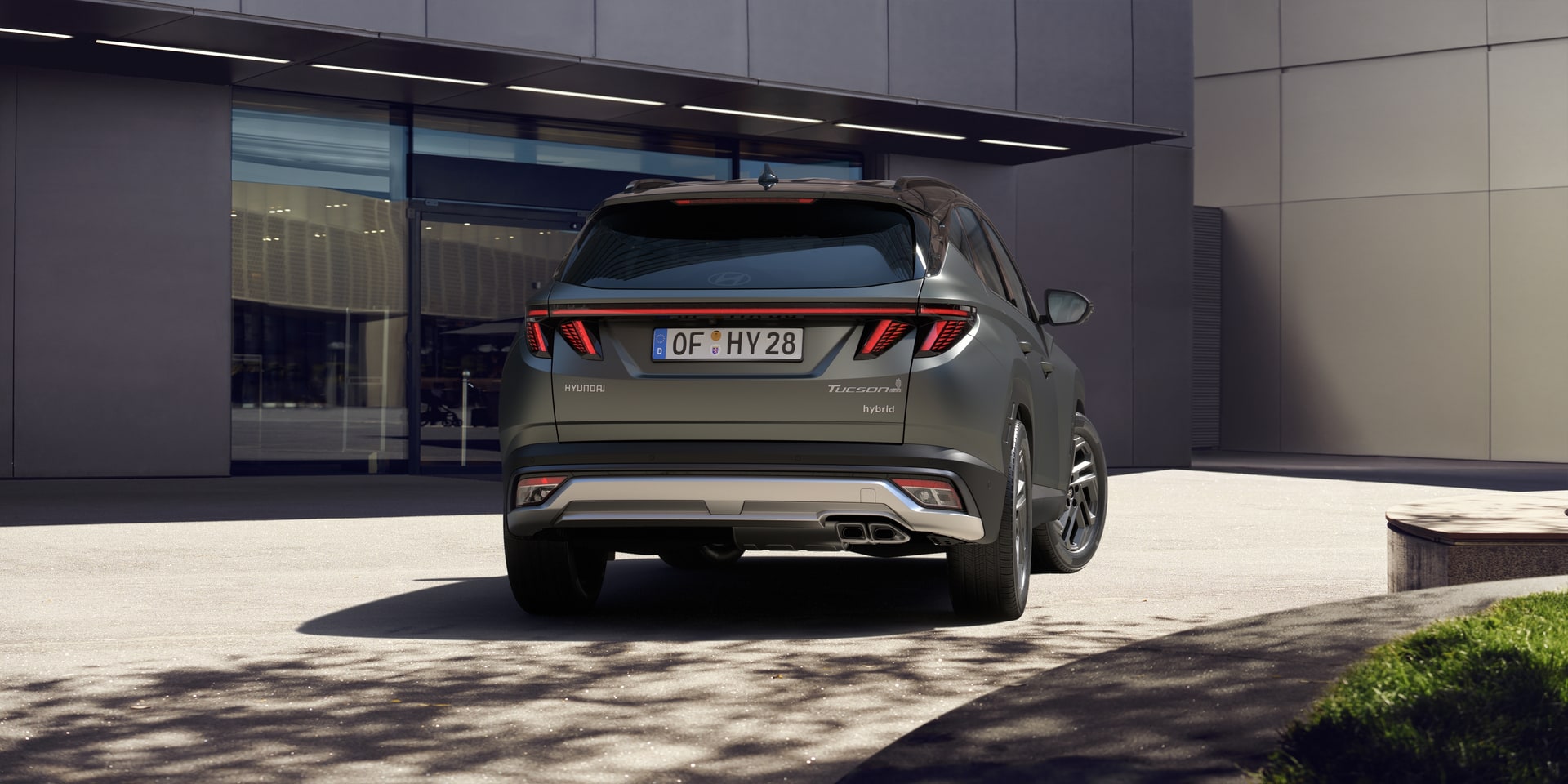
Hyundai Tucson HEV — from €40,146
A close cousin of the Sportage, with its own design personality and a cabin that, for many, ages better. Its dynamic behaviour is correct, nothing more. It is of interest for its dealer network and for aggressive entry prices when there are campaigns running.
| Power kW | Power CV | Top speed | Range | Consumption | Label | Fuel |
|---|---|---|---|---|---|---|
| 176 | 239 | 196 km/h | ~900 km | 5.6 l/100 km | ECO | Hybrid HEV |
Peugeot 3008 Hybrid — from €37,900
The new-generation Peugeot 3008 plays the card of design and premium interior at this price. The i-Cockpit remains divisive — you either love it or you don’t — and the 48V mild-hybrid variant offers an ECO label with reasonable consumption. It is the most daring in styling terms in the group.
| Power kW | Power CV | Top speed | Range | Consumption | Label | Fuel |
|---|---|---|---|---|---|---|
| 107 | 145 | 201 km/h | ~850 km | 5.4 l/100 km | ECO | Mild hybrid MHEV |
Skoda Kodiaq — from €44,700
This is where the seven-seat card comes in. The Skoda Kodiaq offers a 7-seat SUV under €45,000 at its entry point, with interior space as its main selling point. Mind you: the third row is for short journeys, not for carrying two adults from Madrid to Cádiz. 1.5 TSI engine with mild-hybrid; the PHEV exceeds our price ceiling.
| Power kW | Power CV | Top speed | Range | Consumption | Label | Fuel |
|---|---|---|---|---|---|---|
| 110 | 150 | 210 km/h | ~800 km | 6.0 l/100 km | ECO | Petrol MHEV |
Renault Symbioz E-Tech — from €30,115
The Renault Symbioz is the recent surprise of the segment. Very efficient full E-Tech hybrid system (5 l/100 km real-world in town and mixed use), 624 litres of boot space and an aggressive entry price. For intensive urban and interurban use, one of the most honest propositions.
| Power kW | Power CV | Top speed | Range | Consumption | Label | Fuel |
|---|---|---|---|---|---|---|
| 117 | 160 | 180 km/h | ~1,000 km | 4.3 l/100 km | ECO | Hybrid HEV |
Nissan Qashqai e-Power — from €36,900
e-Power system: a combustion engine that only generates electricity, with the wheels always driven by the electric motor. On motorways it loses some of its sparkle; in town it convinces. Good acoustic insulation and some of the best ergonomics in the segment.
| Power kW | Power CV | Top speed | Range | Consumption | Label | Fuel |
|---|---|---|---|---|---|---|
| 140 | 190 | 170 km/h | ~1,080 km | 5.1 l/100 km | ECO | Hybrid HEV |
Dacia Jogger Hybrid 140 — from €24,750
The wildcard. Seven genuinely usable seats, hybrid mechanics inherited from the
Renault group and a price that makes the conversation unavoidable. Materials are simple, yes, but the proposition is unbeatable if you prioritise seats and running costs above everything else.
The real running cost: beyond the price on the label
The family SUV running cost
in 2026 is made up of insurance (fully comprehensive, between €700 and €1,100 depending on model and area), official servicing (€350–550 a year for HEVs, somewhat more for PHEVs), real-world consumption and residual value at three years. A RAV4 holds its price better than a 3008; a Symbioz or a Jogger recovers the investment through consumption and purchase price. And the Plan Auto+ remains the reference for public aid in Spain; it is worth checking the current amount on the official website before signing.
Comparison table with scores
| §h418Renaulth419§ | ||||||
| §h434Renaulth435§ | ||||||
| §h450Renaulth451§ | ||||||
| §h466Renaulth467§ | ||||||
| §h482Peugeoth483§ | ||||||
| §h498Renaulth499§ | ||||||
| §h514Renaulth515§ | ||||||
| §h530Peugeoth531§ |
Editorial recommendation: who each one suits
For a standard family without a charging point and mixed mileage, the Symbioz or the RAV4. If you need seven genuinely usable seats and a tight budget, the Jogger; if you also want refinement, the Kodiaq. The Sportage and Tucson are the versatile options, and the 3008 the aesthetic indulgence. If you want more context on the preliminary filter, we have published a guide with the seven keys before signing
that complements this analysis.
Frequently asked questions
Is a hybrid SUV or a PHEV better under €40,000?
It depends on whether you have a charging point. Without a plug at home, an HEV such as the Symbioz or the RAV4 performs better than its spec sheet promises. With a plug and daily journeys under 50 km, a PHEV pays for itself; without charging, the extra weight penalises consumption.
Which 7-seat SUV genuinely fits under €40,000?
The
Dacia Jogger Hybrid 140 and the Skoda Kodiaq in its mild-hybrid entry version. The first as the functional and economical option; the second as a leap in quality and refinement, right at the upper limit of the price ceiling.
Which family SUV has the lowest real running cost?
The Renault Symbioz and the
Dacia Jogger lead on consumption (4.3–4.8 l/100 km). The RAV4 and Sportage win on residual value at three years, which balances the scales in the long term.§h562§
§h563§§h564§Is it worth buying an electric family SUV under €40,000 in 2026?§h565§
Only if your use fits: home charging, predictable daily journeys and occasional long trips. For intensive mixed use without charging logistics sorted, an HEV remains the more rational choice within this budget.§h566§
Technical specifications of the cars in this article


 Peugeot E-208 GTi: a battery-powered toy that revives the spirit of the 1980s sports cars
 New Lexus ES: luxury grows and goes electric
 First contact with the Dacia Sandero Hybrid 155: power and efficiency from €19,890
Deja un comentario