E-Transit Ford Master Renault Transit Electric Cars Furgonetas Buying Guides
How to Choose a Large Electric Van for Urban Fleets in 2026: Range, Cargo Volume and Depot Charging
 Iván Navarro
22 November 2026
6 min.
A fleet manager does not buy an electric van out of environmental conviction. They buy it because the cost-per-kilometre spreadsheet comes out better than with diesel, and because the low-emission zone rules in their city are starting to bite seriously. In 2026 that calculation is no longer a gamble: there is enough commercial experience in Spain to compare with real data, not catalogue promises.
The question that really matters is not “how much range does it have”, but three chained questions: can it cover the delivery route without recharging at midday?, does the load I need to carry fit?, and can I recharge the whole fleet overnight without the depot needing a contracted power supply worthy of an industrial estate? Let’s take them one at a time.
What defines a large electric van suitable for urban fleets in 2026
WLTP range vs real-world range in urban delivery
The WLTP cycle measures under controlled conditions, and a large electric van loaded to the brim, with the constant braking and acceleration typical of urban delivery, systematically falls short of it. The good news is that the urban profile favours electric vehicles: regenerative braking offsets part of that extra consumption, something that does not happen on motorways. As a practical reference, it is advisable to deduct between 15% and 25% from the WLTP figure to estimate usable range on a last-mile day with a full load.
Cargo volume and L3H2/L4H3 configurations
The codes L3H2 and L4H3 are not a technical whim: they define whether the van fits into the underground car park of the logistics centre or needs its own loading bay. L3H2 is around 11–15 m³ and suits urban delivery with height restrictions well; L4H3 rises to 17 m³ in a closed van and makes sense for fewer stops with more volume per route. The decision depends more on daily operations than on the spec sheet.
Charging: AC vs DC and shift management
For a fleet, overnight three-phase AC charging (11 or 22 kW) is usually enough if there are eight hours of downtime. Fast DC charging only makes sense if the van works a double shift and needs a 30–40 minute top-up at midday. The figure you really need to check here is not the peak kW, but the sustained charging curve: many vans drop in power after 50% battery, just when the driver needs to get back on the road.
Ford E-Transit, from €53,550 (excl. VAT): the benchmark for fleet electronics
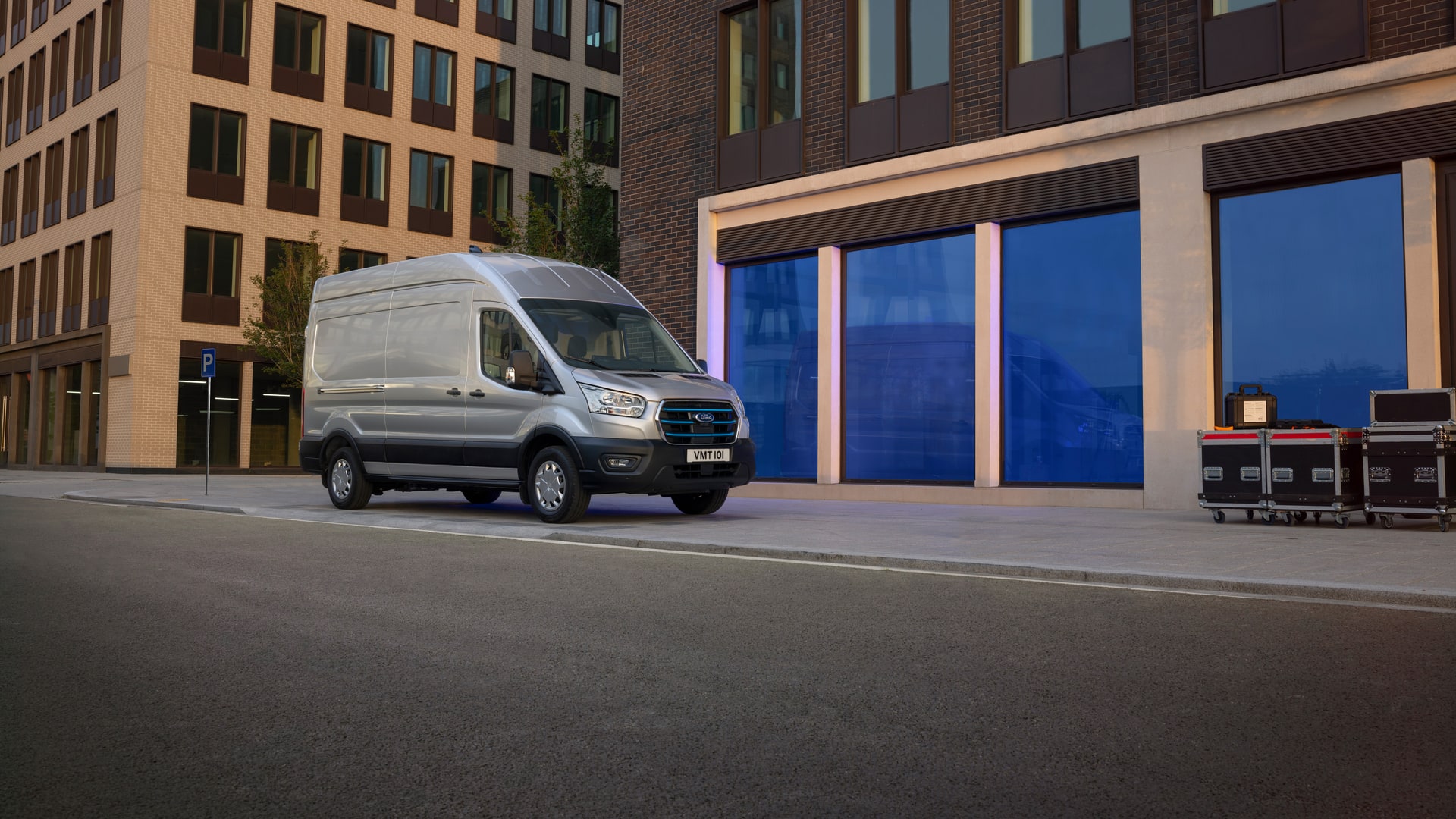
The E-Transit comes with the most mature fleet management software in the segment, inherited from the experience of Ford Pro with delivery customers. Available in L3H2 configuration with 89 kWh usable battery, it offers up to 402 km WLTP in its most efficient version and DC charging up to 180 kW.
| Power (kW) | Power (hp) | Range (WLTP) | Consumption | Label | Fuel |
|---|---|---|---|---|---|
| 135 | 184 | 402 km | ~24.5 kWh/100 km | ZERO | Electric |
Mercedes-Benz eSprinter, from €55,200 (excl. VAT): the premium choice for last-mile delivery
The current generation of the eSprinter offers the greatest battery flexibility in the segment, with options of up to 113 kWh usable, enabling up to 440 km WLTP on the combined cycle in the longest-range version. That figure comes at a price: the large-battery eSprinter noticeably increases TCO if the real route does not need it.
| Power (kW) | Power (hp) | Range (WLTP) | Label | Fuel |
|---|---|---|---|---|
| 100 | 136 | up to 440 km | ZERO | Electric |
Peugeot e-Boxer, from €58,600 (excl. VAT): volume with a Stellantis stamp
The e-Boxer aims to combine large cargo capacity with very solid mechanicals. In L4H3 configuration it reaches up to 17 m³ of cargo volume, enough for routes with few customers but bulky loads, now backed by a 110 kWh battery that takes its WLTP range up to 420 km.
| Power (kW) | Power (hp) | Range (WLTP) | Label | Fuel |
|---|---|---|---|---|
| 200 | 270 | 420 km | ZERO | Electric |
Renault Master E-Tech, from €54,800 (excl. VAT): the most balanced French option
The Master E-Tech combines an 87 kWh battery with up to 14.8 m³ of volume in its longest van version (exceeding 19 m³ in bodied cab-chassis versions), making it a natural candidate for logistics operators seeking aerodynamic efficiency and long range. DC charging reaches up to 130 kW.
| Power (kW) | Power (hp) | Range (WLTP) | Label | Fuel |
|---|---|---|---|---|
| 105 | 143 | 460 km | ZERO | Electric |
Maxus eDeliver 9, from €51,900 (excl. VAT): the entry option with a generous battery
The eDeliver 9 comes in at the most competitive price in the group and with an 88.5 kWh battery offering a good balance between cost per kilowatt-hour and performance. In fleet practice, its after-sales network in Spain is still more limited than that of the mainstream manufacturers, something to consider if operations depend on immediate workshop availability.
| Power (kW) | Power (hp) | Range (WLTP) | Label | Fuel |
|---|---|---|---|---|
| 150 | 204 | 353 km | ZERO | Electric |
Comparison for fleet managers: score by criterion
| Model | Real-world range | Cargo volume | DC charging | Estimated TCO | Overall score |
|---|---|---|---|---|---|
| Ford E-Transit | 8.5 | 7.5 | 9 | 8 | 8.3 |
| Mercedes-Benz eSprinter | 9 | 7.5 | 7.5 | 6 | 7.5 |
| Peugeot e-Boxer | 8.5 | 9 | 8 | 7 | 8.1 |
| Renault Master E-Tech | 9 | 8 | 8 | 7.5 | 8.1 |
| Maxus eDeliver 9 | 7 | 6.5 | 6 | 8 | 6.9 |
The E-Transit and the Master E-Tech come out best in this comparison thanks to their overall balance between range, charging power and operational efficiency. That does not mean they are the only valid option: if the route demands maximum interior volume in a closed van without sacrificing range, the renewed 110 kWh e-Boxer offers a capacity that the eSprinter or the Master van struggle to match.
TCO: how to calculate the real cost per delivered kilometre
The purchase price is only the entry ticket. The calculation that really drives the decision in a fleet of more than ten units combines the cost of energy (much cheaper at off-peak overnight rates), maintenance (no filters, no oil, no AdBlue) and depreciation, which is still a bigger unknown for electric vehicles than for diesel due to the shallower used-market data. To calculate rigorously, it is also worth reviewing criteria for vehicles that are profitable for businesses with intensive road use, which apply the same TCO logic even though the end use differs.
The public aid currently available for commercial vehicle fleets (such as the state incentive programmes for electric mobility) remains relevant for reducing the initial investment, although you should always check the official bases of each call to verify the amounts available.
Frequently asked questions
What real-world range does a large electric van need for urban delivery?
For most last-mile routes in Spanish cities, between 150 and 220 real km per day covers most operations without the need for an intermediate recharge.
Is it better to charge in AC or DC at a fleet depot?
For fleets with an eight-hour or longer overnight stop, three-phase AC charging is sufficient and cheaper to install. DC only pays off if there is a double shift.
What cargo volume do I need, L3H2 or L4H3?
L3H2 if there are height restrictions or urban car parks; L4H3 if the volume per route matters more than the number of stops.
Does it make economic sense to move the fleet to electric vans in 2026?
For most intensive urban use profiles, yes, thanks to lower energy and maintenance costs, although the payback period depends heavily on the final purchase price and on the deductions or aid that apply.
Technical specifications of the cars in this article


 Kia offers an electric range of 10 models, 50 versions and 400 possible combinations
 The seven finalists for the 2027 European Car of the Year (COTY) are exclusively electric
 Peugeot E-208 GTi: a battery-powered toy that revives the spirit of the 1980s sports cars
Deja un comentario