5 Hyundai i30 OMODA Comparisons
Hyundai i30 vs Omoda 5: Efficient compact hybrids in Spain
 Iván Navarro
29 March 2026
8 min.
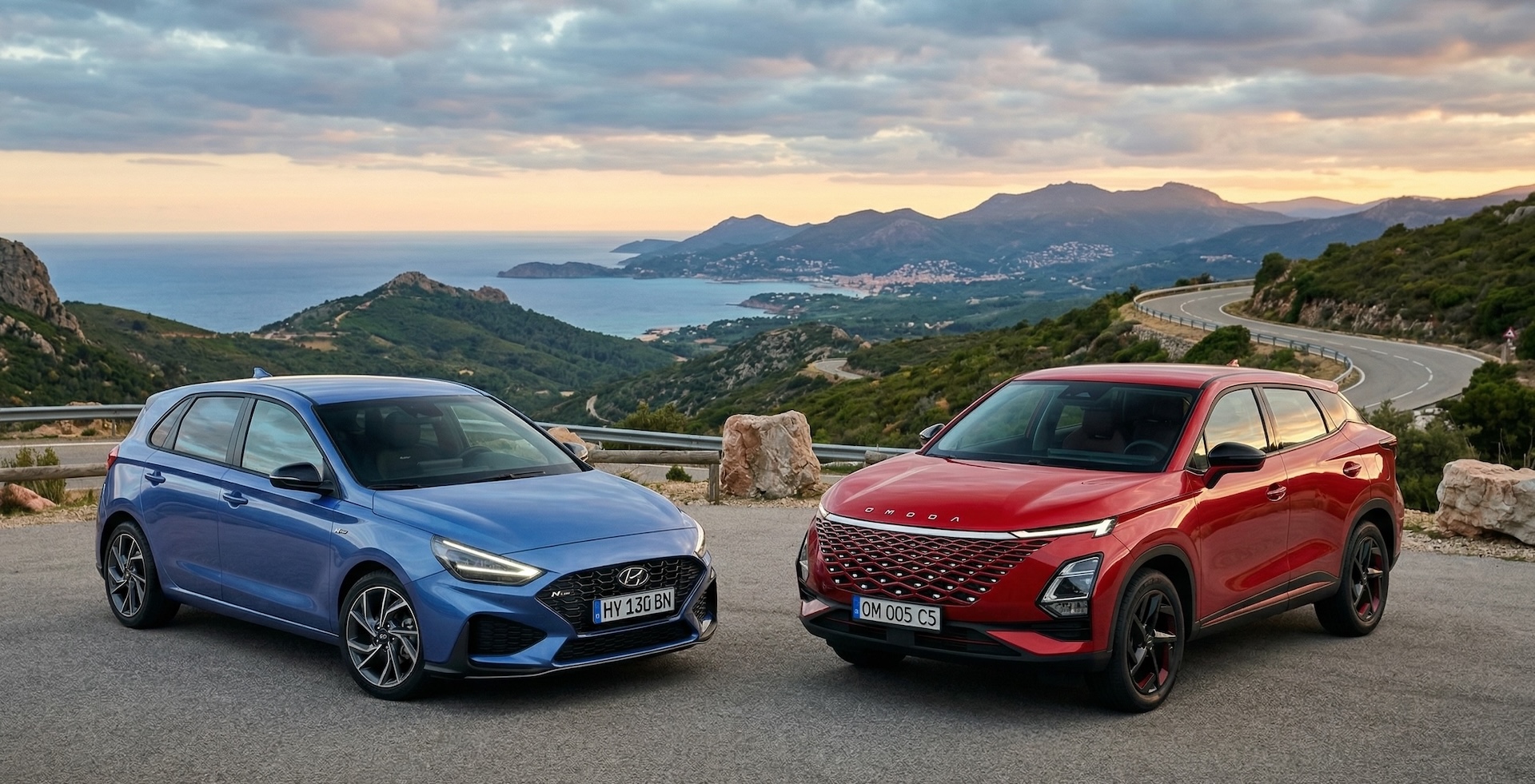
The Hyundai i30 and the Omoda 5 go head to head in this comparison, designed to help you choose between the two models if you are considering buying one.
Compact hybrids remain an attractive option for those seeking a balance between low fuel consumption, easy everyday driving and moderate total cost of ownership. In the Spanish market, demand for this type of vehicle has grown steadily in recent years, driven by buyers who prioritise efficiency without giving up space and equipment.
This comparison pits two recent proposals within the compact hybrid range against each other: the Hyundai i30 and the Omoda 5. Both aim to combine agile urban performance with moderate consumption on the open road and a competitive level of equipment. Here we analyse performance, official consumption, interior space, equipment and value for money to help you decide which compact hybrids make sense depending on real-world use and budget.
The most balanced models in the segment in 2026
To prepare this analysis, balance criteria have been assessed: real-world efficiency, starting price of the base version in Spain, useful performance in real traffic and interior versatility. The aim is to identify which proposal offers the best overall value without sacrificing comfort or active safety.
Hyundai i30
The Hyundai i30 presents itself as a sober, proven alternative in the segment. Its hybrid set-up prioritises smooth running and low consumption in urban use and on interurban roads. It stands out for a suspension tune geared towards comfort, communicative steering and a calibration that favours real-world consumption over extreme performance. The recommended version is the hybrid that balances usable power with moderate consumption according to official data sheets. In terms of interior space, the i30 maintains a sensible benchmark for its class, with a practical boot and carefully designed ergonomics for the front seats and controls.
In equipment, it offers a technology package in line with its rivals: state-of-the-art driver assistance, connectivity and active and passive safety options that place it in a good position against European and Asian competitors. Its strongest asset is reliability and a well-established ownership experience.
The best
- Balanced and comfortable behaviour.
- Moderate real-world consumption in daily use.
- Competitive level of technology equipment.
Room for improvement
- Less striking interior design compared with more modern alternatives.
- Some versions can be less efficient at high speed.
Which compact hybrid offers balanced consumption for mixed use?
The Hyundai i30 stands out for its low real-world consumption and for a tune that prioritises efficiency in town and on urban roads.
| Feature | Data | Score |
|---|---|---|
| power | Depends on version (balanced range focused on efficiency) | 8.8 |
| WLTP range | Hybrid; combined homologated consumption according to the manufacturer’s data sheet | 8.6 |
| Top speed | Limited by an efficiency-oriented engine | 7.8 |
| Boot | Practical and reasonable capacity for its class | 8.2 |
| starting price | According to the official Spanish price list for the base version | 9.0 |
score out of 10 based on the criteria analysed in this article
Omoda 5
The Omoda 5 arrives with a bolder design proposal and an abundantly equipped offer, which makes it appealing to those seeking a modern look and technology from the entry-level version. Its hybrid set-up focuses on delivering good urban response and a broad connectivity package. The recommended version seeks to maximise efficiency while keeping reasonable performance; its steering and suspension are geared towards a balance between comfort and dynamism.
Where the Omoda 5 competes strongly is in its price-to-equipment ratio: many assistance and technology options are available as standard or in affordable packs. In terms of interior space it offers clever solutions, although the perceived interior fit and the quality of some materials still lag behind more established brands.
The best
- Modern and eye-catching exterior design.
- Generous technology equipment from basic versions.
- Attractive price-to-equipment ratio.
Room for improvement
- Interior fit and perceived quality in some details.
- Service and maintenance network less established than traditional brands.
Which compact hybrid has the best value-for-equipment ratio?
The Omoda 5 stands out for offering a very competitive level of equipment relative to its price, which makes it an interesting option for those who prioritise technology and aesthetic presence.
| Feature | Data | Score |
|---|---|---|
| power | Varies by version; focus on efficiency and urban response | 8.4 |
| WLTP range | Hybrid; homologated consumption according to the manufacturer’s data sheet | 8.0 |
| Top speed | Adequate for daily use, not performance-oriented | 7.6 |
| Boot | Good use of interior space | 8.0 |
| starting price | Official Spanish price list, competitive in the segment | 8.6 |
score out of 10 based on the criteria analysed in this article
Technical comparison
At a quick glance, the Hyundai i30 offers a more traditional and established driving experience, prioritising real-world efficiency and comfortable chassis settings. The Omoda 5 pursues a value proposition centred on equipment and design, at competitive prices. The key differences lie in the sense of quality inside the cabin and in the commercial equipment policy: one sacrifices a little spectacle for a more refined tune, while the other offers a technology package at a lower cost.
| Model | power | WLTP range | starting price | Score |
|---|---|---|---|---|
| Hyundai i30 | Range focused on efficiency | Hybrid: combined consumption according to data sheet | Official Spanish price list | 9.0 |
| Omoda 5 | Efficient and well-equipped range | Hybrid: combined consumption according to data sheet | Official Spanish price list | 8.4 |
score out of 10 based on the criteria analysed in this article
Which car to buy according to your profile
If you do a lot of city driving
Prioritise low consumption and smooth response in traffic jams: the Hyundai i30 offers a tune geared towards efficiency and urban comfort, so it is a logical choice if your use is mostly daily city driving.
If you travel frequently
Look for stability and comfort on the road: the Hyundai i30 provides more settled behaviour on long journeys and better efficiency at sustained speeds, which reduces costs on frequent trips.
If you are looking for the best price
If budget and equipment are your priority, the Omoda 5 usually offers more standard technology at a competitive price, which improves value for money in the entry-level range.
If you prioritise technology
For those who value screens, assistants and connectivity from the entry-level version, the Omoda 5 is the most attractive alternative in this comparison.
Frequently asked questions
Which of the two uses less fuel in urban driving?
In mixed use the more balanced option for consumption is usually the Hyundai i30, thanks to its efficiency-focused tune; official consumption figures should be checked on the manufacturer’s data sheet and WLTP data.
Which has the better standard equipment?
The Omoda 5 usually offers the more complete technology package and driver aids from the entry-level versions, which makes it competitive in terms of price-to-equipment ratio.
Are these hybrids reliable?
Both proposals use solutions well established in the hybrid market and come with a manufacturer warranty; real reliability also depends on maintenance and the after-sales network in Spain.
Which rival models should I consider?
Models such as the Toyota Corolla Hybrid, the Honda Civic in electrified variants or compact alternatives from European brands can be direct competition and deserve comparison according to your priorities in consumption, space and price.
What is the difference in maintenance cost?
Maintenance varies by dealership network and service policies; in general, modest hybrids have costs similar to petrol cars, with consumption advantages for long urban journeys.
Expert opinion
Beyond the official figures, the choice between the Hyundai i30 and the Omoda 5 should be based on real use and the buyer’s priorities. If your driving is mostly urban and you value moderate consumption and a sober, reliable driving experience, the i30 represents a sensible choice: its tune rewards efficiency and comfort, factors that reduce operating costs over the long term.
If, on the other hand, you are looking to stand out for design and get maximum technology equipment in the entry-level version, the Omoda 5 offers a more eye-catching proposal with a price-to-equipment ratio that is hard to beat, even if some interior fittings fall short of established brands. For frequent journeys and sustained-speed trips, the i30 provides a more settled response; for users who prioritise connectivity and aesthetic presence, the Omoda 5 is better aligned with those needs. In short: both are valid options within the compact hybrids, but the final recommendation should rest on three key questions: how much you drive each day, how much you value equipment from the base version, and which service network you prefer in Spain.
Technical specifications of the cars in this article


 Peugeot E-208 GTi: a battery-powered toy that revives the spirit of the 1980s sports cars
 New Lexus ES: luxury grows and goes electric
 First contact with the Dacia Sandero Hybrid 155: power and efficiency from €19,890
Deja un comentario