Magna Steyr starts production of the GAC Aion UT in Austria
 Javier Cantagalli
29 March 2026
3 min.
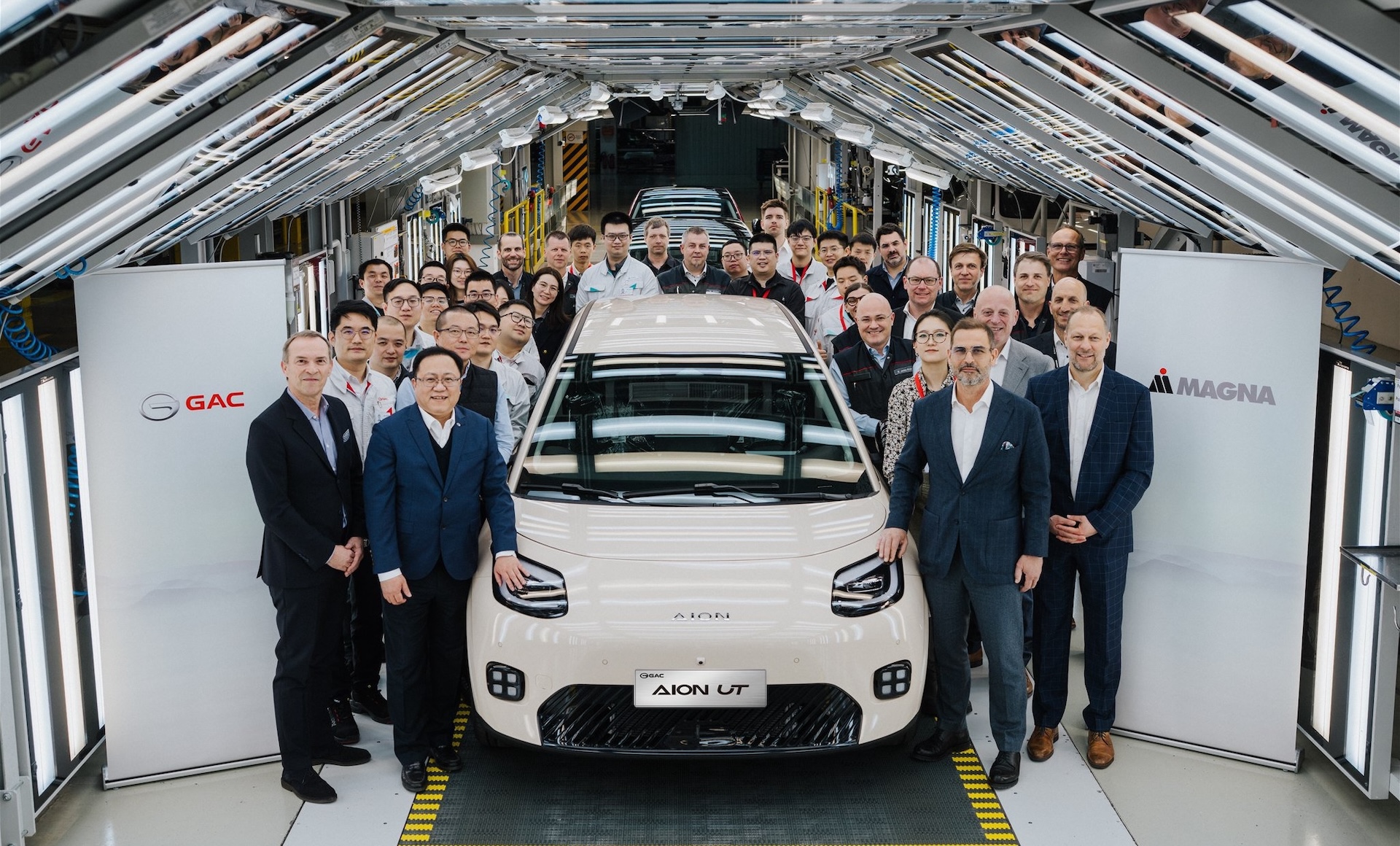
With the start of Aion UT production in Graz, Magna Steyr and GAC are strengthening their alliance and moving forward with localising the assembly of Chinese electric vehicles on European soil.
Magna Steyr, which specialises in assembling vehicles for third parties, has started production of the GAC Aion UT at its Austrian plant in Graz. It is the second electric model from the Chinese brand to be assembled at these facilities, after the first units of the mid-size SUV Aion V began rolling off the assembly line at the plant last November.
This rapid expansion of production of the Chinese brand’s models is part of a comprehensive cooperation agreement signed between GAC and Magna in November 2025, which from the outset envisaged future projects beyond the assembly of that first model.
The Aion UT is a compact car with a fully electric powertrain that has been sold in China since March 2025 and is also produced in Thailand. A few weeks ago it was officially presented to the European market at the Motion Expo show held in Graz. Although it has not yet reached dealerships on the continent, its local production in Austria confirms GAC’s strategy of increasing its presence in Europe.
Some earlier clues
In December 2025 GAC announced that it would use LFP batteries supplied by Farasis Energy in its vehicles intended for the European market. The joint mention of the Aion V and the Aion UT in that announcement served as indirect confirmation that both models would be assembled in Graz.
The cells for the battery packs supplied by Farasis are pouch-type with LFP chemistry. The total order volume exceeds 10 GWh, an amount that should be enough to equip around 100,000 vehicles with 100 kWh battery packs, and some more if the total capacity is below those 100 kWh. For the time being the Chinese manufacturer has not disclosed the exact capacity of the battery pack for these models.
Magna’s Austrian plant is consolidating its position as an important production hub for several Chinese brands seeking to avoid import tariffs on vehicles from their own country. Since last September, the Xpeng G6 and G9 models have also been assembled in Graz.
There is no shortage of work at Magna Steyr’s Austrian plant
It is important to note that Magna is exclusively responsible for manufacturing the vehicles, while GAC retains full control over distribution and sales in Europe. The Chinese company has stated its intention to expand its distribution and service network through new alliances, although it has not yet detailed the specific markets or the production capacity allocated in Graz.
Magna’s assembly lines in Graz are flexible and allow the simultaneous production of combustion-engine, hybrid and electric vehicles. Among the electric models that have come off, or are coming off, this plant are notably the Jaguar I-Pace, the Mercedes G-Class with EQ technology, and the aforementioned XPENG models. Combustion-engine production continues with the BMW Z4 and the Toyota Supra.


 Peugeot E-208 GTi: a battery-powered toy that revives the spirit of the 1980s sports cars
 New Lexus ES: luxury grows and goes electric
 First contact with the Dacia Sandero Hybrid 155: power and efficiency from €19,890
Deja un comentario