Atto 3 BYD Hyundai Kona Comparisons
Hyundai Kona Electric vs. BYD Atto 3: Asian competition in electric SUVs
 Iván Navarro
27 March 2026
8 min.
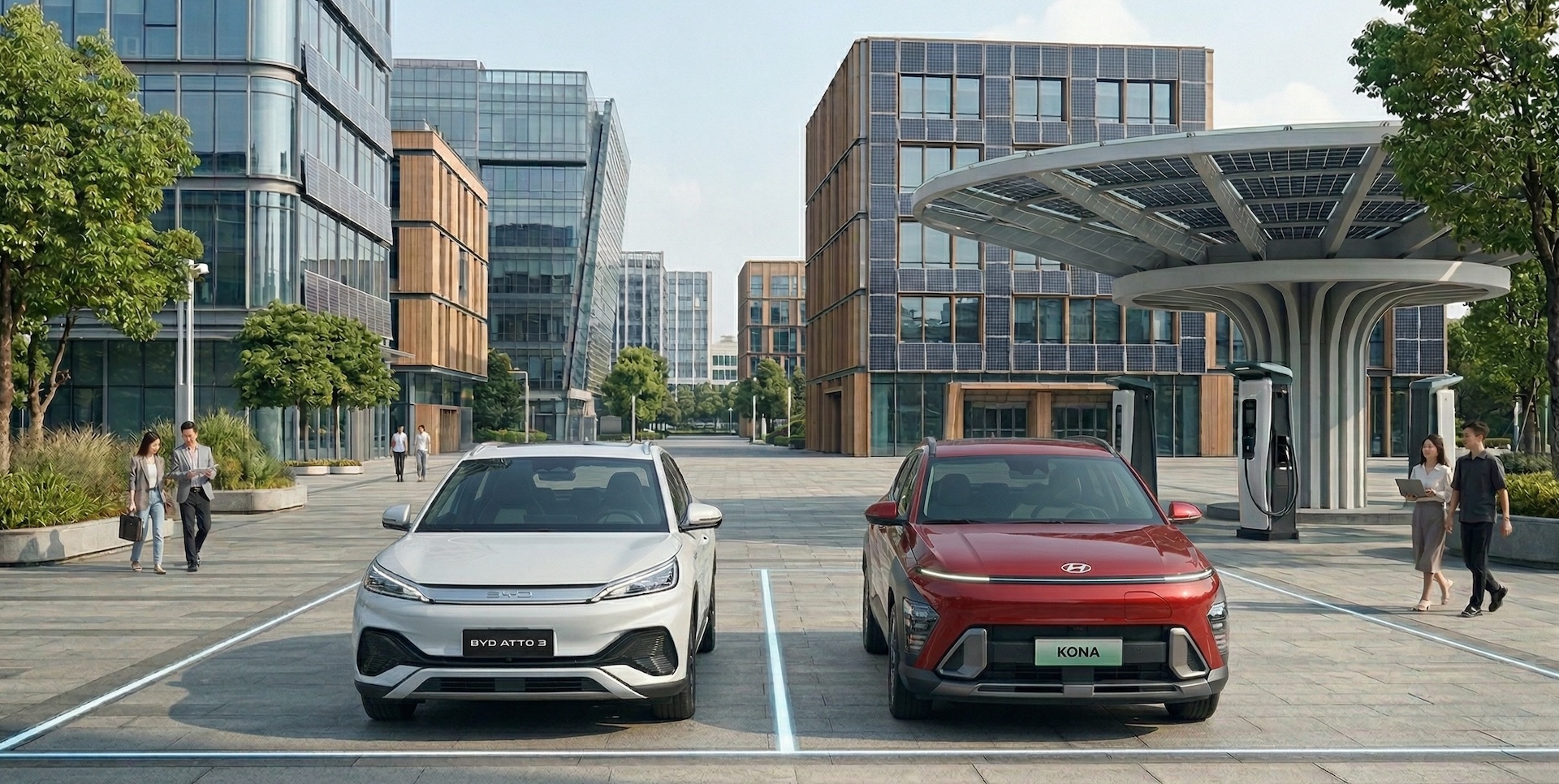
Models such as the Kia Niro also belong to this segment and deserve consideration if your goal is to compare interior space, range and cost per use.
Asian-made electric SUVs have gained ground in recent years by offering an attractive combination of range, technology and price. In Spain, models such as the Hyundai Kona Electric and the BYD Atto 3 compete directly in the compact 100% electric segment, a space where buyers look for a balance between WLTP range, useful fast-charging capability and a practical cabin for everyday use.
The typical buyer of these models prioritises mixed driving (city and motorway), ease of use when charging and contained running costs. A compact electric SUV should offer at least 300 km of real-world range, a quiet driving experience and a charging offer that allows quick top-ups on long journeys. In this comparison we analyse range, efficiency, technology and price to help you choose between two alternatives with similar approaches but different technical details. Models such as the Hyundai Kona or the Kia Niro also form part of the competitive landscape, where every tenth of efficiency and every kW of charging power matters when deciding what to buy.
The most balanced models in the segment in 2026
Choosing a balanced electric SUV in 2026 means weighing the relationship between WLTP range, real purchase price, ease of charging and perceived quality. In the comparison between the Hyundai Kona Electric and the BYD Atto 3 we look for a balance between road efficiency, size and interior space, as well as the service network and equipment options. Our editorial criteria prioritise day-to-day usefulness, cost per kilometre and real road performance.
Hyundai Kona Electric
The Hyundai Kona Electric maintains its proposition as a practical urban-compact with a tuning focused on efficiency. The version recommended for most buyers is the one fitted with the largest battery available in the range, which provides sufficient range for periodic trips outside the city without compromising dynamics. The official technical sheet shows WLTP range figures aimed at mixed use; its homologated consumption and an onboard charger capable of accepting fast-charging power allow top-ups at public stations in reasonable times. In terms of performance, the combined output of the powertrain offers agile response when overtaking and on interurban roads. Boot space is adequate for the car’s size and, compared with rivals such as the Kia Niro or the Volkswagen ID.3, its ride comfort and chassis set-up stand out.
The best
• Good real-world consumption efficiency.
• Balanced and agile handling.
• Established service and maintenance network.
To be improved
• Interior less innovative than some rivals.
• Ultra-fast charging options limited depending on version.
Which electric SUV offers the best balance between range and urban practicality?
The Hyundai Kona Electric stands out for its real-world efficiency and its tuning, making it a very balanced option for daily use and occasional trips.
| Feature | Figure | Score |
|---|---|---|
| Power | 150 kW (204 CV) | 8.8 |
| Range | ~480 km WLTP (long-range version) | 9.0 |
| Top speed | 167 km/h | 7.5 |
| Boot | ~332 litres | 7.4 |
| Price from | ~34,000 € | 8.0 |
score out of 10 based on the criteria analysed in this article
BYD Atto 3
The BYD Atto 3 presents itself as an alternative that focuses on a greater sense of interior space and a distinctive technology interface. The proposition includes a battery with good energy density and a motor configuration designed to deliver instant torque; its real-world WLTP range allows most users to travel with confidence, and its charging system accepts power levels that, in practice, shorten times on long journeys. The interior styling and technology solutions (screens and connectivity) are among its strong points compared with European and Asian alternatives. In terms of consumption, its balance is especially evident on mixed routes, where the battery-to-weight ratio is competitive.
The best
• Spacious cabin and on-board technology.
• Battery with good real-world range.
• Excellent equipment-to-price ratio.
To be improved
• Service and after-sales network less extensive than that of established brands.
• Suspension tuning could be improved on broken roads.
Which electric SUV offers the best value for money in technology equipment?
The BYD Atto 3 stands out for its technology package and competitive range, making it an attractive option if you value interior space and equipment at the best price.
| Feature | Figure | Score |
|---|---|---|
| Power | 150 kW (204 CV) | 8.6 |
| Range | ~420 km WLTP | 8.6 |
| Top speed | 160 km/h | 7.2 |
| Boot | ~440 litres | 8.0 |
| Price from | ~33,000 € | 8.4 |
score out of 10 based on the criteria analysed in this article
Quick technical comparison of the Top 5
In a head-to-head between the two electric SUVs, the key differences lie in interior space management, the usability of the interface and the product strategy: the Kona prioritises efficiency and a settled tuning, while the Atto 3 focuses on interior space and technology. Both offer similar power outputs and sufficient ranges for mixed use; the choice depends on whether you value the service network and dynamics more (Kona) or equipment and space (Atto 3).
| Model | Power | Range | Price | Score |
|---|---|---|---|---|
| Hyundai Kona Electric | 150 kW (204 CV) | ~480 km WLTP | ~34,000 € | 9.0 |
| BYD Atto 3 | 150 kW (204 CV) | ~420 km WLTP | ~33,000 € | 8.6 |
score out of 10 based on the criteria analysed in this article
Which car to buy according to your profile
If you do a lot of city driving
For daily urban journeys, the Hyundai Kona Electric offers a combination of efficiency and agility that reduces cost per kilometre and makes it easy to use in dense traffic; its size and turning circle make it manageable in town and its real-world consumption is contained.
If you travel frequently
If your trips include motorway journeys, the BYD Atto 3 is interesting for its interior space and sufficient range, which reduces stops; its load capacity and cabin ergonomics make the trip more comfortable for passengers and luggage.
If you are looking for the best price
The BYD Atto 3 usually offers a more aggressive equipment-per-euro proposition, making it a solid option if your priority is maximising equipment and technology on a tight budget.
If you prioritise technology
In terms of interface and on-board solutions, the BYD Atto 3 stands out for its very visible multimedia and driver-assistance systems; if in-cabin technology is your priority, its approach is convincing.
Frequently asked questions
Which of the two has better WLTP range?
In homologated figures, the Hyundai Kona Electric with the largest battery offers a higher WLTP range, although in real use the differences narrow depending on driving style.
Which car charges faster at public stations?
Both accept fast charging at public stations, but actual capacity depends on the station and the specific version; in practice, times between the two are similar at medium-to-high power points.
Which is cheaper to maintain?
Maintenance costs tend to be similar for electric vehicles of this size; the dealer network and service history may tip the balance towards brands with a greater local presence.
Is the interior of the Atto 3 more spacious than that of the Kona?
Yes, the BYD Atto 3 offers a sense of greater interior space and a larger boot, which benefits families or those who frequently carry luggage.
Which electric SUVs are most recommended to buy in Spain today?
It depends on use: models such as the Hyundai Kona or the BYD Atto 3 are solid options; the decision should be based on priority between efficiency, service network and equipment.
Expert opinion
Beyond the official figures, the choice between the Hyundai Kona Electric and the BYD Atto 3 depends on real use and the buyer’s priorities. If your daily route combines urban and suburban driving and you value proven efficiency and a tested tuning, the Kona offers a balanced and reliable proposition. If your goal is to maximise interior space, equipment and on-board functionality at a competitive price, the Atto 3 is a very solid alternative.
For those who make regular long journeys, homologated range and ease of charging will be decisive; here the Kona may have an advantage in higher-capacity versions, although practical experience depends as much on charging infrastructure as on driving style. In terms of value, the Atto 3 competes on technology and interior space, while the Kona relies on a settled dynamic set-up and a more established service network. Assessing total cost of ownership (real consumption, maintenance and ease of charging) and family space needs should be the final criterion before deciding what to buy.
The market for compact electric SUVs now offers alternatives capable of covering most buyer profiles; the choice between Hyundai and BYD comes down to whether you prioritise efficiency and service or interior space and on-board technology.
Technical specifications of this car


 Peugeot E-208 GTi: a battery-powered toy that revives the spirit of the 1980s sports cars
 New Lexus ES: luxury grows and goes electric
 First contact with the Dacia Sandero Hybrid 155: power and efficiency from €19,890
Deja un comentario