BYD Hyundai Santa Fe Tang Comparisons
Hyundai Santa Fe plug-in hybrid and BYD Tang plug-in hybrid: large PHEV SUVs in Spain
 Iván Navarro
31 March 2026
10 min.
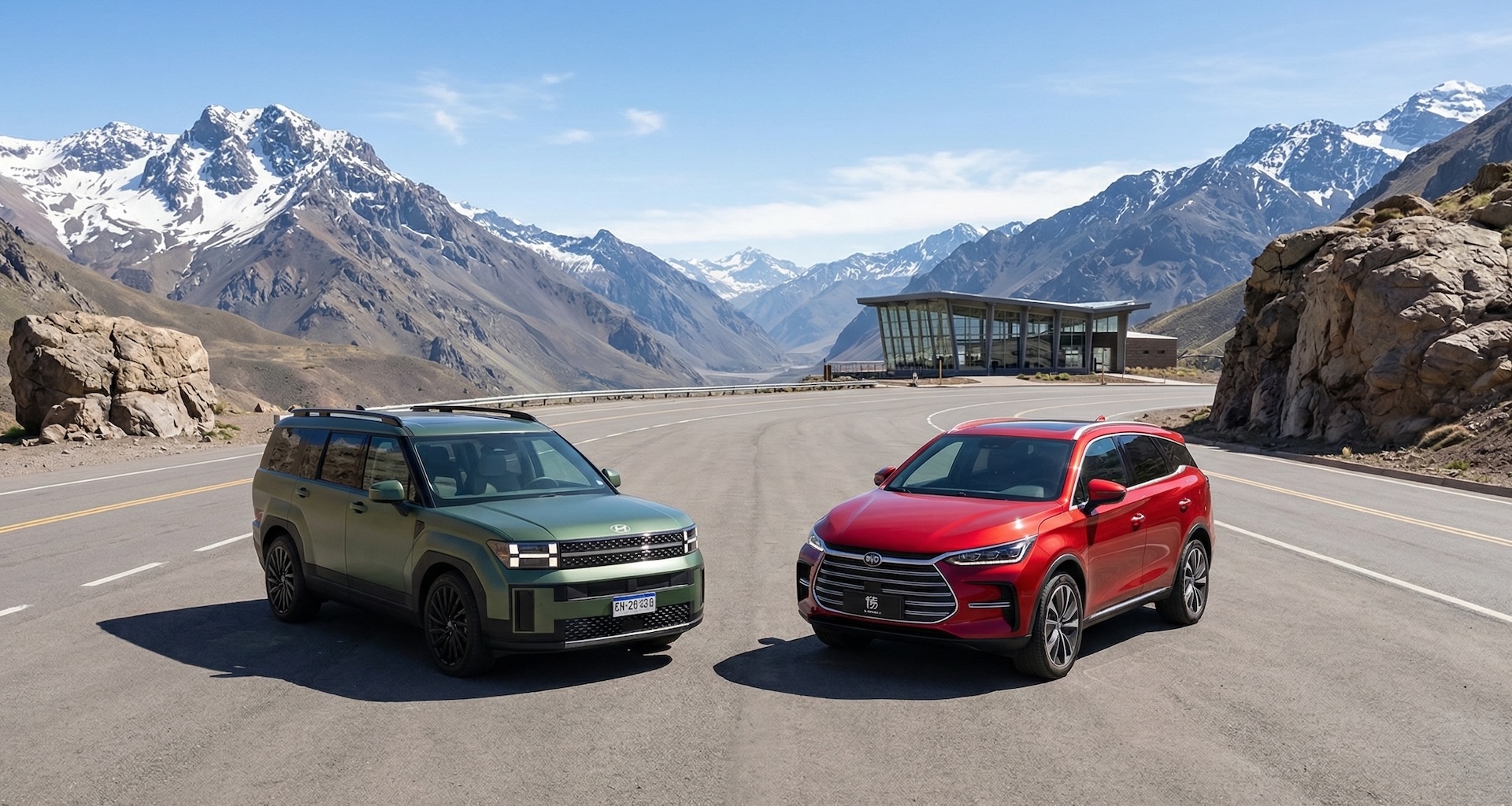
Hyundai Santa Fe vs BYD Tang: Two family giants face to face. The traditional Korean SUV or the new electric Chinese titan?
Large PHEV SUVs are starting to take a prominent place among family alternatives that seek a balance between electric mobility and range for long journeys. In Spain, demand for plug-in SUVs has grown in recent years thanks to the combination of lower real-world consumption in urban use and the ability to travel between cities without relying solely on the charging network.
This analysis compares in depth two representative options in the large plug-in segment: the
Hyundai Santa Fe plug-in hybrid and the BYD Tang plug-in hybrid. We examine range, interior space, technology, official consumption figures, and starting price for the entry-level version in Spain, with the aim of guiding families who want a plug-in car without giving up size and comfort. The market shows a clear trend: those who need space every day demand PHEV solutions that reduce urban consumption but maintain range for long trips. However, not all large PHEV SUVs offer the same technical balance or the same value for money.
Commercially, PHEV versions occupy a growing share of sales volume within the large SUV segment, driven by the availability of home charging points and improvements in WLTP cycles. When choosing, buyers weigh especially
WLTP range, boot capacity, ease of use of the plug-in hybrid system, and real running costs, more than maximum power in CV. Below we break down each proposal and present a technical comparison that makes the decision easier.
The most balanced models in the segment in 2026
To determine balance, we assess price, real electric capacity, interior space and driver-assistance technology. Our editorial criteria prioritise efficiency in daily use and real capacity for long journeys, over high power figures with no practical application. In this context, both the
Hyundai Santa Fe and the BYD Tang represent different alternatives: the former offers a proven solution focused on comfort; the latter proposes an approach emphasising electrification and extended electric range.
Hyundai Santa Fe
The
Hyundai Santa Fe plug-in hybrid presents itself as a logical choice for families who need space and a comfortable tune. It stands out for a mechanical architecture already familiar to the brand and for a setup geared towards ride comfort. The PHEV version combines a petrol engine with electric propulsion to offer electric-only driving on daily routes and a regeneration system adapted to the size of the car.
For practicality, the Santa Fe maintains generous space in the two main rows and offers 7-seat options depending on configuration, broadening its versatility for family use. Charging and driving-mode management is intuitive, and the integration of the multimedia system and driver aids is in line with expectations for the large segment.
In terms of figures, the Santa Fe proposition aims for a balance between
power, efficiency and space. The official Spanish price for the basic PHEV version sits around the starting price announced by the manufacturer for the entry range. Official consumption figures and the electric WLTP range allow most daily journeys to be covered without fuel consumption, while fuel tank capacity and the combustion engine make long trips easy without range anxiety.
What’s good
• Interior space and seat options (practical for families).
• Integration and ergonomics of the plug-in hybrid system.
• Sense of comfort and ride quality.
What could be better
• The
WLTP range in electric mode, which is sufficient for everyday use but does not stand out against rivals with larger battery packs.
• Price-to-equipment ratio on some trim levels.
Which large PHEV offers the best balance between space and comfort for a family?
The
Hyundai Santa Fe stands out for its interior space and ride comfort, making it a very well-balanced option for families who prioritise space and functionality.
score out of 10 based on the criteria analysed in this article
BYD Tang
The
BYD Tang plug-in hybrid targets those who value extended electric range and propulsion technologies with a clear focus on the electric side. BYD has developed battery and electric management solutions that usually offer greater electric-only range than many conventional PHEVs. The Tang also blends a modern design with equipment oriented towards connectivity and efficiency.
In terms of interior space, the Tang offers a sense of roominess and good interior dimensions; in some cases its boot is competitive against more traditional alternatives. Its setup prioritises efficiency; energy recovery and electric driving modes are a constant in its design. In terms of performance, there is an offering that combines good acceleration figures with modest consumption when regular electric charging is used.
From a pricing perspective, the manufacturer positions the entry PHEV version at a competitive level, with equipment options that raise the final price. The Tang’s
WLTP range is usually one of its main selling points against other large PHEV SUVs, especially for users who can charge frequently and want to minimise use of the combustion engine.
What’s good
•
Electric range superior in its PHEV configuration.
• Battery management and energy recovery technology.
• Performance-to-efficiency ratio in mixed use.
What could be better
• Size and interior finish may feel less conventional for some traditional buyers.
• Service network and brand perception still developing in some markets.
Which large PHEV offers the greatest electric range to reduce consumption on everyday journeys?
The
BYD Tang stands out for its extended electric range and its focus on efficiency, making it a solid option for those who prioritise covering more kilometres in electric mode.
score out of 10 based on the criteria analysed in this article
Technical comparison
In this comparison we highlight practical differences: the
BYD Tang leans towards a greater electric focus and range, while the Hyundai Santa Fe relies on interior space and a balanced mechanical setup. On price and ease of servicing the Santa Fe may offer greater dealer-network reassurance, whereas the Tang usually excels in electric range and battery technology. For a family that prioritises daily electric kilometres, the Tang is usually more compelling; if use combines seven seats and trips with luggage, the Santa Fe is more functional.
| Hyundai Santa Fe | ||||
| BYD Tang |
score out of 10 based on the criteria analysed in this article
Which car to buy according to your profile
If you do a lot of city driving
If your journeys are mostly urban and you can charge daily, the
BYD Tang
benefits from its greater WLTP electric range and reduced real-world consumption; its electric focus lets you minimise trips to the petrol station.
If you travel frequently
For those who regularly make long intercity journeys and need space and boot capacity, the
Hyundai Santa Fe
offers a more comfort-oriented drive and practical cargo capacity for families and luggage.
If you’re looking for the best price
If the initial budget is the deciding factor, it is important to compare specifications and standard equipment: the
Hyundai Santa Fe
tends to offer a very balanced price-to-equipment ratio within the large PHEV segment.
If you prioritise technology
If your priority is electric management technology and effective
fast charging
in town, the BYD Tang tends to offer solutions more focused on maximising electric-mode kilometres and overall efficiency of the plug-in hybrid system.
Frequently asked questions
What real electric range can be expected in urban use?
Real-world range in town usually approaches or even exceeds the WLTP figure if driven efficiently and charged regularly; models with larger batteries will have a practical advantage in covering consecutive days without using petrol.
Is it expensive to maintain a large PHEV?
Running costs depend heavily on charging habits: those who charge at home or at work significantly reduce fuel spending; maintenance is usually similar to a hybrid’s, though with considerations for the battery and electronics.
Which approvals and incentives affect these cars?
Environmental labels are assigned according to regulations and electric range; in Spain, the label and access to restricted zones will depend on electric capacity and the manufacturer’s classification under WLTP.
What is the main difference between a large PHEV and a non-plug-in hybrid?
The essential difference is the larger-capacity battery that allows 100% electric mode for tens of kilometres; this reduces consumption on daily routes compared with a conventional hybrid that relies more on the combustion engine.
How important are the service network and charging points?
It is key: access to home charging and the brand’s workshop network shape the experience. A wide network makes maintenance and updates easier, something to consider especially with recently established brands.
Expert opinion
Beyond official figures, the choice between the
Hyundai Santa Fe
and the BYD Tang depends on real use and family priorities. For those who prioritise interior space, ease of use and a buying experience backed by an established service network, the Santa Fe is a sensible option: its balance of space and PHEV system makes it very versatile for families needing extra seats or frequent carrying capacity. Conversely, if the priority is maximising electric-mode kilometres and minimising consumption on daily journeys without sacrificing performance, the BYD Tang offers solid technical arguments: greater electric range and a more decisive approach to electrification.
In terms of total cost of ownership, charging habits are decisive. A user who charges daily at home or at work will see clear benefits with both models, although the Tang may offer a higher proportion of 100% electric kilometres. If the initial budget is tight and value for money is a priority, the Santa Fe tends to position itself very well; if you want to get the most out of the electric side and have charging infrastructure available, the Tang deserves priority consideration.
In summary: for families who prioritise space and a traditionally comfortable driving experience, choose the Hyundai Santa Fe. For those living in areas with frequent charging access who want to reduce fuel use as much as possible, the BYD Tang is the most compelling alternative among large PHEV SUVs. The final decision should be based on actual annual mileage, charging availability, and the need for seats or cargo volume.
Technical specifications of the cars in this article


 Peugeot E-208 GTi: a battery-powered toy that revives the spirit of the 1980s sports cars
 New Lexus ES: luxury grows and goes electric
 First contact with the Dacia Sandero Hybrid 155: power and efficiency from €19,890
Deja un comentario